The four-hour saving that belonged to everyone
A company measures a new AI workflow and concludes that it saves a typical knowledge worker four hours a week. Finance puts part of the saving into a headcount-avoidance case. Operations assumes the same four hours will support higher output. Managers tell employees the technology should remove low-value administration. The transformation team also expects better quality because people will have more time to check important work.
Every claim sounds reasonable on its own. Together, they can be impossible. The same four hours have been allocated several times.
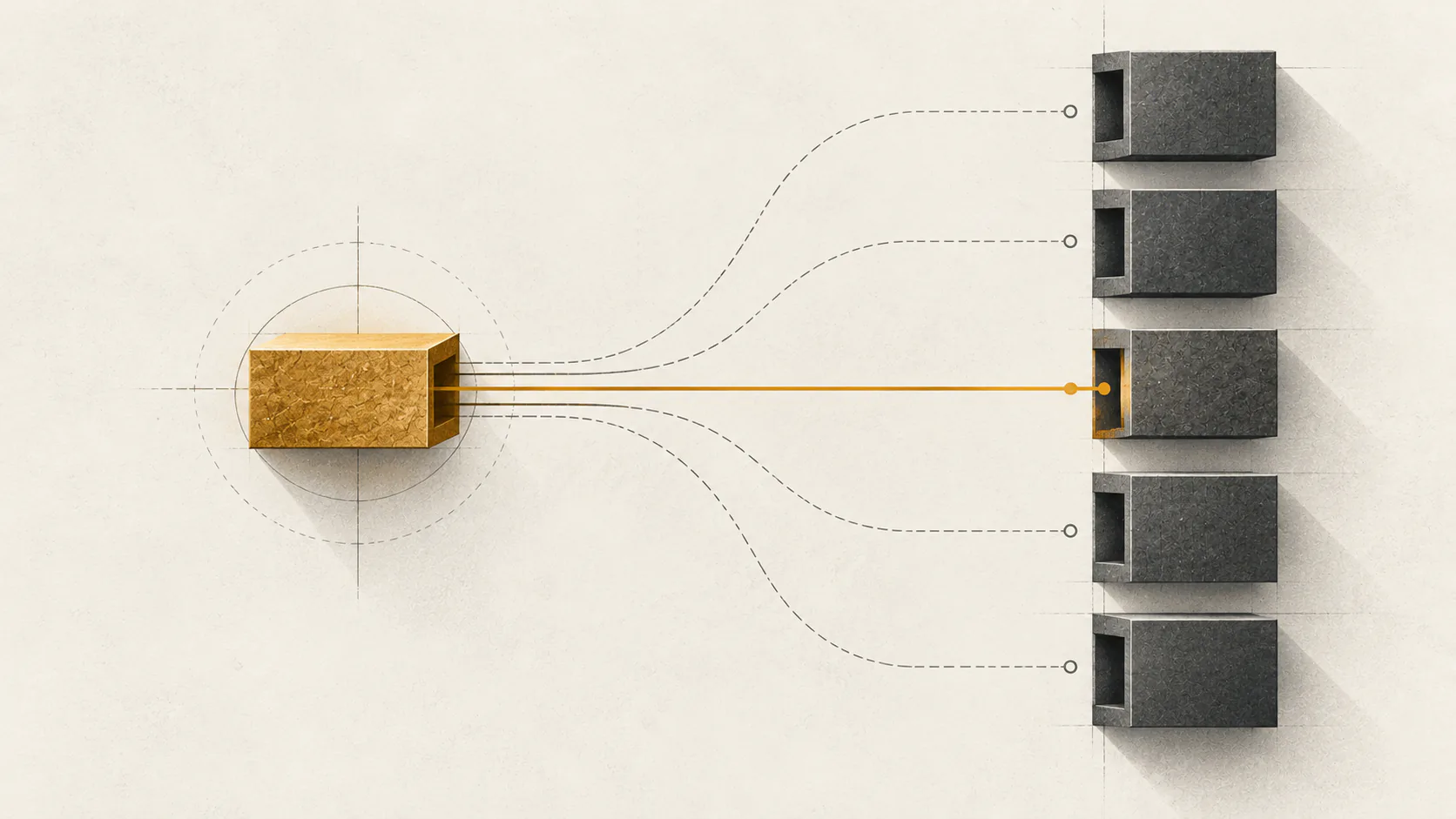
This is one of the easiest mistakes to make in an AI business case. A task-level time saving is treated as if it were automatically reusable organisational capacity. Then different parts of the business quietly spend the same dividend on cost, output, quality, growth and employee relief.
The management problem is not whether AI can save time. It can. The problem is deciding what the organisation is going to do with that time—and recognising that one hour cannot fund several outcomes at once.
The HBR signal: AI can intensify work
Aruna Ranganathan and Xingqi Maggie Ye raised a useful warning in their February 2026 Harvard Business Review article, “AI Doesn’t Reduce Work—It Intensifies It”. 1
Ranganathan and Ye’s in-progress research is an eight-month ethnography at one 200-person US technology company. The lead researcher observed work on site and conducted more than 40 interviews across functions. Employees had broad access to generative AI, and the researchers observed work expanding in ways that often were not requested by management. 2
The researchers describe three forms of intensification: people extend the scope of what they attempt; AI lowers the friction of starting work so tasks leak into pauses and boundaries; and workers keep more threads active at once. What begins as an empowering increase in capability can become a denser, harder-to-sustain workday.
That is an important management signal, but it should not be read as a universal law. This is in-progress qualitative research from one technology company, not prevalence evidence for the whole economy or a causal estimate. The sharper question for managers is why time savings sometimes become lower workload, sometimes become more output, and sometimes disappear into additional work.
Time saved is real—but it is not the same thing as spare capacity
In a six-month randomised field experiment across 66 firms and 7,137 knowledge workers, selected employees received access to generative AI integrated into email, meetings and writing tools. In the second half of the experiment, the 80% of treated workers who used the tool spent two fewer hours a week on email and reduced their time working outside regular hours. Apart from those individual time savings, the researchers did not detect changes in the quantity or composition of workers’ tasks from individual-level AI provision. 3
That is exactly the distinction an AI business case needs. A tool can remove time from a task without automatically redesigning the surrounding job, team or operating model.
The OECD’s weighted survey evidence is mixed. Among SMEs using generative AI in seven surveyed countries, 32.7% reported decreased workload and 11.8% an increase; 83.0% said generative AI had no effect on overall staff need. The same AI-using SME base was roughly twice as likely to be classified as reporting increased relative skill needs as decreased skill needs, 19.7% versus 9.4%. 4
The implication is not that AI fails to create productivity. It is that productivity arrives first as a local change in the economics of particular tasks. Converting that change into organisational capacity requires management decisions.
The newest UK signal: better work, but not necessarily less work
PwC UK’s October 2026 Hopes and Fears survey of 2,023 UK workers adds a timely self-reported signal. Fifty-six per cent said they had used AI at work in the preceding year. Among those AI users, 70% said it had improved the quality of their work, while 44% reported a heavier workload and 45% greater role complexity. 5
PwC is commercially interested in enterprise AI transformation, and the findings are self-reported rather than causal. The press release does not publish the unweighted size of the AI-user subset. The results should therefore be treated as a management signal, not neutral proof. Even so, the combination is revealing: employees can perceive genuine improvement in quality and value while also experiencing more work and more complexity.
That is not contradictory. It is what we should expect when a new capability expands what can economically be attempted.
The AI dividend has competing claimants
Once AI reduces the effort required for a task, at least five claimants can appear.
Cost
The organisation may slow hiring, reduce contractor spend or eventually remove roles.
Output
Teams may be asked to produce more reports, proposals, analyses, code or customer interactions with the same headcount.
Quality
Saved time can be reinvested in checking, deeper analysis, better customer service, testing or risk reduction.
Growth
Work that was previously too expensive, slow or specialist may become worth doing. That can expand the organisation’s effective scope rather than shrink its workload.
People
Some of the dividend can be left deliberately unspent as slack, focus time, learning capacity or a reduction in after-hours work.
Any of these can be sensible. The accounting becomes fictional when management assumes that all of them can be delivered from the same saving.
Reconcile capacity before you claim the benefit
The first number in many AI cases is gross task time saved. It should not be the last.
A more useful reconciliation starts with gross time removed from the original task, then subtracts the new work required to make the AI-enabled process dependable. That includes prompting and preparation, verification, correction and exception handling, workflow coordination, learning and maintenance, and any new tasks that become economical because the capability now exists.
What remains is recovered capacity. Only then should the organisation decide how much of that capacity will be converted into lower cost, additional throughput, better quality, new activity or protected slack.
This changes the business case from a multiplication exercise into an operating decision. Saving ten minutes on a task performed 100,000 times does not automatically mean 16,667 hours of removable labour. Some of that time may be fragmented. Some may sit in a bottleneck that is not labour-constrained. Some may be consumed by checking. Some may create demand for more downstream work. And some may be deliberately reinvested.
Do not let the target create the workload
There is a second danger. Once a time-saving number enters a plan, it can become a new performance expectation before the organisation knows whether the saving is stable.
A pilot shows that a report can be prepared 30% faster. The target is reset. People then use the released time to handle exceptions, review AI output and take on adjacent work. The organisation concludes that the productivity gain is real because output increased. Employees experience a denser day because the gain was converted into workload before the new process was understood.
This is how a capability improvement can become an intensity ratchet. The baseline moves upward, but the new overhead remains invisible because it did not exist in the old process.
Managers should therefore separate observed task acceleration from a permanent capacity commitment. Treat early savings as provisional until the workflow has run long enough to expose verification costs, failure modes, new dependencies and induced demand.
Make the allocation explicit
A practical AI capacity review can be done with one page and five questions.
On a narrow screen, each step is shown as a separate card.
| Step | What to record | Control question |
|---|---|---|
| Gross task time saved | Time removed from the original task, including the measurement method and period. | What task time has actually disappeared, and how was it measured? |
| New AI-enabled work | Prompting and preparation; verification, correction and exception handling; workflow coordination; learning and maintenance; and new work made economical by the capability. | What new work has been created around the AI-enabled process? |
| Recovered capacity | Gross task time saved less the new AI-enabled work; distinguish contiguous team-level capacity from time scattered across individual days. | How much of the saving is reliably recoverable at team or organisational level? |
| Allocation | Choose one outcome or explicitly divide the capacity across lower cost, additional throughput, better quality, new activity or growth, and protected slack or people. | What outcome is this recovered capacity funding? |
| Reconciliation owner | A named owner and the single capacity ledger. | Who ensures that the same capacity is not claimed again elsewhere? |
The final question matters more than it looks. Finance may be counting hiring avoidance while operations counts higher throughput and HR communicates workload relief. Unless someone reconciles those claims, the organisation can report several benefits that depend on the same hours.
A credible productivity programme should have one capacity ledger, even if the benefits appear in different budgets.
What to ask vendors and consultants
Suppliers routinely translate task acceleration into annualised savings. Buyers should ask what sits between the benchmark and the financial claim.
Was the time saving observed in a controlled task, a pilot workflow or live operations? Does the calculation include review, correction, exception handling and governance? Is saved time contiguous enough to change staffing, or fragmented across a working week? What assumptions are made about new demand and task expansion? Is the benefit lower workload, higher output, avoided hiring or cashable cost—and are any of those outcomes being counted more than once?
If the answer is simply “hours saved multiplied by labour cost”, the business case is measuring theoretical task capacity, not necessarily economic value.
The management decision
AI can create a dividend. The mistake is assuming that the dividend allocates itself.
A business that chooses to turn most of a saving into growth may rationally end up with employees doing more, not less. A business that uses the saving to reduce after-hours work may improve sustainability without cutting headcount. A business that reinvests the time in checking and analysis may see quality improve while measured workload barely changes. None of these outcomes disproves the productivity gain.
What matters is whether management knows which outcome it has chosen.
The discipline is simple: measure the gross saving, subtract the new costs of using the capability, identify the recovered capacity, and allocate that capacity once. Do not promise lower cost, greater output, better quality and easier work from the same hour unless the arithmetic genuinely supports all four.
AI may make time cheaper. It does not make time infinite.
Executive view
- Task-level time savings are not automatically reusable organisational capacity.
- AI can reduce time on existing tasks while simultaneously creating new scope, verification work, coordination and higher expectations.
- The same recovered hour cannot legitimately fund cost reduction, higher output, improved quality and employee relief several times over.
- Treat early productivity gains as provisional until the full workflow and its new overhead are visible.
- Use a single capacity reconciliation to decide deliberately where the AI dividend will be spent.
Sources and evidence
This article combines one in-progress single-company ethnography, an accepted and forthcoming randomised field experiment, weighted SME survey evidence and a commercially interested UK workforce survey. Numbered links identify the supporting sources. The capacity-reconciliation framework is Andrew’s Intel management synthesis rather than a tested intervention.
Source posture: The evidence supports a distinction between task-level time savings and reusable organisational capacity, not a universal claim that AI either reduces or intensifies workload. Ranganathan and Ye report in-progress qualitative research from one 200-person US technology company, supported by more than 40 interviews; the HBR and Berkeley pieces describe the same study and provide neither prevalence nor causal estimates. Dillon et al. report a six-month randomised field experiment across 66 firms and 7,137 knowledge workers: in the second half, the 80% of treated workers who used the tool spent two fewer hours a week on email and less time outside regular hours, with no detected broader task shifts; the article remains forthcoming in AER: Insights. OECD results are weighted firm-level self-reports from SMEs using generative AI in seven countries, and PwC results are self-reports from the AI-using subset of a 2,023-worker UK survey; neither establishes causality. The five claimants, capacity ledger, gross-to-recovered reconciliation, intensity-ratchet framing and vendor questions are Andrew's Intel management synthesis, not tested interventions or measured outcomes.
Evidence checked 30 October 2026.
- AI Doesn’t Reduce Work—It Intensifies It: Aruna Ranganathan and Xingqi Maggie Ye, Harvard Business Review, 9 February 2026. Initiating management signal from in-progress qualitative research at one technology company; not prevalence or causal evidence. Harvard Business Review
- AI promised to free up workers’ time. UC Berkeley Haas researchers found the opposite: Laura Counts, UC Berkeley Haas News, 18 February 2026. Methodology and researcher interview for the same eight-month ethnography, including more than 40 interviews across functions; not independent corroboration. UC Berkeley Haas
- Shifting Work Patterns with Generative AI: Eleanor W. Dillon, Sonia Jaffe, Nicole Immorlica and Christopher T. Stanton, American Economic Review: Insights, accepted and forthcoming, DOI 10.1257/aeri.20250275. Six-month randomised field experiment across 66 firms and 7,137 knowledge workers. American Economic Association
- Generative AI and the SME Workforce: New Survey Evidence: OECD, 5 November 2025. Weighted firm-level survey of 5,232 SMEs across seven countries; the cited impact measures concern SMEs using generative AI. OECD report
- One in five UK employees are now using AI everyday at work but 44% report a heavier workload: PwC UK, 1 October 2026. Commercially interested, self-reported survey signal; total UK sample 2,023, while the cited quality, workload and complexity percentages describe the AI-user subset. PwC UK
Editorial construct: The five claimants, gross-saving-to-recovered-capacity reconciliation, capacity ledger, intensity-ratchet framing, provisional-capacity period and vendor questions are Andrew’s Intel management tools. They are not tested interventions, accounting standards or measured organisational outcomes.