Imagine this. You give the AI a substantial job. It begins doing whatever the little moving symbol says it is doing. You have no idea whether you have time to answer an email or make lunch.
Sitting there feels wasteful. You open a proposal, find the difficult paragraph and begin to see how to fix it. Then the AI finishes.
Excellent. Another task completed. Unfortunately, you have just become interested in this one.
It is rather like being a dog that has found a fascinating smell, only to feel the lead tighten. You were getting somewhere. Apparently, you are now getting somewhere else.
There is a serious work-design question underneath this small indignity: are we converting machine speed into useful capacity, or into more demands on the same person’s attention?
This is a work-design hypothesis, not a diagnosis. The concern is that when we fill uncertain gaps with demanding work, and treat every completed output as a summons, some of the gain may be spent changing direction. The specific effect of unpredictable AI waiting still needs testing.
Congratulations. You have more capacity
AI can genuinely help people get work done. In a randomised experiment, Shakked Noy and Whitney Zhang found that access to ChatGPT improved both speed and judged quality on professional writing assignments. That is evidence of useful task-level gains. It is not a promise of a quieter afternoon. 1
The question is what happens next. A task becomes easier. You take on another. A report becomes quicker to produce. Three versions now seem reasonable. Yesterday’s impressive extra becomes tomorrow’s perfectly ordinary expectation.
Nor does this require a manager lurking behind the printer with a stopwatch. Sometimes we are quite capable of raising our own targets.
An eight-month University of California, Berkeley’s Haas School of Business study at one technology company described employees widening their responsibilities, letting work enter former pauses and keeping several AI-assisted activities going. Much of the expansion was self-driven. It is an early, single-company observation, not a verdict on every workplace. But it gives the concern a firmer basis than a weary social-media post. 2
More output may be valuable. The mistake is assuming that more output automatically means less effort, or that the capacity gained on one task can be spent twice.
Multitasking is not one thing
The tempting headline is “AI can multitask. Humans cannot.” It is also too crude.
People can combine activities. How well they do so depends on the demands involved and how much those demands overlap. A familiar, largely automatic activity is not the same proposition as two jobs that both need careful reading, reasoning and decisions. Research on multiple resources makes precisely this distinction: interference is about competing demands, not merely how many tasks are open. 3
Making tea while listening to a familiar podcast and checking a complicated argument while drafting a sensitive email are not equivalent tests of human competence. One may involve a misplaced teaspoon. The other has rather more scope for trouble.
The processor analogy is useful if we do not press it too hard. A set of AI jobs can advance in parallel. The person supervising them still has to allocate attention, understand results and decide what happens next. Human cognition is not literally a single-threaded computer.
There is also a cost to leaving something unfinished. Sophie Leroy’s experiments on “attention residue” found that thoughts about a previous task can persist and interfere with performance on the next. Changing the window is not necessarily the same as changing your mental context. 4
The practical question is therefore not “Can this person multitask?” It is “Which tasks, at what level of difficulty, with what interruption pattern?”
The awkward wait is the one you cannot plan for
Consider two hypothetical waits. One is reliably about five minutes. The other might be a few seconds or several minutes. Neither is ideal, but only one lets you make a reasonably informed plan.
In the second case, you are making a small bet every time you start something else. Is there enough room for a useful piece of work, or only enough room to get into it?
Call this speculative multitasking: opening another task because you do not know how much usable time you have. That is a label for the behaviour proposed here, not an established scientific category.
The distinction matters. Five minutes of calendar time is not automatically five minutes of available attention. A gap can be long enough to tempt you away but too uncertain to use well.
And there are two possible outcomes when the AI finishes. You can switch immediately, perhaps abandoning a thought halfway through. Or you can leave the result waiting and finish a sensible chunk of the current task. The second option is not a malfunction.
In this proposed loop, the risk lies in “it is ready” quietly becoming “I must look at it now”. Sometimes the pull is an alert; sometimes it is your own urge to check. Either way, a completed job and an interruption are different events. Work design can help keep them separate.
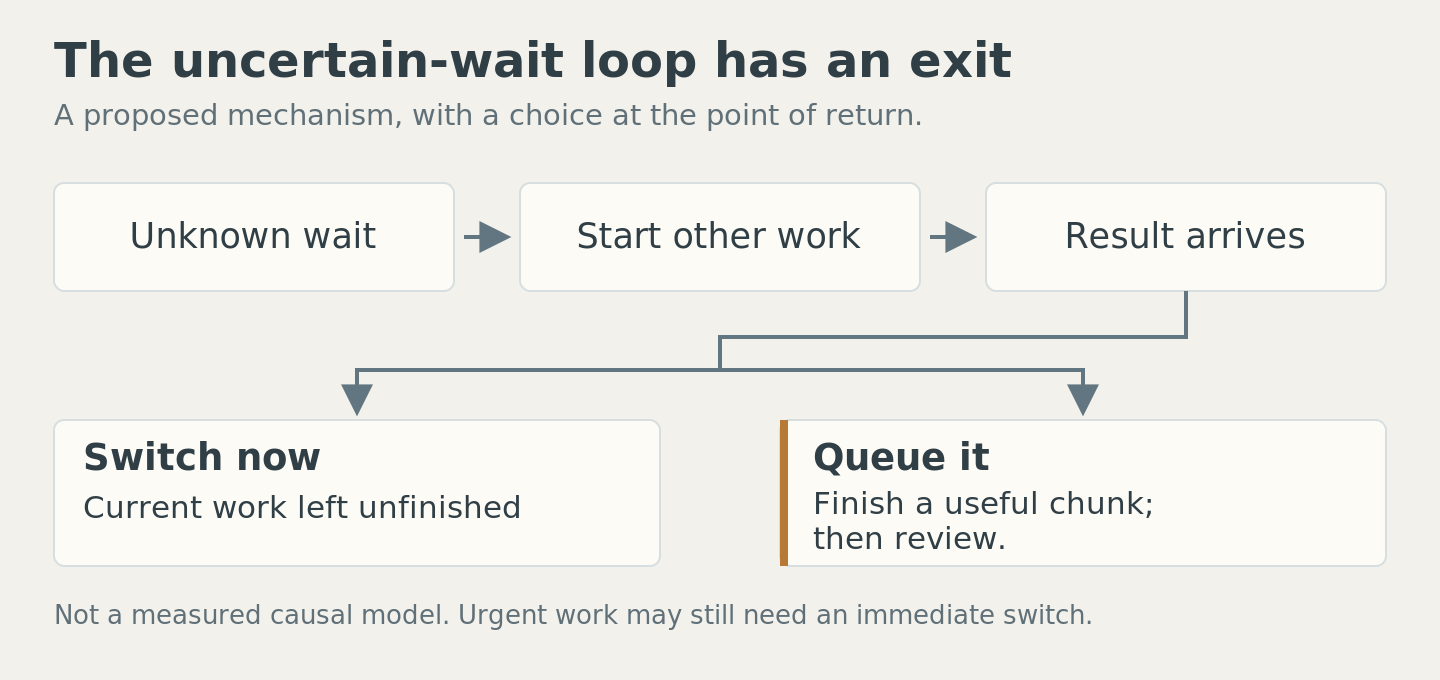
The uncertain-wait loop has an exit
A proposed mechanism, with a choice at the point of return.
Not a measured causal model. Urgent work may still need an immediate switch.
What “brain fry” does, and does not, tell us
“Brain fry” is a vivid name for an unpleasant experience. Boston Consulting Group has used it in survey research to describe mental fatigue associated with excessive AI use or oversight. That is a commercially interested consultancy reporting people’s experiences, not a diagnosis of damaged brains. 5
The specific role of uncertain waiting is less settled. A 2026 experiment with 240 participants compared fixed waits of two, nine and twenty seconds before responses began. Recorded interaction behaviour was broadly similar across those delays. It did not test unpredictable completion times in a busy workplace. 6
That distinction prevents an attractive story from becoming a claim the evidence cannot carry. We have research on competing cognitive demands, task transitions and emerging patterns of intensified work. We do not yet have a demonstrated causal chain from an unpredictable AI wait to this entire workplace problem.
Nor is the answer to make AI slower. A genuinely immediate answer can remove the awkward gap. A long, dependable background job may allow a useful block of other work. The interesting design problem is the uncertain middle, and whether the human has control over when to re-engage.
Ready is not urgent
Imagine an analyst with a research job running, a draft being prepared and a spreadsheet awaiting review. The tools may be progressing nicely. The analyst has also acquired an extra role: deciding which result deserves attention, remembering the purpose of each request and checking what can safely wait.
That is scheduling work. It belongs in the cost of the workflow, even when nobody has put it in the job description. “The AI is doing it” can conceal quite a lot of human briefing, checking and deciding.
Give curiosity an appointment
Learning not to check every finished job sounds sensible. Until “I’ll look at the next break” becomes tomorrow’s reminder pile.
Look now, and you risk interrupting your concentration. Look later, and you risk forgetting the result. Curiosity adds its own persuasive argument: you would quite like to know whether the thing worked.
Neither problem needs a lecture about laziness. One needs a reliable reminder; the other needs an interruption rule.
Try a smaller compromise than “queue everything until lunch”.
Park the purpose, not just the output. Put one line beside the run: what it was for, the first thing you will check and when you will return. Ideally write it when you launch the job, so recording it does not become another reason to answer the chime.
For example: “Supplier comparison: check whether the prices include support; review after this call, by 3 pm.”
Keep that note in a queue you actually revisit, with a reminder or review-by time where it matters. A note tells you how to return. It does not, on its own, bring you back.
This borrows from Sophie Leroy and Theresa Glomb’s “ready-to-resume” research. In the studied interruptions, planning a return to unfinished work reduced attention residue and helped performance on the interrupting task. It did not establish better performance on returning to the original work, or test remembering finished AI results. Using a return note for those results is a practical adaptation to try, not a demonstrated finding. 7
Batch the curious looks. At the end of a paragraph or a call, make a short pass through completed jobs rather than inspecting each arrival. Perhaps check which of three results needs attention next. Three is an example, not a magic number, and a quick triage is not three full reviews.
Curiosity gets a slot. It does not get a veto.
Let genuinely urgent or blocking work bypass the queue. Tomorrow may be perfectly acceptable for a non-urgent draft. It is not acceptable for a result a colleague needs this afternoon. Agree those exceptions before “ready” starts impersonating “urgent”.
The habit to practise is not ignoring finished work. It is giving it a dependable route back.
Ask for honest timing information where the system can provide it. A credible range, a stage indicator or an explicit “time uncertain” is preferable to theatrical precision. These are features to test, not benefits to assume. A progress bar that invents certainty has simply given the problem a horizontal shape.
Above all, do not measure the person’s contribution by whether they managed to stay visibly busy through every pause. The objective is useful work completed to the required standard, not the elimination of all unoccupied seconds.
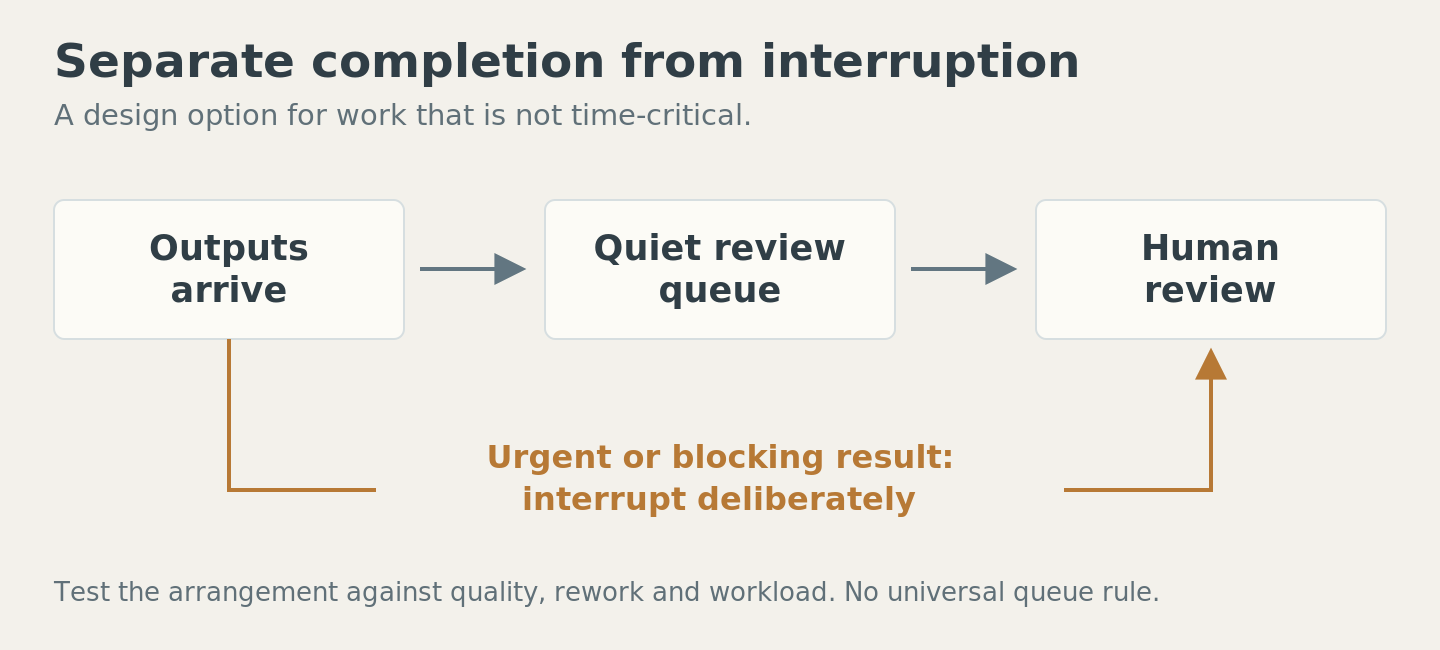
Separate completion from interruption
A design option for work that is not time-critical.
Test the arrangement against quality, rework and workload. There is no universal queue rule.
A better question for the next team meeting
Instead of asking only “How many minutes did AI save?”, take one real workflow and ask the following. This is a discussion aid, not a validated diagnostic test.
- The gap. Do we know roughly how long the AI will take, and how often is that estimate wrong?
- The competing task. What does the person start while waiting, and how hard is it to leave halfway through?
- The return. Which results genuinely require immediate attention, and what will bring deferred results back for review?
- The human work. Are briefing, checking, deciding and reorienting included when we count the time saved?
- The expectation. Has faster production changed the amount, quality or speed of work now expected?
- The outcome. Are accepted results, rework and perceived workload improving together, or is one hiding another?
Test a change in a low-risk workflow: fewer demanding jobs active at once, a quiet review queue, or clearer timing information. Compare the result with the previous arrangement. Do not turn an untested idea into a company-wide rule, or a count of open tasks into a new surveillance target.
The point is not to deny the productivity gain. It is to decide how to spend it.
AI may give us more work in motion. It does not give every result a claim on our attention the instant it appears. A finished task is good news. It is not a summons.
A finished task is good news. It is not a summons.
Sources and evidence
This article combines research findings with a proposed work-design mechanism. Numbered links identify the supporting sources. The uncertain-wait explanation, speculative-multitasking label, result-return notes and review-queue test are editorial interpretations or adaptations, not established diagnostic measures or a validated AI-workflow intervention.
Source posture: Noy and Zhang report a preregistered experiment on bounded professional-writing tasks, not the effect of AI on whole working days. The UC Berkeley Haas item is an originating institutional report on in-progress, single-company ethnographic research, not a peer-reviewed general estimate. Wickens synthesises multiple-resource theory, and Leroy’s 2009 experiments concern unfinished-task switching rather than AI waiting. The BCG result is commercially interested, self-reported survey evidence, and “AI brain fry” is not a clinical diagnosis. Tan and colleagues test fixed 2-, 9- and 20-second time-to-first-token delays in controlled LLM tasks; they do not test unpredictable workplace completion times. Leroy and Glomb’s ready-to-resume studies concern interruptions and performance on the interrupting task, not remembering completed AI outputs or performance after returning. The uncertain-wait mechanism, “speculative multitasking” label, result-return note, review queue, examples and management prescriptions are Andrew’s Intel editorial synthesis. No reviewed source demonstrates that unpredictable AI waiting causes the proposed workplace loop or that this intervention improves end-to-end AI-workflow performance.
Evidence checked 30 October 2026.
- Experimental evidence on the productivity effects of generative artificial intelligence: Shakked Noy and Whitney Zhang, Science 381(6654), 187–192, 13 July 2023. Preregistered experiment with 453 college-educated professionals completing bounded writing assignments. Supports task-level speed and judged-quality gains, not an easier whole working day or every factual-accuracy claim. Science DOI
- AI promised to free up workers’ time. UC Berkeley Haas researchers found the opposite: Laura Counts, reporting research by Xingqi Maggie Ye and Aruna Ranganathan, UC Berkeley Haas, 18 February 2026. Originating institutional report on in-progress, eight-month ethnographic research in one technology company. Supports the carefully qualified observation about widening work and former pauses, not a general workplace estimate. UC Berkeley Haas report
- Multiple Resources and Mental Workload: Christopher D. Wickens, Human Factors 50(3), 449–455, June 2008. Theory and model paper supporting the distinction between overlapping resource demands and a simple count of open tasks. It does not study AI waiting. Journal DOI
- Why is it so hard to do my work? The challenge of attention residue when switching between work tasks: Sophie Leroy, Organizational Behavior and Human Decision Processes 109(2), 168–181, July 2009. Two experiments on unfinished-task switching. It does not test AI, uncertain waits or notifications. Journal DOI
- AI for CEOs: Amplifying Time and Judgment at the Top: Christine Barton, Julie Bedard, Nicolas de Bellefonds and Judith Wallenstein, Boston Consulting Group, 23 June 2026. Commercially interested survey research based on self-report. Supports the bounded description of reported mental fatigue; it is not a clinical diagnosis or evidence that uncertain waiting caused the effect. BCG report
- The Impact of Response Latency and Task Type on Human-LLM Interaction and Perception: Felicia Fang-Yi Tan, Moritz A. Messerschmidt, Wen Yin and Oded Nov, Proceedings of the 2026 CHI Conference on Human Factors in Computing Systems, published 13 April 2026. Controlled experiment with 240 participants and fixed 2-, 9- or 20-second time-to-first-token delays. It does not test unpredictable completion times in busy workplaces. ACM DOI
- Tasks Interrupted: How Anticipating Time Pressure on Resumption of an Interrupted Task Causes Attention Residue and Low Performance on Interrupting Tasks and How a “Ready-to-Resume” Plan Mitigates the Effects: Sophie Leroy and Theresa M. Glomb, Organization Science 29(3), 380–397, 2018. Four studies on anticipated time pressure, attention residue and ready-to-resume plans. They do not establish better performance after returning to the original task or test memory for completed AI output. Journal DOI
Editorial construct: The uncertain-wait mechanism, speculative-multitasking label, result-return note, review queue, examples, management prescriptions and low-risk trial are Andrew’s Intel tools for testing attention design. They are not validated diagnostic measures, clinical claims or demonstrated universal interventions.