
Do this first
Identify a management cycle whose evidence is costly to assemble. Then separate the cadence of sensing from the cadence of human interpretation and the threshold for intervention. Use the eight-question test before automating the rhythm.
Ask a manager why a forecast is monthly, a supplier review quarterly or an appraisal annual, and the cadence may sound like deliberate management design. Often it is also an economic compromise. Human attention is scarce. Managers sample what is happening, reconstruct the intervening period from reports and memory, then act on the evidence most visible at the review point.
Artificial intelligence changes the cost of that first layer of management. Systems can collect operational signals, organise events, compare periods, surface anomalies and prepare alternatives continuously. They can make attention to the organisation much cheaper without making judgement, accountability or human relationships cheap at all.
That creates an immediate managerial question: if the cost of paying attention fell towards zero, what would be worth managing continuously?
The tempting answer is "everything". It is also the wrong one. Some management is periodic because attention has historically been expensive. Other management is periodic because people need space, context and a fair opportunity to be heard. The opportunity is not to make management omnipresent. It is to decide, activity by activity, whether the organisation needs continuous sensing, periodic interpretation or selective intervention.
AI changes the price of paying attention
Fixed management cycles were often designed around the cost of assembling information. A monthly forecast, for example, reflects not only how often leaders want to make decisions but how long it takes to collect data, reconcile assumptions and produce a view that people trust. Similar constraints shape capacity reviews, supplier scorecards, portfolio reviews, service-quality meetings and performance appraisals.
A July 2026 McKinsey article argued that AI agents can make continuous financial planning practical at scale because they reduce the work required to connect operational and financial signals, refresh forecasts and identify possible interventions. McKinsey is a commercially interested source, so this is better treated as a market signal than as independent proof. What it reveals is that "continuous management" is moving from a theoretical possibility into enterprise operating-model language. 1
The broader shift is already visible. An OECD survey of more than 6,000 mid-level managers across six countries found algorithmic-management tools were commonly used under the study's broad definition. Sixty per cent of surveyed managers said such tools improved the quality of their decisions. Yet managers also reported concerns about unclear accountability, difficulty following the systems' logic and inadequate protection of workers' health. The same technology can therefore increase informational reach while making responsibility harder to locate. 2
The important change is not that software suddenly becomes a manager. It is that organisations can afford to observe more of their operating reality, more often. The bottleneck shifts. Once sensing and routine analysis become cheaper, the scarce resource is no longer information alone. It is judgement about which signals deserve interpretation and when interpretation should become intervention.
The first mistake: cheap sensing becomes cheap interference
More frequent information is not automatically better management. A measurement may be incomplete. A proxy may reward the wrong behaviour. An anomaly may have an innocent cause. An intervention made too early can turn an ordinary fluctuation into a management event. Continuous attention can therefore create a new failure mode: not neglect, but interference.
Research on electronic performance monitoring offers a useful warning. A meta-analysis covering 94 independent samples and 23,461 workers found no evidence that electronic performance monitoring improved performance, while its presence was associated with greater worker stress. More transparent and less invasive monitoring was associated with more positive worker attitudes. 3 A separate meta-analysis covering 70 independent samples likewise found no meaningful relationship with performance, alongside small reductions in job satisfaction and increases in stress. 4
These findings do not mean organisations should stop collecting operational evidence. They do mean there is no simple bargain in which more monitoring produces more performance. The psychological and organisational design of the system matters. So does the difference between observing a process and continually judging a person.
When every signal becomes feedback, employees may begin working for the measurement rather than for the purpose of the job. Quiet contributions, judgement exercised in ambiguous situations, mentoring, conflict avoided and risks prevented can disappear from the record because they are harder to count. Cheap attention then narrows managerial vision instead of widening it.
Continuous sensing does not require continuous intervention
The most useful design move is to separate three activities that are often collapsed into one: sensing, interpretation and intervention.
Continuous sensing collects relevant events and signals over time. Periodic interpretation asks what those events mean, adds context and allows competing explanations to be considered. Selective intervention turns interpretation into action only when a threshold, decision or material risk justifies it.
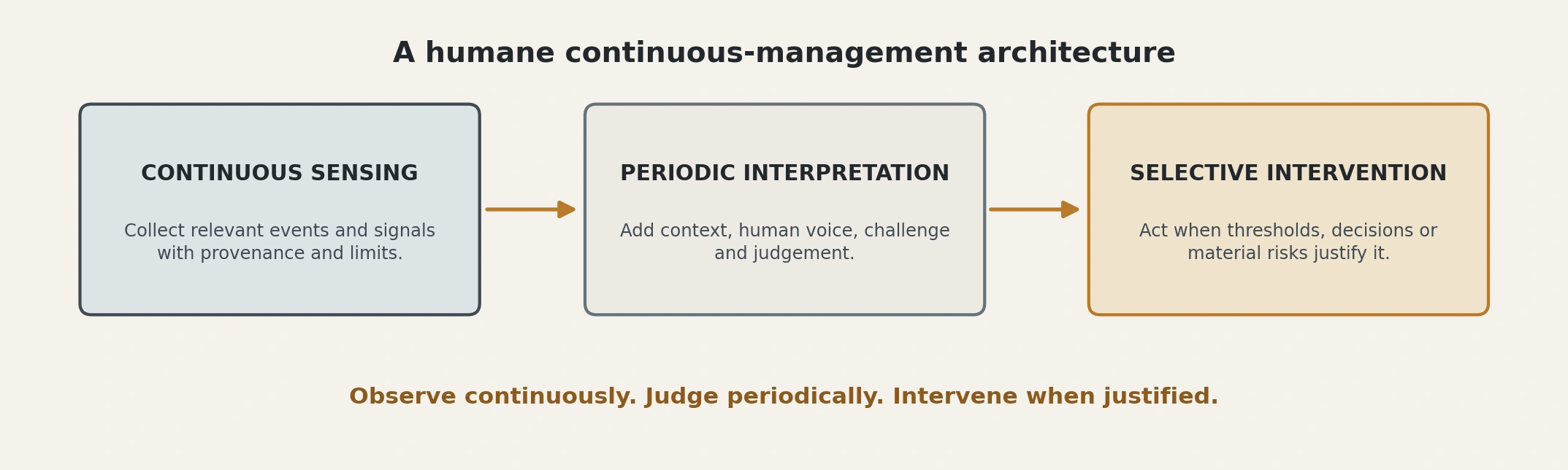
Observe continuously. Judge periodically. Intervene when justified.
This separation changes the employee-review question. A system can preserve a year of relevant evidence without issuing a live score. It can help a manager see patterns without nudging the employee every time a metric moves. It can support a quarterly or annual conversation without turning the months between reviews into an uninterrupted appraisal.
The same principle applies to suppliers. Delivery performance, defect rates, response times and unresolved exceptions may be sensed continuously. The formal supplier review can remain periodic, because that is where causal context, contractual interpretation, relationship value and corrective plans are considered. A critical service failure may still trigger immediate intervention, but an ordinary fluctuation need not.
How continuous evidence can improve periodic reviews
Consider a project lead whose annual review takes place a month after a difficult implementation. The delayed launch is vivid. The manager remembers the latest escalation, the strained client call and the final weeks of pressure. Without a reliable record, that episode can dominate the interpretation of the whole year.
A well-designed sensing layer could present a different chronology: eight months of stable delivery, a difficult project with dependencies outside the lead's control, two risks raised early, a period of overload, recovery after resources were added, and mentoring work that would otherwise have been forgotten. The system would not decide the rating. It would make the period harder to reconstruct selectively.
Recency effects in performance evaluation are not merely managerial folklore. In controlled experiments, Steiner and Rain found that the serial position of unusually good or poor performance could affect overall ratings, including recency effects when the distinctive performance occurred last. The study does not prove that every appraisal is dominated by the final month, but it supports the mechanism managers recognise: recent events can receive disproportionate weight. 5
Continuous evidence can reduce that effect by preserving the full period. It can also distinguish a pattern from an anomaly. A supplier's late delivery immediately before a quarterly review may be a one-off disruption; alternatively, it may be the latest example of a persistent problem. The better record makes either conclusion easier to defend.
However, continuous collection does not automatically produce a complete account. It can simply move bias upstream into the choice of data. If the system captures deadlines but not complexity, tickets closed but not problems prevented, or sales outcomes but not inherited account quality, the longitudinal record may be consistent and still unfair. Reducing recency bias is valuable only if the evidence is representative of the work.
More evidence is not the same as procedural fairness
The subject of a review must still be able to make a case. Research on performance appraisal has long shown that voice matters. Korsgaard and Roberson found that both instrumental voice - participation capable of affecting the decision - and non-instrumental voice - the experience of being heard - were related to appraisal satisfaction; non-instrumental voice also affected attitudes towards the manager. 6 Taylor and colleagues' due-process appraisal research similarly treated adequate notice, a fair hearing and judgement based on evidence as part of a legitimate evaluation process. 7
This is where continuous sensing can either improve the human process or damage it. If employees or suppliers can see the evidence, add context, correct errors and identify missing factors, the system can help them build a stronger case than memory alone would allow. If the record is invisible until the formal meeting, it becomes a one-sided dossier assembled continuously against them.
A humane design therefore gives the reviewed party more than a right to object to the final score. It gives them practical contestability throughout the evidence chain: visibility of relevant records, an opportunity to annotate events, a route to correct factual errors, clarity about how information will be used, and separation between developmental evidence and disciplinary evidence where appropriate.
The formal review should remain a hearing, not the reading-out of an algorithmic conclusion. AI can improve the record. It should not remove the reviewed person's ability to explain what the record means.
Three management rhythms, not one
Once sensing, interpretation and intervention are separated, activities fall into at least three broad rhythms. The categories are not fixed; the point is to design the cadence rather than inherit it.
| Management rhythm | Suitable candidates | Human-design rule |
|---|---|---|
| Continuous sensing and rapid intervention | Cash-flow anomalies; critical service queues; safety or compliance thresholds; stock-outs; severe supplier failures. | Define thresholds, ownership and escalation. Preserve a human override for material consequences and false alarms. |
| Continuous sensing and periodic judgement | Employee and supplier performance; project health; capacity balance; account risk; portfolio progress. | Use the evidence to reduce memory bias, but preserve context, voice, challenge and a deliberate review point. |
| Deliberately periodic or event-triggered judgement | Promotion; disciplinary action; leadership potential; cultural contribution; high-consequence role decisions. | Do not convert partial proxies into a live score. Periodicity protects reflection, due process and evidence that is difficult to quantify. |
The middle category is likely to be the most important. Many organisations will gain from continuous awareness without gaining from continuous intervention. That is the space in which AI can improve reviews, planning and risk recognition while leaving consequential judgement at a human cadence.
The Continuous Management Test
Before increasing the frequency of any management activity, ask the following questions. The test is designed for a meeting: it helps a management team decide whether a process needs continuous sensing, more frequent interpretation, faster intervention - or deliberate restraint.
| Question | Why it matters |
|---|---|
| 1. What is the present cadence paying for? | Is the process monthly, quarterly or annual because that rhythm is genuinely useful, or because collecting and interpreting evidence more often used to cost too much? |
| 2. What would earlier sensing change? | More data is valuable only if earlier recognition creates a better decision, prevents avoidable harm or preserves more options. |
| 3. Is the signal representative of the work? | Identify what the system cannot see: complexity, judgement, prevented problems, inherited conditions, informal contribution or external dependencies. |
| 4. Would continuous observation distort behaviour? | Consider stress, gaming, risk avoidance, loss of autonomy and the possibility that people optimise the metric rather than the purpose. |
| 5. Can the subject see, explain and correct the evidence? | A longitudinal record should improve contestability, not create an invisible dossier. Build access, annotation and correction into the process. |
| 6. Who decides when a signal becomes intervention? | Separate the alert from the decision. Define thresholds, human accountability, escalation and appeal before the system begins operating. |
| 7. Who benefits from the greater frequency? | A useful design should improve conditions for employees, suppliers, service users or customers as well as management visibility. |
| 8. When does the organisation stop watching? | Limit purpose, retention and reuse. Evidence gathered for development should not silently become permanent disciplinary or surveillance data. |
What to ask before buying or building
The market will increasingly offer systems that promise continuous performance, supplier, workforce or operational intelligence. Before accepting the promise, decision-makers should ask questions that expose the difference between a useful evidence layer and an automated judgement machine.
- Does the system preserve events or manufacture a score? Ask to see the evidence trail behind any rating, recommendation or alert.
- What important work remains invisible? Identify the contributions, constraints and causal context that the data cannot represent.
- How can the reviewed party participate? Require visibility, annotation, correction and a practical route to challenge interpretation.
- Who owns the intervention? A vendor should be able to explain where human review is mandatory, who is accountable and how appeals or exceptions are handled.
- How is purpose limited? Specify what data is collected, why, how long it is retained and whether developmental information can be reused for discipline, promotion or contracting decisions.
- How will the organisation test for uneven effects? Evaluate whether the system systematically disadvantages particular roles, working patterns, demographic groups or suppliers with different operating conditions.
In Europe, the governance question is not merely cultural. The EU AI Act classifies certain AI systems used for employment and worker management as high-risk. The current Commission timetable applies the relevant Annex III obligations from 2 December 2027, including requirements around risk management, data quality, logging, documentation and human oversight. Exact classification depends on the system and use case, so this is a governance signal rather than legal advice. 8
The new managerial skill is cadence design
Management will not become free. Paying attention may become much cheaper, but deciding what matters, hearing competing accounts, accepting responsibility and acting with proportionate judgement will remain costly human work.
The opportunity is therefore more disciplined than "manage continuously". Some operational conditions should be sensed continuously and acted on quickly. Some activities should be sensed continuously but interpreted at planned intervals. Some high-consequence judgements should be protected from continuous scoring altogether.
Employee and supplier reviews show why the distinction matters. A longitudinal record can reduce the disproportionate influence of recent events, distinguish patterns from anomalies and give all parties a firmer evidential base. But it improves the process only when the reviewed party can see, explain and challenge the record. Continuous sensing should increase the quality of periodic judgement, not abolish the human hearing.
As the economic constraint on attention weakens, managers will inherit a design responsibility they did not previously have. They will need to decide not only what deserves attention, but which layer deserves which cadence.
Sources and evidence
The approved briefing was written on 24 August 2026. The originating research, commercial source and European Commission implementation guidance were rechecked on 1 November 2026. The three-rhythm model and Continuous Management Test are editorial decision aids, not validated interventions.
Source posture: McKinsey is a commercially interested market signal. The OECD survey reports managers’ perceptions under a broad definition of algorithmic management, not audited causal performance gains. The monitoring meta-analyses show associations and do not establish that all sensing is harmful. Appraisal evidence is bounded to its study designs. EU AI Act classification depends on the system and use case; the 2 December 2027 Annex III date is current guidance, not individual legal advice.
- McKinsey & Company (24 July 2026), "How AI agents can help FP&A better steer the business." Commercially interested consultancy source; used as a market and operating-model signal, not neutral proof. Read source
- Milanez, A., Lemmens, A. and Ruggiu, C. (2025), "Algorithmic management in the workplace: New evidence from an OECD employer survey," OECD Artificial Intelligence Papers, No. 31. DOI: 10.1787/287c13c4-en. Read source
- Ravid, D. M. et al. (2023), "A meta-analysis of the effects of electronic performance monitoring on work outcomes," Personnel Psychology, 76(1), 5-40. DOI: 10.1111/peps.12514. Read source
- Siegel, R. et al. (2022), "The impact of electronic monitoring on employees' job satisfaction, stress, performance, and counterproductive work behavior: A meta-analysis," Computers in Human Behavior Reports, 8, 100227. DOI: 10.1016/j.chbr.2022.100227. Read source
- Steiner, D. D. and Rain, J. S. (1989), "Immediate and delayed primacy and recency effects in performance evaluation," Journal of Applied Psychology, 74(1), 136-142. DOI: 10.1037/0021-9010.74.1.136. Read source
- Korsgaard, M. A. and Roberson, L. (1995), "Procedural justice in performance evaluation: The role of instrumental and non-instrumental voice in performance appraisal discussions," Journal of Management, 21(4), 657-669. DOI: 10.1177/014920639502100404. Read source
- Taylor, M. S., Tracy, K. B., Renard, M. K., Harrison, J. K. and Carroll, S. J. (1995), "Due process in performance appraisal: A quasi-experiment in procedural justice," Administrative Science Quarterly, 40(3), 495-523. DOI: 10.2307/2393795. Read source
- European Commission, "AI Act: regulatory framework for artificial intelligence" and implementation FAQ, accessed 24 August 2026. High-risk Annex III rules are currently scheduled to apply from 2 December 2027. Read source