
Do this first
Before converting an AI time saving into a productivity target, identify which human judgement the new workflow still requires. Name the workflow, the judgement it still requires and how value will be measured beyond output volume.
An analyst who once needed two days to produce a market report can now produce a credible first version in two hours.
The obvious management response is to raise the target. If one report took two days and now takes two hours, perhaps the analyst can produce four or five times as many.
That may be sensible. Much of the removed effort may have been mechanical: collecting familiar material, extracting figures, normalising formats, drafting standard sections and turning notes into presentable prose.
But the old two-day process may also have contained less visible work. The analyst encountered contradictory evidence, noticed an unusual customer segment, tested an assumption against operational reality, discussed an anomaly with a colleague and developed a feel for which conclusions were robust.
Not all of those hours were valuable. Not all of them were waste.
Generative AI has created a cognitive dividend: capacity released when machines absorb part of the production, synthesis and coordination effort previously carried by people. The dividend is real. But it does not arrive with instructions for how it should be spent.
That is now a management decision.
The saved hours are not automatically spare
Research has already established that generative AI can materially improve performance in bounded knowledge-work tasks.
In a controlled experiment involving professional writing assignments, Shakked Noy and Whitney Zhang found that access to ChatGPT reduced average completion time by 40 per cent and increased output quality by 18 per cent.1
A much larger workplace study followed 5,172 customer-support agents. Access to an AI assistant increased issues resolved per hour by 15 per cent on average. Less experienced and lower-skilled agents gained substantially more, while the most experienced agents saw little speed improvement and small declines on some quality measures.2
Those are meaningful gains. They also show why a single productivity target is dangerous. The size and character of the dividend vary by task, experience and the match between the system and the work.
The management question begins after the time saving has been identified.
What should the organisation do with it?
Earlier tools moved work. AI moves more of the cognitive boundary
The issue is not entirely new.
The typewriter changed the economics of producing text. Word processors removed retyping and made revision cheap. Computer-aided design moved professionals away from much manual drafting. Desktop publishing compressed typesetting and layout work. Spreadsheets externalised calculation and made alternative scenarios easier to test. Search engines reduced the cost of retrieving information.
Every one of those shifts changed the division of cognitive labour. It would be false to pretend that earlier tools affected only the hands while leaving the mind untouched.
General-purpose technologies also tend to require complementary investment before their full value appears. Erik Brynjolfsson, Daniel Rock and Chad Syverson describe a productivity J-curve in which organisations must invest in intangible complements such as new processes, skills and organisational forms before gains are fully realised.3
Generative AI extends this familiar pattern into a wider portion of knowledge work. It can retrieve and summarise, but it can also propose categories, draft arguments, generate alternatives, simulate objections and produce a candidate recommendation.
The time removed may therefore include more than execution. It may include part of the route through which a human previously learnt the territory and formed a judgement.
That does not make the transfer undesirable. It makes the allocation of the resulting capacity more consequential.
A dividend is an option, not an outcome
The phrase cognitive dividend is used here as a management metaphor, not as a directly measured accounting category.
It describes the capacity released when AI reduces the effort required to produce an acceptable result. That capacity can be spent in several ways:
- more output, shorter queues and faster response;
- stronger verification, integration and challenge;
- reflection, learning and skill development;
- experimentation, workflow redesign and better collaboration;
- or, less deliberately, denser workdays and permanently higher expectations.
The crucial point is that saved time does not sit untouched in an organisational bank account.
It is rapidly absorbed by targets, backlogs, ambition, customer demand and the natural tendency of capable people to take on more. Unless leaders make a deliberate allocation, the dividend will usually be spent on throughput.
Existing incentives will usually buy more
A current example from academic publishing shows how quickly lowered production costs can interact with an existing quantity incentive.
An analysis by the editors of Organization Science found that submissions to the journal had risen 42 per cent since the release of ChatGPT, while writing quality declined. The authors did not argue that AI use was inherently wrong. Their conclusion was narrower and more useful: current AI tools, amplified by publish-or-perish incentives, appeared to be pushing the system towards more rather than better research.4
Academic peer review is a particular environment and should not be treated as a model for every workplace. But the mechanism is familiar. When the marginal cost of producing another unit falls and the system rewards countable units, volume expands.
The same pressure can appear inside organisations:
- more reports because reports are easier to produce;
- more campaigns because content is cheaper;
- more proposals because first drafts arrive quickly;
- more analysis because each additional scenario appears almost free;
- more meetings because every meeting can now generate a polished brief.
A separate eight-month ethnographic study at a 200-person technology company offers an early qualitative signal about the pace of AI-enabled work. Researchers reported that employees widened the scope of what they attempted, kept multiple AI-assisted threads active and extended work into more hours of the day, often without being asked. The research was still in progress when described in 2026, so it should not be treated as settled evidence. It does, however, illustrate how quickly a supposed time saving can be converted into denser work rather than genuine slack.5
The dividend can disappear before anyone notices that an allocation decision existed.
The valuable human work moves, and becomes harder to see
When AI takes on more of the visible production, the remaining human contribution changes shape.
A 2025 study of 319 knowledge workers found that critical thinking around generative AI was shifting towards verification, integration and task stewardship.6 Those activities are not decorative checks around the real work. In many AI-assisted workflows, they become the work that determines whether an output is useful, safe and fitted to context.
The pattern resembles a much older lesson from automation. In 1983, Lisanne Bainbridge observed that automating routine control can leave people responsible for the abnormal, difficult and infrequent situations the automation cannot handle. The human role may become smaller in volume while becoming more important at the point of failure.7
Knowledge work now faces a related problem.
The old contribution was visible: hours of reading, drafting, calculating, assembling and revising. The new contribution may be a ten-minute intervention that reframes the question, catches an assumption, rejects an attractive recommendation or links the answer to an operational constraint the model cannot see.
Those ten minutes may prevent a bad decision. They may produce no extra page, slide or line item.
This creates a measurement problem. Organisations are good at counting deliverables. They are less good at counting:
- the weak recommendation that was stopped;
- the hidden assumption that was exposed;
- the exception that prevented a rollout;
- the missing stakeholder who was brought into the discussion;
- the false urgency that was resisted;
- the useful alternative preserved for later.
A manager who evaluates the new workflow only by output volume may mistake its highest-value human contribution for delay, hesitation or unused capacity.
One capability can support two very different strategies
A field experiment with 791 Procter & Gamble professionals makes the allocation choice unusually clear.
Participants worked on real product-innovation challenges, either individually or in pairs, with or without generative AI. Individuals using AI matched the average performance of two-person teams without AI. Teams using AI were more likely to produce top-decile solutions, while human judgement remained important in selecting the strongest idea from a set.8
The same capability therefore supported two legitimate strategies.
One was substitution and efficiency: an individual with AI could reproduce some of the benefits previously obtained through human collaboration.
The other was complementarity: human teams with AI could use the technology to increase the chance of exceptional outcomes.
The researchers themselves noted that some organisations may focus on efficiency while others focus on complementarity. That is not a technical choice. It is a strategic allocation choice.
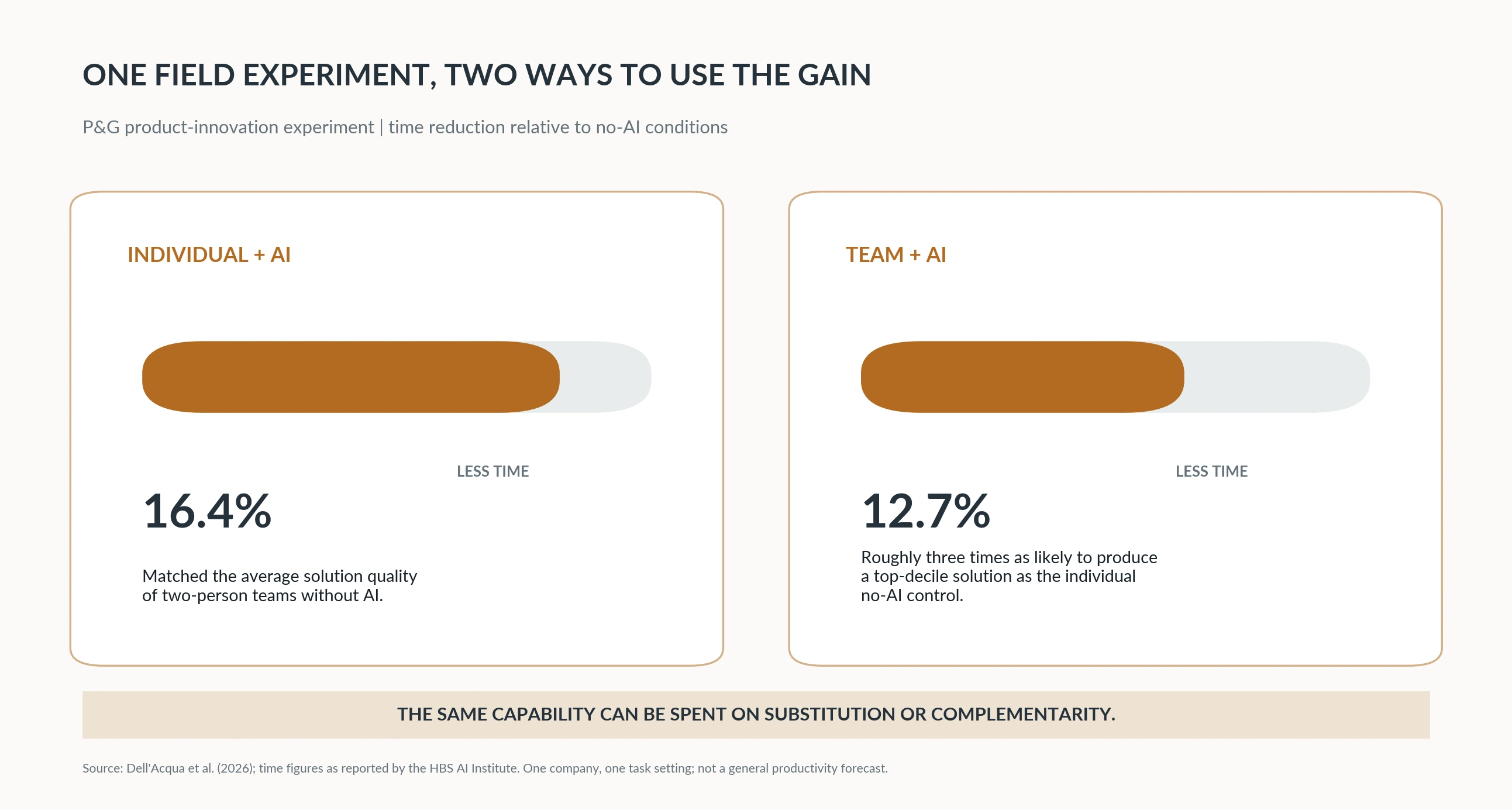
The experiment does not tell every organisation to preserve every team or to chase breakthrough quality in every task. It shows that an AI gain can be harvested in more than one form. Treating the cheapest form as the only form is a management decision, even when it is presented as arithmetic.
Reinvesting time can outperform simply doing more
The strongest case for reinvestment does not depend on the romantic claim that all effort is valuable.
Some effort is repetitive and should disappear. The relevant question is whether a small part of the released capacity can produce more value when directed towards learning and judgement than when directed towards another unit of output.
A field experiment conducted during employee training at Wipro provides a useful, if pre-generative-AI, comparison. One group spent the final 15 minutes of the working day reflecting on what it had learnt. A control group spent those 15 minutes continuing to work. The reflection group performed 22.8 per cent better on the final training test.10
This is a working paper from a particular training context, not proof that every AI-enabled employee should spend 15 minutes writing a reflective note. Its value is in the mechanism. Additional activity and additional learning are not the same thing. Once some experience has accumulated, articulating what has been learnt can outperform simply accumulating more experience.
For AI-assisted work, cognitive reinvestment might include:
- checking the evidence behind a recommendation;
- comparing the strongest alternative rather than accepting the first plausible route;
- holding a short after-action review on where the model helped and failed;
- recording exceptions that should change future prompts or workflow rules;
- giving experienced staff time to explain the judgement that novices might otherwise inherit only as output;
- testing whether a process should be redesigned rather than merely accelerated.
This is not an argument for adding bureaucracy to every prompt. It is an argument for buying the forms of human work that the new workflow still needs.
The cognitive reinvestment rule
That rule turns an abstract concern into six management questions:
- What production effort has genuinely disappeared?
- What cognitive work has moved to the model?
- What new checking, integration or exception-handling work has appeared?
- Which judgement remains human and accountable?
- How much of the released capacity should go to throughput, judgement, learning and redesign?
- How will the organisation know whether AI improved the decision rather than merely accelerating the output?
The answer will vary by workflow.
A routine extraction task may justify spending almost the entire dividend on speed and volume. A strategic recommendation, regulated decision, product concept or unfamiliar market analysis may justify a much larger reinvestment in challenge, context and review.
The mistake is not choosing efficiency. The mistake is allowing a crude output metric to make the choice invisibly.
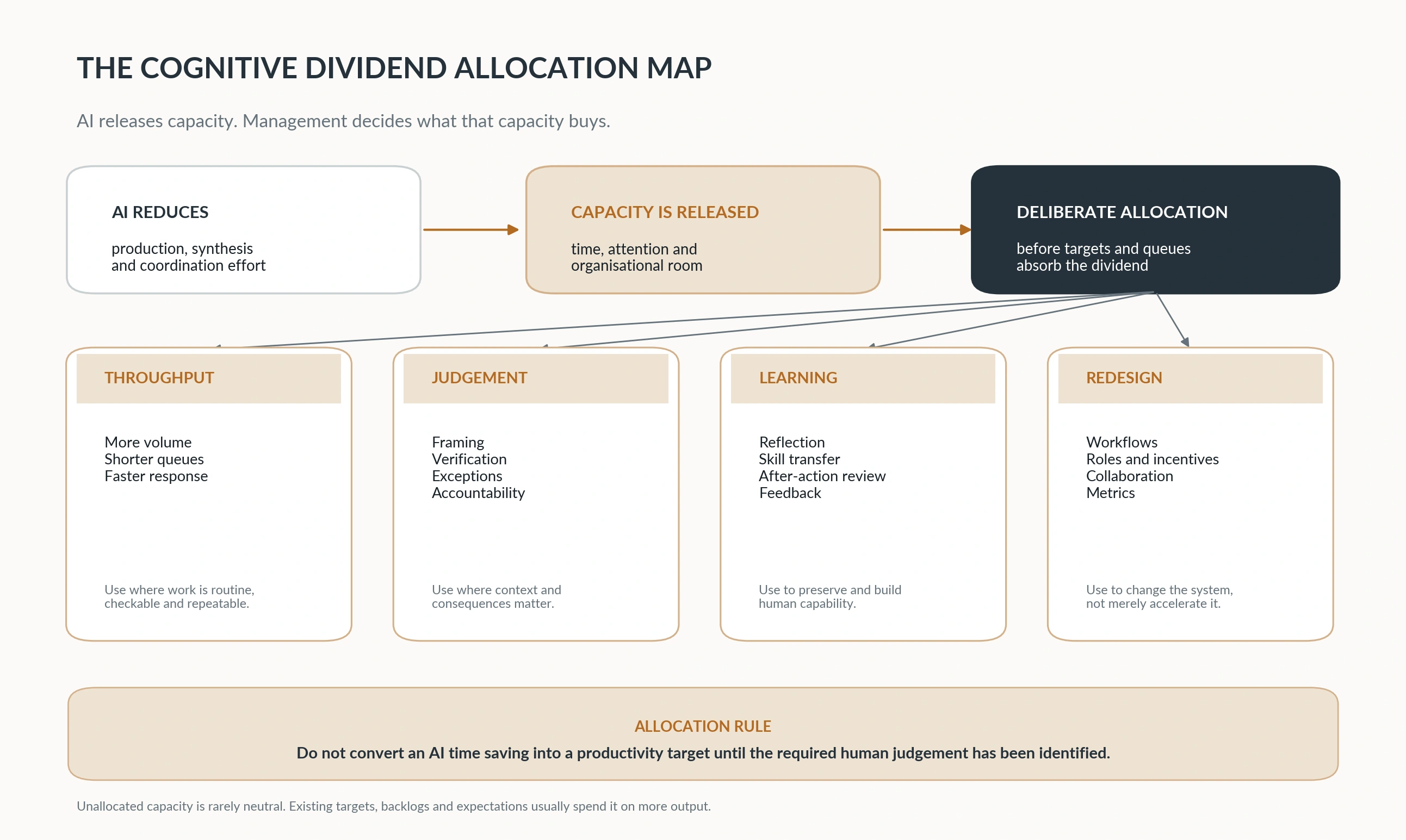
- Throughput: more output or speed
- Judgement: verification, challenge and exception handling
- Learning: reflection and capability
- Redesign: better workflows and collaboration
Allocate deliberately; do not let a single output target decide by default.
The dividend can also buy a better question
The production history behind this article provides a modest operating illustration.
Its initial idea concerned the organisational management of cognitive effort. During development, a more personal and immediate problem emerged: a person can possess an AI-assisted output without possessing the reasoning needed to defend it. That became a separate article.
The original idea was not forced into the first piece or discarded as a failed direction. It was preserved, clarified and later recovered at a different level of analysis.
The value created was not simply two outputs instead of one. It came from using released capacity to challenge the first frame, separate two questions and retain a rejected path long enough for its proper role to become visible.
That is one observation from one AI-enabled publishing workflow, not evidence of a general organisational law. It is, however, a practical example of the article's central claim: AI creates more value when part of the dividend is reinvested in reframing and judgement rather than being converted immediately into production.
More output is not the same as more value
Generative AI has made a genuine productivity promise. Organisations should take it seriously.
They should also resist a very old management error: treating whatever is easiest to count as the whole of the value created.
When production becomes cheaper, more output is one rational use of the gain. It is not the only one.
Some of the dividend may be better spent on verification, deeper integration, deliberate learning, exceptional cases, stronger collaboration and redesigning the work itself. Those activities can look slower than immediate throughput because their value often appears later, in better decisions and fewer avoidable failures.
The management task is therefore not to preserve effort for effort's sake. It is to distinguish waste from the cognitive work that still creates understanding, adaptability and accountability.
AI has not made judgement obsolete. It has changed where judgement sits and made it easier to overlook.
The final question is not simply how much time AI saved.
It is what the organisation did with the thinking it got back.
Sources and evidence
The approved article was written on 8 August 2026. The ten originating research and institutional sources were checked again on 1 November 2026. Figure 1 reproduces the approved article’s analytical companion graphic; its time reductions are reported in the Harvard Business School AI Institute summary of the P&G field experiment.
Source posture: “Cognitive dividend” is a management metaphor, not a standardised or directly measured category. The article distinguishes peer-reviewed experiments, a working paper and provisional qualitative research. Its allocation rule and the personal publishing example are editorial management implications, not measured outcomes of those studies.
- Noy, S. and Zhang, W. (2023). “Experimental Evidence on the Productivity Effects of Generative Artificial Intelligence.” Science, 381(6654), 187-192. DOI: 10.1126/science.adh2586. Read source
- Brynjolfsson, E., Li, D. and Raymond, L. R. (2025). “Generative AI at Work.” The Quarterly Journal of Economics, 140(2), 889-942. DOI: 10.1093/qje/qjae044. Read source
- Brynjolfsson, E., Rock, D. and Syverson, C. (2021). “The Productivity J-Curve: How Intangibles Complement General Purpose Technologies.” American Economic Journal: Macroeconomics, 13(1), 333-372. DOI: 10.1257/mac.20180386. Read source
- Gartenberg, C., Hasan, S., Murray, A. and Pierce, L. (2026). “More Versus Better: Artificial Intelligence, Incentives, and the Emerging Crisis in Peer Review.” Organization Science, 37(3), 795-812. DOI: 10.1287/orsc.2026.ed.v37.n3. Read source
- Counts, L. (2026). “AI promised to free up workers’ time. UC Berkeley Haas researchers found the opposite.” UC Berkeley Haas News, 18 February 2026. Reports in-progress research by Xingqi Maggie Ye and Aruna Ranganathan; used as an early qualitative signal, not as settled peer-reviewed evidence. Read source
- Lee, H.-P. H. et al. (2025). “The Impact of Generative AI on Critical Thinking: Self-Reported Reductions in Cognitive Effort and Confidence Effects From a Survey of Knowledge Workers.” CHI '25. DOI: 10.1145/3706598.3713778. Read source
- Bainbridge, L. (1983). “Ironies of Automation.” Automatica, 19(6), 775-779. DOI: 10.1016/0005-1098(83)90046-8. Read source
- Dell'Acqua, F. et al. (2026). “The Cybernetic Teammate: A Field Experiment on Generative AI and Teamwork.” Organization Science, 37(4), 1217-1242. DOI: 10.1287/orsc.2025.20702. Read source
- Harvard Business School AI Institute (2025). “The Cybernetic Teammate: How AI is Reshaping Collaboration and Expertise in the Workplace.” Official study summary used for the reported time reductions in Figure 1. Read source
- Di Stefano, G., Gino, F., Pisano, G. P. and Staats, B. R. (2016). “Making Experience Count: The Role of Reflection in Individual Learning.” Harvard Business School NOM Unit Working Paper No. 14-093 / HEC Paris Research Paper No. SPE-2016-1181. DOI: 10.2139/ssrn.2414478. Read source