
The reasoning ownership rule
Figure 1 sets out five checks for consequential AI-assisted work. It is an editorial decision aid, not a validated measure of understanding.
An AI-assisted document can be genuinely useful, logically structured and still leave its author exposed by one ordinary question:
Why?
The experience behind this article is personal. A document looked useful, persuasive and ready to use. It could be read, edited and passed on. But when a particular conclusion was questioned, the reasoning beneath it was not readily available. The words were there. The intellectual footing was not.
Nothing dramatic had gone wrong. There was no obvious hallucination, invented statistic or nonsensical recommendation. The document was useful. That was exactly why the gap was so easy to miss.
Possessing the output is not the same as possessing the reasoning.
The document can be right and the human can still be unprepared
Much of the anxiety about AI-assisted work concentrates on incorrect answers. That is understandable, but it misses a quieter failure mode.
A person can accept an AI-generated recommendation that is broadly sensible, present it competently and still be unable to answer the questions that reveal whether the recommendation is understood:
- Why this option rather than the strongest alternative?
- Which evidence mattered most?
- What trade-off was accepted?
- Which assumption is carrying the conclusion?
- What would make the recommendation change?
Those questions do not merely test whether the final words are correct. They test whether the person presenting them has a usable model of the problem.
That distinction matters because knowledge work rarely remains inside the neat boundaries of the first prompt. Clients ask follow-up questions. Colleagues challenge assumptions. New facts arrive. Budgets tighten. A recommendation that looked sound on Monday has to be adapted on Thursday.
The person who owns only the output can repeat it. The person who owns the reasoning can work with it.
This is not the first time technology has moved cognition outside the head
The underlying behaviour is not new. Humans have always used external systems to reduce mental effort. Writing preserves memory. Calculators remove arithmetic. Spreadsheets perform repeated calculation. Search engines retrieve information that no individual could retain.
Those tools changed cognition as well as execution. Experiments published in Science in 2011 found that expecting future access to information affected what people remembered: they became more likely to remember where information could be found than the information itself.1 Research published in 2015 found that searching online could inflate people's estimates of their own internal knowledge, even when the knowledge remained outside them.2
So the case against AI cannot sensibly be that every transfer of cognition is harmful. Cognitive offloading is one of the ways humans exceed their unaided limits.
Generative AI does, however, move the boundary further.
A word processor shortens the distance between intention and finished document. CAD and desktop publishing remove much of the manual drafting, correction and layout work. A spreadsheet calculates a model its user has substantially specified. Search retrieves material that the user must still interpret. Those systems can change skills and working habits, but they usually leave the human specifying the design, model or argument.
A generative system can shorten the distance between problem and conclusion. It can frame the question, select the categories, propose the recommendation, reject alternatives and express the result in professional language. It can even mirror the vocabulary and cadence of the person using it.
That creates an unusually convincing appearance of ownership. The output sounds like something the user might have written on a very good day. Fluency and familiarity can therefore become poor proxies for understanding.
The tax is not the thinking transferred to the machine
This is where the phrase thinking tax needs adjustment.
The cognitive effort transferred to AI is often the benefit. There is no virtue in manually performing every synthesis, first draft or routine comparison merely to prove that a human worked hard. Useful automation should remove effort that adds little value.
The potential tax is what may be lost as a consequence of the transfer.
The difficult process of working through a problem often produces more than a deliverable. It creates a mental map. It reveals contradictions. It forces comparison between plausible options. It exposes weak evidence and hidden assumptions. It gives the person doing the work a memory of the paths considered and rejected.
When AI jumps directly to a polished answer, some of that useful residue may never form.
The immediate transaction looks attractive:
- less time spent reading and sorting;
- less effort spent structuring the problem;
- faster production of a plausible recommendation;
- cleaner language and presentation.
The liability appears later:
- weaker understanding of how the conclusion was reached;
- no clear memory of rejected alternatives;
- limited ability to defend the trade-offs;
- greater difficulty adapting when assumptions change;
- confidence created by the output rather than by command of the problem.
That is closer to cognitive debt than a tax. The benefit is received immediately. The liability remains hidden until the missing understanding is required. The term is used here as a working metaphor, not as a clinical diagnosis or a quantity the research has directly measured.
And, like other forms of debt, it can be entirely rational. Nobody needs deep intellectual ownership of every reformatted paragraph, meeting summary or routine email. The risk lies in taking on cognitive debt without noticing that the work will later require judgement, explanation or accountability.
What the research supports, and what it does not
The evidence does not support a sweeping claim that AI simply makes people less intelligent.
It does support a more useful proposition: the effect depends substantially on the task, the user's confidence, and the way the interaction is designed.
A 2025 CHI study surveyed 319 knowledge workers and collected 936 examples of generative AI use at work. Higher confidence in the AI was associated with less reported critical thinking, while higher confidence in the user's own ability was associated with more. The researchers also found that critical thinking was shifting rather than disappearing, towards verification, integration and stewardship of AI output.3
That is important. The future of knowledge work is not necessarily a choice between unaided human thinking and passive machine dependence. Human effort can move towards asking better questions, checking evidence, integrating context and deciding what should be accepted.
But those activities do not happen automatically.
In an experiment with 199 participants, researchers found that interventions designed to interrupt automatic acceptance of AI recommendations reduced overreliance more effectively than simply showing an explanation. The less comfortable designs were also the ones participants liked least.4 Friction can improve judgement, but people naturally prefer systems that feel easy.
A small exploratory study of AI-assisted shortlisting took a more economical approach. It supplied users with brief "provocations": critiques, risks and alternatives attached to AI suggestions. The researchers found qualitative evidence that these prompts induced critical and metacognitive thinking.5
The educational evidence points in the same design direction. In a large field experiment involving nearly 1,000 high-school mathematics students, unrestricted GPT-4 access improved performance during practice but was followed by worse performance when the tool was removed. A version designed to provide hints rather than answers largely removed the negative learning effect.6
Education is not the workplace, and short-term experimental tasks are not a consulting engagement. These studies should not be stretched into universal claims. They do, however, reinforce the practical point: AI assistance can either bypass or support understanding, depending on how the work is structured.
AI can strengthen the human position
The answer is not to preserve cognitive effort for its own sake.
Research with knowledge workers also shows substantial benefits. A field experiment involving 758 consultants found that AI improved quality and productivity on tasks inside its capability frontier, but could reduce performance outside it. Skilled use required people to recognise that the frontier was uneven and to examine the work rather than assume the tool would be equally capable everywhere.7
A separate field experiment with 791 Procter & Gamble professionals found that individuals using generative AI could match the performance of two-person teams on product innovation tasks. AI improved idea generation and helped bridge functional silos, while human judgement retained value in evaluating and selecting ideas.8
That is the positive case worth preserving. AI can extend expertise, generate alternatives and improve preparation. The problem is not that the machine contributes too much thought. The problem is allowing a polished contribution to pass into accountable work without enough human engagement to make the decision usable.
A small additional prompt can change the relationship.
Consider a recommendation to move towards a subscription model. Instead of asking only for a strategic response, the user could add:
Give the recommended approach, then briefly explain why it is preferred. Identify the strongest alternatives considered and why they were not selected, the assumptions the recommendation depends on, and the new information most likely to change the conclusion.
That request does not require the user to reproduce hours of analysis manually. It may add only a few minutes of reading and challenge.
But it changes what arrives. The user receives not only a conclusion, but also a compact map of the decision. A tiered licensing model may appear as a serious alternative. Cash flow may emerge as a decisive assumption. The recommendation can then be accepted, amended or rejected with some understanding of the trade-off.
When the inevitable question arrives in the meeting, the AI-assisted user is no longer trapped behind a bullet point. The position is stronger, not weaker.
The reasoning ownership rule
For personally prompted work, a simple guideline is enough:
The more accountable you are for an AI-assisted conclusion, the less willing you should be to accept it without its decision structure.
For consequential work, ask the model to provide five things:
- The recommendation - what it believes should be done.
- The brief rationale - why that choice appears preferable.
- The strongest rejected alternatives - what else could reasonably have been chosen, and why it was not.
- The key assumptions - what must be true for the recommendation to hold.
- The change conditions - what evidence or circumstances would reverse the choice.
Then apply the human test:
Can the conclusion be explained without returning to the AI?
A useful answer should make it possible to state the central trade-off, name the strongest alternative and identify the assumption most likely to change the decision.
This is not a request for a model's hidden chain of thought. A generated rationale is another generated artefact, and research has shown that apparently plausible model explanations can misrepresent why an answer was produced.9 The rationale is not proof. It is material for human scrutiny.
The objective is not to peer inside the model. It is to create a decision structure that the responsible human can inspect, challenge and internalise.
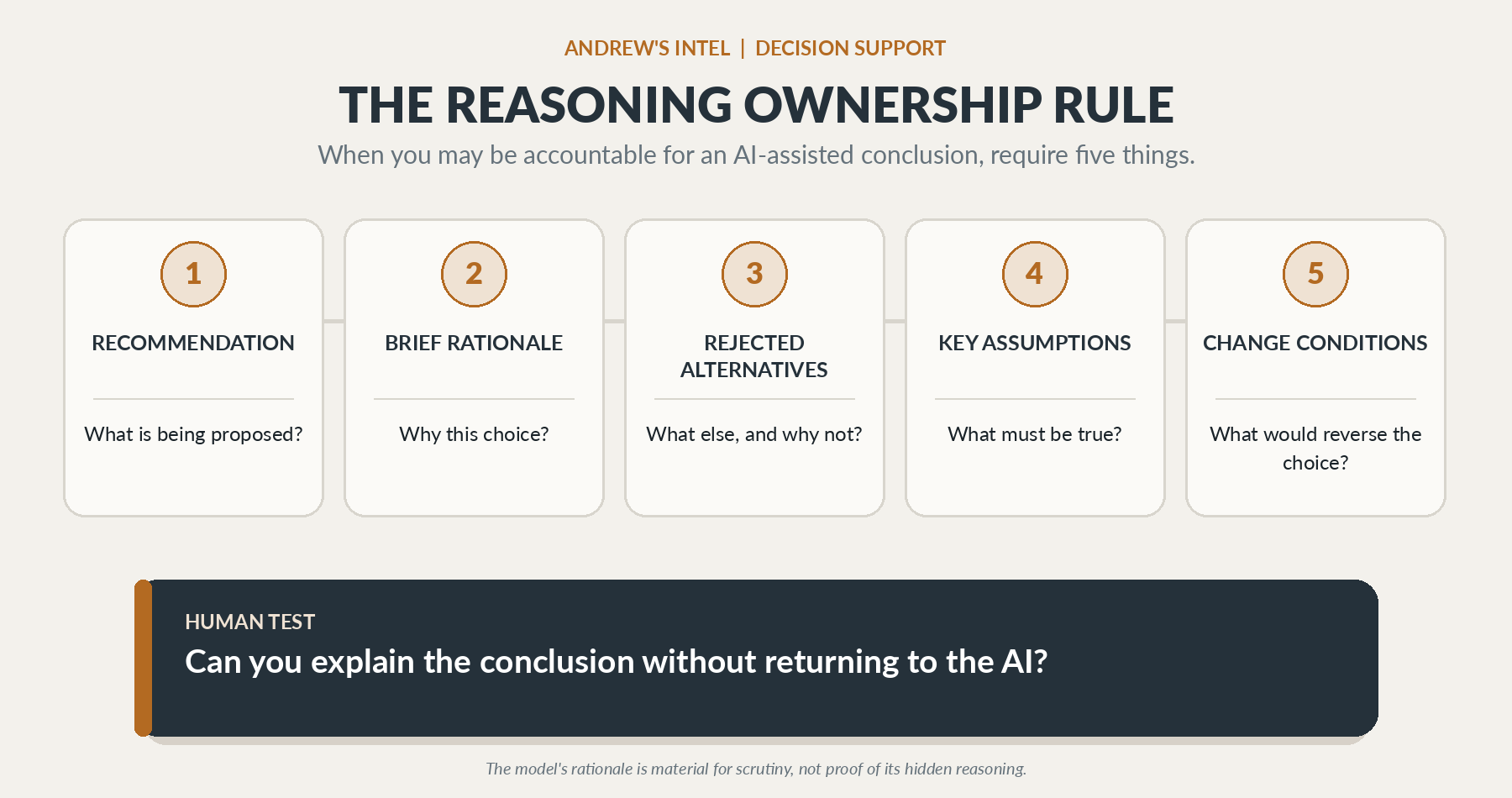
- Recommendation: what should be done.
- Brief rationale: why this choice is preferable.
- Strongest rejected alternatives: what else could reasonably be chosen.
- Key assumptions: what must hold for the choice to work.
- Change conditions: what would reverse the choice.
Human test: can the responsible person explain the conclusion without returning to the AI?
Not every task needs the same level of ownership
The rule should be applied proportionately.
Heavy cognitive offloading is usually sensible when the task is low consequence, readily checked and unlikely to require later defence. Formatting, transcription, extraction, routine rewriting and initial orientation often fall into this category.
More ownership is needed when the output contains a recommendation, diagnosis, promise, strategic choice, professional judgement or decision that somebody will be expected to explain.
The dividing question is not simply, "Did AI help?"
It is:
Who will be accountable when the work meets reality?
If the answer is a named person, that person needs more than clean prose.
The logic can be built into the workflow
The principle does not have to rely entirely on individual discipline. It can be designed into AI-assisted work.
A process can require source evaluation before drafting, distinguish claims from evidence, record why an angle was selected, preserve caveats, expose assumptions, create alternatives, and run a separate quality-control stage before publication or decision.
Andrew's Intel uses that kind of staged production system. Source evaluation, topic routing, article-family choice, briefing, outlining, drafting, revision and final quality control are separated deliberately. The point is not to make AI slower or to preserve human labour as theatre. It is to keep enough of the decision structure visible that the finished work can be challenged, revised and defended.
That is a modest implementation of the same logic this article recommends.
From cognitive offloading to cognitive leverage
Generative AI has not created the first technology capable of moving cognition outside the human mind. Nor does every shortcut create a loss.
The distinctive risk is that AI can produce a complete, fluent and professionally credible conclusion before the person responsible for it has built the understanding that would normally make the conclusion theirs.
That can create cognitive debt: apparent competence now, with a hidden liability when somebody asks why, challenges an assumption or changes the conditions.
But the remedy need not consume the productivity gain. A short request for rationale, alternatives, assumptions and change conditions can turn the model from an answer machine into a source of structured challenge.
The aim is not to ask AI to do less thinking.
It is to ask for enough of the decision structure that a human can own the answer.
Sources and evidence
Source destinations and publication status were rechecked 31 October 2026. The CHI workplace survey reports associations and self-reported examples; the shortlisting paper is a provisional working draft; the student experiment is educational evidence, not a workplace outcome. The two 2026 field experiments concern specific consulting and product-innovation tasks.
Source posture: “Cognitive debt” is a working metaphor, not a measured quantity or diagnosis. The exact five-part prompt has not been validated as an intervention. A model-generated rationale is useful scrutiny material, not proof of its internal decision process or hidden chain of thought. The article’s personal opening is the author’s account.
- Sparrow, B., Liu, J. and Wegner, D. M. (2011). “Google Effects on Memory: Cognitive Consequences of Having Information at Our Fingertips.” Science, 333(6043), 776–778. DOI: 10.1126/science.1207745 Read source.
- Fisher, M., Goddu, M. K. and Keil, F. C. (2015). “Searching for Explanations: How the Internet Inflates Estimates of Internal Knowledge.” Journal of Experimental Psychology: General, 144(3), 674–687. DOI: 10.1037/xge0000070 Read source.
- Lee, H.-P. H. et al. (2025). “The Impact of Generative AI on Critical Thinking: Self-Reported Reductions in Cognitive Effort and Confidence Effects From a Survey of Knowledge Workers.” CHI ’25. DOI: 10.1145/3706598.3713778 Read source.
- Buçinca, Z., Malaya, M. B. and Gajos, K. Z. (2021). “To Trust or to Think: Cognitive Forcing Functions Can Reduce Overreliance on AI in AI-assisted Decision-making.” Proceedings of the ACM on Human-Computer Interaction, 5(CSCW1). DOI: 10.1145/3449287 Read source.
- Drosos, I., Sarkar, A., Xu, X. T. and Toronto, N. (2025). “It makes you think”: Provocations Help Restore Critical Thinking to AI-Assisted Knowledge Work. Unpublished working draft; n=24 and described by the authors as provisional. arXiv: 2501.17247 Read source.
- Bastani, H. et al. (2025). “Generative AI Without Guardrails Can Harm Learning: Evidence from High School Mathematics.” Proceedings of the National Academy of Sciences, 122(26), e2422633122. DOI: 10.1073/pnas.2422633122 Read source.
- Dell’Acqua, F. et al. (2026). “Navigating the Jagged Technological Frontier: Field Experimental Evidence of the Effects of Artificial Intelligence on Knowledge Worker Productivity and Quality.” Organization Science, 37(2), 403–423. DOI: 10.1287/orsc.2025.21838 Read source.
- Dell’Acqua, F. et al. (2026). “The Cybernetic Teammate: A Field Experiment on Generative AI and Teamwork.” Organization Science, 37(4), 1217–1242. DOI: 10.1287/orsc.2025.20702 Read source.
- Turpin, M., Michael, J., Perez, E. and Bowman, S. R. (2023). “Language Models Don’t Always Say What They Think: Unfaithful Explanations in Chain-of-Thought Prompting.” Advances in Neural Information Processing Systems 36. Official paper Read source.