
For many organisations, the central AI problem is no longer access. It is conversion.
People can acquire a powerful model in minutes. Departments can run pilots. Vendors can demonstrate agents completing multi-step work. Employees can find useful shortcuts long before a formal programme exists.
Yet the organisation may remain substantially unchanged. Work still passes through the same approvals. Capacity released by AI is not reallocated. Managers do not know which outputs need checking. Policies describe risk without giving people an operating route. Pilot teams can show activity but cannot show why one use case deserves to scale and another should stop.
This is the AI readiness gap: the distance between what individuals can now do with the technology and what the organisation can support, govern and convert into value.
It is tempting to interpret that gap as a shortage of tools, technical talent or training. Those can all be constraints. But they often sit downstream of a more consequential issue. Leaders have not made the decisions that allow the organisation to change around the technology.
Adoption is widespread. Transformation is not
McKinsey's 2025 global AI survey offers a useful, though commercially interested, view of the gap. Eighty-eight per cent of its 1,993 respondents said their organisations regularly used AI in at least one function. Only about a third said their organisations had begun scaling AI across the enterprise. Thirty-nine per cent reported any enterprise-level EBIT impact, usually below five per cent, and the consultancy classified only about six per cent as AI "high performers".1
The precise percentages should not be mistaken for a universal census. The survey is self-reported and produced by a consultancy that sells transformation work. The pattern is nevertheless consistent with a wider body of evidence: access and experimentation are advancing faster than organisational redesign.
A smaller McKinsey panel published in 2026 sharpened that point. Among 750 AI-using employees and leaders, 70 per cent said they felt personally ready to use AI, while only 27 per cent of leaders believed their organisations were ready to make the people and culture changes required for a more agentic operating model. The sample was deliberately weighted towards organisations further advanced in AI adoption and is not representative of the whole market, so it is best read as a readiness signal rather than a prevalence estimate.2
Microsoft's 2026 Work Trend Index, another commercially interested source, reached a similar conclusion from a survey of 20,000 AI-using knowledge workers and product telemetry: people are often adapting faster than the systems around them. Its statistical analysis associated organisational factors such as culture, manager support and talent practices with more than twice the reported AI impact of individual effort alone. The relationship is correlational and based on self-reported outcomes, not causal proof.3
Different sources, incentives and methods are involved. None proves that leadership is the only constraint. Together, however, they expose the same managerial question: what must the organisation change before widespread use becomes dependable capability?
The difference between personal efficiency and organisational value
Consider an illustrative 120-person advisory firm. Suppose each employee saves an average of 30 minutes a week through AI-assisted drafting, research and administration. Across 46 working weeks, that is 2,760 hours of theoretical capacity. At an illustrative loaded cost of €70 per hour, the arithmetic appears to reveal roughly €193,000 of annual value.
It does not.
Unless the firm increases throughput, improves quality, shortens delivery times, reduces external cost, creates a new service, changes staffing requirements or deliberately reallocates the capacity, the value remains notional. Individuals may feel less rushed or fill the time with other work, which can still be beneficial. But a spreadsheet of estimated hours saved is not evidence that the organisation has captured €193,000.
This distinction explains why AI activity can be high while enterprise results remain low. Individual tools change tasks. Organisational value requires changes in priorities, workflows, roles, measures and resource allocation.
Those changes do not happen automatically. They are led.
Seven signs that the readiness gap is really a leadership gap
The readiness gap rarely appears as one dramatic failure. It appears as a collection of familiar organisational symptoms.
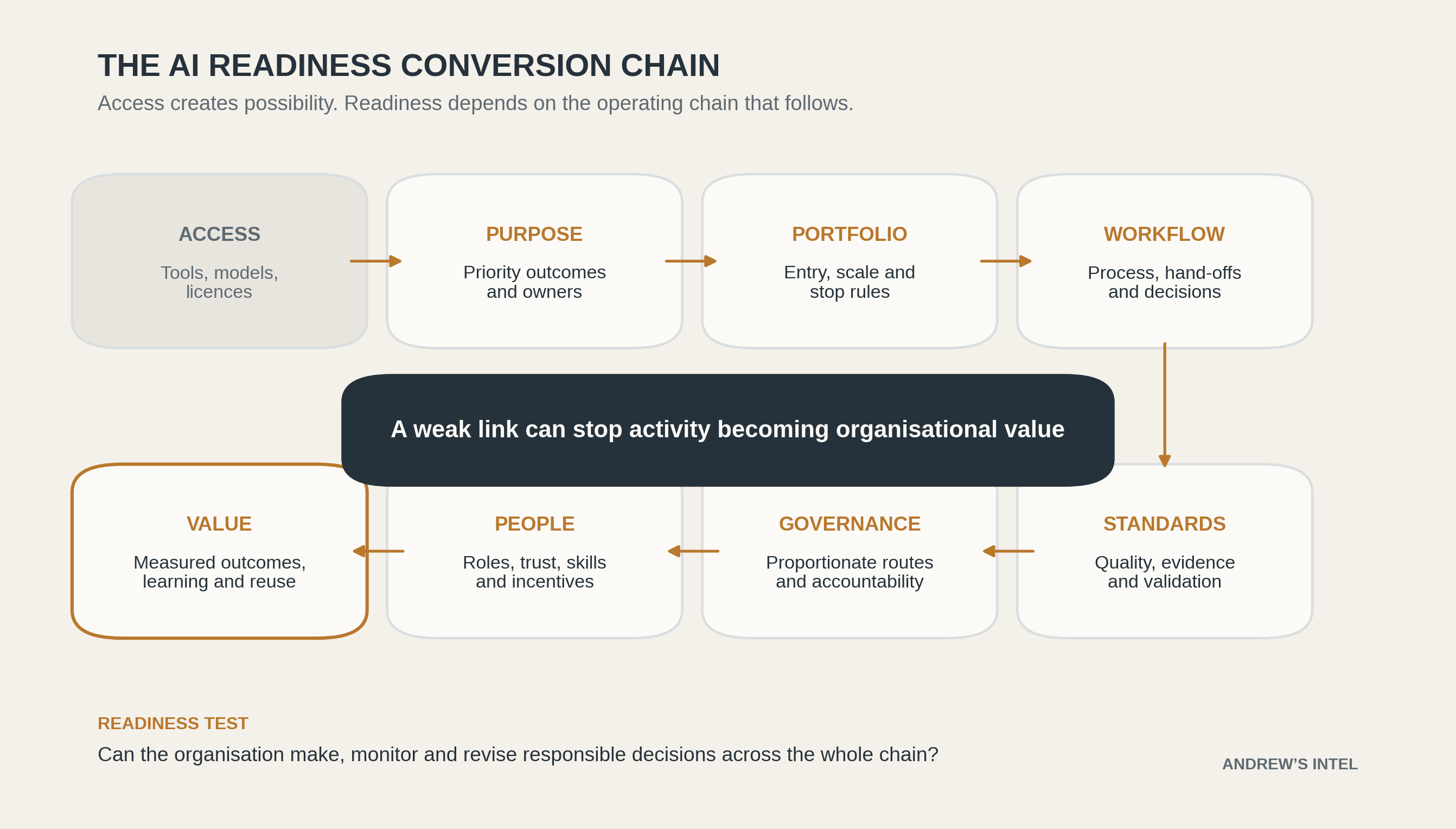
- 1Access · Tools, models and licences
- 2Purpose · Priority outcomes and owners
- 3Portfolio · Entry, scale and stop rules
- 4Workflow · Process, hand-offs and decisions
- 5Standards · Quality, evidence and validation
- 6Governance · Proportionate routes and accountability
- 7People · Roles, trust, skills and incentives
- 8Value · Measured outcomes, learning and reuse
1. The purpose gap: ambition without a defined problem
The organisation announces that AI is strategic, but cannot name the small number of workflows, decisions or service outcomes that matter most.
Teams are invited to experiment and return with use cases. This produces energy, but it also produces a portfolio of incomparable ideas: a drafting assistant, a forecasting pilot, an automated inbox, a chatbot, a research workflow and a proposed agent. Each may be useful. Without a shared value frame, leaders cannot decide where to concentrate scarce attention, data, integration effort or change capacity.
The OECD's 2025 study of AI adoption in firms reported that managers often struggle to understand how AI can address real workplace problems while simultaneously underestimating the enterprise-wide implications and cultural changes that adoption may require.4
Readiness begins when leaders can connect a specific organisational priority to a specific change in work. "Use more AI" is an ambition. "Reduce avoidable rework in claims preparation without weakening evidence quality" is a decision problem.
2. The portfolio gap: pilots without selection rules
A pilot proves that something can be demonstrated. It does not prove that it deserves to scale.
Organisations commonly allow pilots to begin with no agreed criteria for continuation, comparison or termination. Sponsorship, novelty and local enthusiasm then become substitutes for evidence. A weak pilot survives because its sponsor has status. A useful experiment remains trapped in one team because no one owns the decision to redesign the wider process.
A ready organisation has a portfolio logic. It knows what evidence is required to move from exploration to controlled use, from controlled use to scale, or from investigation to closure. It can stop a project without treating the result as failure.
This is leadership work because it involves priorities, trade-offs and resource allocation. A technical team can report performance. It cannot decide how much organisational change a benefit is worth.
3. The workflow gap: task gains inside an unchanged system
AI often produces its first benefits at task level: a faster draft, a cleaner summary, a quicker comparison or a more complete set of options.
Those gains may disappear when the surrounding workflow remains unchanged. A faster first draft still waits three days for approval. A machine-generated analysis creates an additional review stage. A service agent prepares a response quickly, but the case system cannot pass the relevant information to the next team. A manager receives more material than before and becomes the new bottleneck.
McKinsey's broad 2025 survey found that workflow redesign was one of the practices most strongly associated with its high-performing group. Its 2026 readiness panel reported a similar association: within the earliest "enablement" stage, leaders were much more likely to report value where workflows had changed rather than where tools were simply made available.12
These are associations in consultancy surveys, not proof of a universal formula. They do point to the right test: not whether AI made one task faster, but whether the end-to-end work became better.
4. The standards gap: output without an agreed definition of good
AI can produce material at a speed that overwhelms informal quality control.
If the organisation has not defined acceptable quality, evidence, review and escalation, each user invents a personal standard. One person checks every claim. Another trusts the output if it sounds plausible. A third avoids AI completely because the risk is unclear. Managers discover the inconsistency only after work has reached a customer, regulator, board or member of the public.
The "jagged technological frontier" research is particularly relevant here. On suitable tasks, consultants using AI worked faster and produced better material. On an unsuitable complex task, AI users were materially less likely to reach the correct answer, even though their responses could remain coherent.5
Readiness therefore requires more than a generic instruction to keep a human "in the loop". It requires a defined human role: what must be checked, against what evidence, by whom, at what level of risk, and with what authority to stop or override the system.
5. The governance gap: policy without an operating route
Many organisations have begun to write AI principles and policies. Fewer have translated them into daily decisions.
A policy may prohibit confidential data from entering unapproved tools but fail to offer an approved alternative. It may require risk assessment without defining who performs it. It may classify use cases as low, medium or high risk without giving teams a proportionate route to proceed. The predictable result is not safety. It is delay, avoidance or hidden use.
The NIST AI Risk Management Framework treats governance as continuous and cross-cutting. It connects technical choices to organisational values, policies, strategic priorities and risk tolerance, with senior leadership setting the tone and management aligning those choices with operations.6
Public-sector evidence shows the same issue in a different setting. The OECD's 2025 review of government AI adoption identified governance, data, infrastructure, skills, investment, procurement and partnerships as interdependent enablers. It also found that many initiatives remained in pilot stages because impact measurement, guidance, skills and data arrangements were weak.7
Governance readiness is therefore not the presence of a policy. It is the ability to make a proportionate, accountable decision and allow responsible work to continue.
6. The people gap: training without role, trust or incentive design
Training is necessary. It is not sufficient.
An employee may know how to use an AI assistant yet reasonably avoid it because mistakes are punished more heavily than experimentation is rewarded. A manager may encourage adoption while quietly fearing that successful automation will reduce the status or size of the team. A junior professional may become faster at producing work but receive less feedback and fewer opportunities to develop judgement. A subject-matter expert may be asked to validate increasing volumes of AI output without receiving time, recognition or authority.
These are not user-skill problems. They are questions of role design, incentives, capacity and trust.
The 2026 McKinsey panel found that respondents who reported low trust in organisational support during AI change were more likely to report anxiety. Its stronger point was not that leaders should reassure people that nothing will change. It was that trust depends upon honesty about uncertainty, clarity about how decisions will be made and visible support as roles evolve.2
A ready organisation does not promise a painless transition it cannot guarantee. It gives people a credible account of what is being tested, what decisions remain open, how performance will be judged and how the organisation will respond when work changes.
7. The value gap: activity metrics without conversion
Licence activation, prompt volume, training attendance, pilot count and generated content are easy to measure. They are not the same as value.
The organisation needs to know what improved and what that improvement enabled. Did cycle time fall? Did error rates change? Did the service handle more cases? Did customer or citizen outcomes improve? Did the organisation avoid external spend? Was capacity redirected towards higher-value work? Did risk increase elsewhere?
Value measurement also needs a baseline and a counterfactual. A team may become faster while demand increases faster still. A model may reduce drafting time but create review cost. A new service may create revenue while weakening margin. Without a complete view, success can be declared by selecting the most convenient metric.
Leadership closes this gap by deciding what value means, who owns it and what action follows. If capacity is released, someone must decide how it will be used. If an experiment does not create enough value, someone must be willing to stop it.
The AI readiness gap diagnostic
Use the diagnostic below to distinguish visible activity from operating readiness.
On a narrow screen, swipe the table to see all three columns.
| Readiness dimension | Evidence that the organisation is becoming ready | Warning sign that the gap remains |
|---|---|---|
| Purpose | A small number of priority outcomes, workflows and named owners | A long use-case list with no ranking or value logic |
| Portfolio | Entry, test, scale and stop criteria for experiments | Pilots survive through sponsorship or novelty |
| Workflow | End-to-end process, hand-offs and decision rights have changed | Individual tasks are faster but the system is unchanged |
| Standards | Quality, evidence, review and escalation are explicit by risk | "Human oversight" is stated but not defined |
| Governance | Teams have a proportionate route to approve, monitor and escalate use | Policy exists mainly as a barrier or disclaimer |
| People | Roles, incentives, learning and released capacity are addressed | Training is offered while fear, workload and career paths are ignored |
| Value | Baselines, outcomes, cost of review and capacity conversion are measured | Success is reported through licences, prompts or estimated hours saved |
| Learning | Incidents, exceptions, model changes and user evidence update practice | Success stories travel; limitations remain local |
The diagnostic is deliberately demanding. Readiness is not a certificate the organisation earns once. It is evidence that the system can make, monitor and revise responsible decisions.
A 90-day leadership agenda
Closing the readiness gap does not require a grand transformation programme before useful work can begin. It requires a more disciplined sequence.
Choose two consequential workflows
Select work that matters enough to justify attention but is bounded enough to examine properly. One may be low risk and operational; the other may expose a more strategic opportunity or governance challenge.
Establish the baseline before changing the work
Measure current cycle time, cost, quality, error, rework, demand and user experience. Without a baseline, improvement will be a story rather than evidence.
Map the human and AI decision rights
Define what the system prepares, what a person decides, what must be verified, what exceptions escalate and who owns the final result.
Test failure, not only success
Use representative difficult cases, ambiguous inputs, missing data and adversarial examples. A capability that works only on the clean demonstration path is not ready for a live workflow.
Decide how value will be converted
State in advance what happens if time or capacity is released. Will the organisation handle more work, improve service, reduce cost, deepen analysis, create a new offer or reduce risk? Nominal efficiency should not be allowed to evaporate.
Communicate the decision process
Tell affected people what is known, what is being tested, what is not yet decided, how their evidence will be used and when the next decision will be made. Trust grows from a credible process, not blanket reassurance.
Questions for the leadership meeting
- Which two or three organisational outcomes justify our current AI investment?
- Where are employees already using AI more effectively than our formal processes allow?
- Which workflow has changed end to end — not merely acquired a faster task?
- What output is acceptable without review, what requires validation and what should never be delegated?
- Who has authority to scale, stop or restrict an AI use case?
- What role, incentive or workload problem will appear if the use succeeds?
- How will released capacity become visible value rather than absorbed activity?
- What have we learned from failures, exceptions and abandoned pilots in the past 90 days?
If the leadership team cannot answer those questions, the organisation may still be active in AI. It is not yet demonstrably ready.
Readiness is an operating condition, not a technology state
AI readiness is often presented as a ladder of data maturity, infrastructure, skills and governance. Those foundations matter. But a checklist can obscure the central fact: somebody must make the trade-offs that connect them.
Leaders decide which outcomes matter, which workflows change, which risks are acceptable, where accountability sits, how people are treated and how value is measured. Technology, data, legal, risk, procurement and operational teams provide essential expertise. They cannot substitute for that integrative judgement.
The readiness gap is therefore a leadership gap — not because leaders must perform every technical task, but because only leadership can create the conditions under which technical capability becomes organisational capability.
Access creates possibility. Leadership converts it into a dependable result.
For the leadership decisions behind this diagnostic, read the companion analysis: AI is no longer just a tool. It is a leadership capability.
Sources and interpretation
Commercially interested surveys are treated as market signals rather than neutral proof. Effect sizes and associations are not generalised beyond their methods and contexts.
- McKinsey & Company, The State of AI in 2025: Agents, Innovation, and Transformation, 2025. The online survey received 1,993 responses across 105 countries. It is self-reported and commercially interested; figures are used as market signals, not independent causal proof.
- McKinsey & Company, From Adoption to Impact: Three Horizons of AI Transformation, 2026. The panel included 750 English-speaking AI users, with organisational-readiness results drawn from a smaller leader subset. Recruitment deliberately included more advanced organisations, so prevalence estimates should not be generalised to the whole market.
- Microsoft, 2026 Work Trend Index: Agents, Human Agency, and the Opportunity for Every Organization, 2026. The report combines a survey of 20,000 AI-using knowledge workers with Microsoft product telemetry. Its organisational-factor findings are statistical associations with self-reported outcomes, not causal effects. The report is commercially interested and should be read as a market and behaviour signal rather than neutral proof.
- OECD/BCG/INSEAD, The Adoption of Artificial Intelligence in Firms: New Evidence for Policymaking, 2025. The core enterprise survey was conducted in 2022-23, before the present wave of generative AI adoption; its findings are most useful for persistent organisational barriers rather than current adoption rates.
- Fabrizio Dell'Acqua et al., Navigating the Jagged Technological Frontier: Field Experimental Evidence of the Effects of Artificial Intelligence on Knowledge Worker Productivity and Quality, Organization Science 37(2), 2026. Results are task- and model-specific and should not be generalised mechanically.
- US National Institute of Standards and Technology, Artificial Intelligence Risk Management Framework (AI RMF 1.0), 2023. The framework is voluntary and adaptable to organisational context.
- OECD, Governing with Artificial Intelligence, 2025. The report focuses on public-sector use but offers a useful cross-sector view of the interdependence between governance, data, skills, procurement, infrastructure and impact measurement.
This article provides general decision support. It is not legal, regulatory, employment or professional advice.