An organisation can buy access to AI in an afternoon. It cannot buy the judgement needed to use it well.
Consider a professional-services firm whose people already use several AI assistants. Analysts summarise research with them. Consultants use them to draft proposals. Managers ask them to prepare meeting notes. A few confident users have built small workflows that colleagues quietly depend upon.
The board's first instinct may be to ask which model the firm should standardise, which vendor offers the safest enterprise licence, or how many people need prompt training. Those are legitimate questions. They are no longer the consequential ones.
The consequential questions are different. Which work should change? What evidence is sufficient before an AI-assisted conclusion can be relied upon? Where must a human still exercise judgement? Who is accountable when a plausible answer is wrong? What happens to junior development if the first draft, initial analysis and routine checking are increasingly automated? How should any capacity released by AI be converted into better service, greater throughput, lower cost or new value?
Those are leadership questions. Technology teams can inform them. They cannot answer them on the organisation's behalf.
The category error: treating capability as a tool
Tools sit inside an existing way of working. A spreadsheet accelerates calculation. A video platform changes how a meeting is held. A customer relationship system records and distributes information. Each may require process changes, but its role is comparatively legible.
AI is less obedient to that category. It does not simply execute a clearly bounded instruction. It can draft, compare, classify, infer, advise, simulate, challenge and sometimes act across several steps. Its usefulness varies sharply by task, context, data, model and user. It may support a novice, compress part of a senior role, expose a weak process or create a new review burden. In some settings, it can begin to perform work that previously required a colleague, a team or an external specialist.
A field experiment at Procter & Gamble, published in 2026, is illustrative. Individuals using generative AI matched the performance of conventional two-person teams on product-development tasks. AI also helped technical and commercial specialists produce more balanced solutions across their usual professional silos.1 One experiment does not prescribe a new organisation chart. It does show why AI cannot be treated only as another item in the software estate. When a system changes who can perform a task, what expertise is required and how teams combine knowledge, leadership choices follow.
The distinction is simple:
A tool helps someone perform work. A capability changes what the organisation can reliably do.
Once AI begins to affect the second category, leaders have to decide what the organisation should become capable of — and what it should deliberately refuse to do.
Why judgement matters more as capability grows
AI's expanding usefulness does not remove the need for judgement. It increases it.
The clearest evidence comes from the research on the "jagged technological frontier". In a field experiment involving 758 management consultants, AI users working on tasks within the model's capability completed 12.2 per cent more tasks, worked 25.1 per cent faster and produced work rated more than 30 per cent higher in quality. On a complex task outside that frontier, however, participants using AI were 19 percentage points less likely to reach the correct answer than those working without it.2
The danger was not simply bad output. AI-assisted answers could remain coherent and persuasive. The professional using the system therefore needed to recognise that the task had crossed an invisible boundary between useful augmentation and misleading assistance.
No vendor can map that boundary perfectly for every organisation. It moves as models change, as data changes and as the work itself changes. The organisation must learn where AI is dependable, where it needs checking, where it should be constrained and where it should not be used at all.
That is not a training issue alone. It is a question of standards, decision rights, risk appetite and learning design. In other words, it is a leadership capability.
Here, leadership capability does not mean a personal talent possessed by one unusually enthusiastic executive. It means a repeatable organisational ability, created through leadership decisions, to choose useful problems, redesign work, set standards, allocate accountability and learn from evidence.
Leaders do not need to become AI engineers
Calling AI a leadership capability does not mean every director should learn to build models or become the most accomplished prompt writer in the organisation.
The OECD's 2026 review of AI and skills makes a useful distinction. It reports that fewer than one per cent of workers are likely to need advanced AI-specific skills such as programming or model development. Far more people will need the ability to use, analyse and interpret data, alongside managerial and human skills such as problem-solving, creativity and innovation.3
For leaders, practical fluency matters more than technical performance. They should understand enough to recognise the difference between a demonstration and a dependable workflow; between an output and evidence; between individual convenience and organisational value; between a model limitation and a poorly designed process.
They should also be able to ask questions that force specificity:
- What decision or workflow is this supposed to improve?
- What does the system need in order to perform reliably?
- How will we know when it is wrong?
- Which human judgement is being preserved, shifted or removed?
- Who owns the result after AI has contributed to it?
A leader who can ask and act upon those questions may be more valuable than one who can produce the cleverest prompt.
The six acts of AI-capable leadership
Leadership capability becomes visible through decisions. Six acts matter particularly.
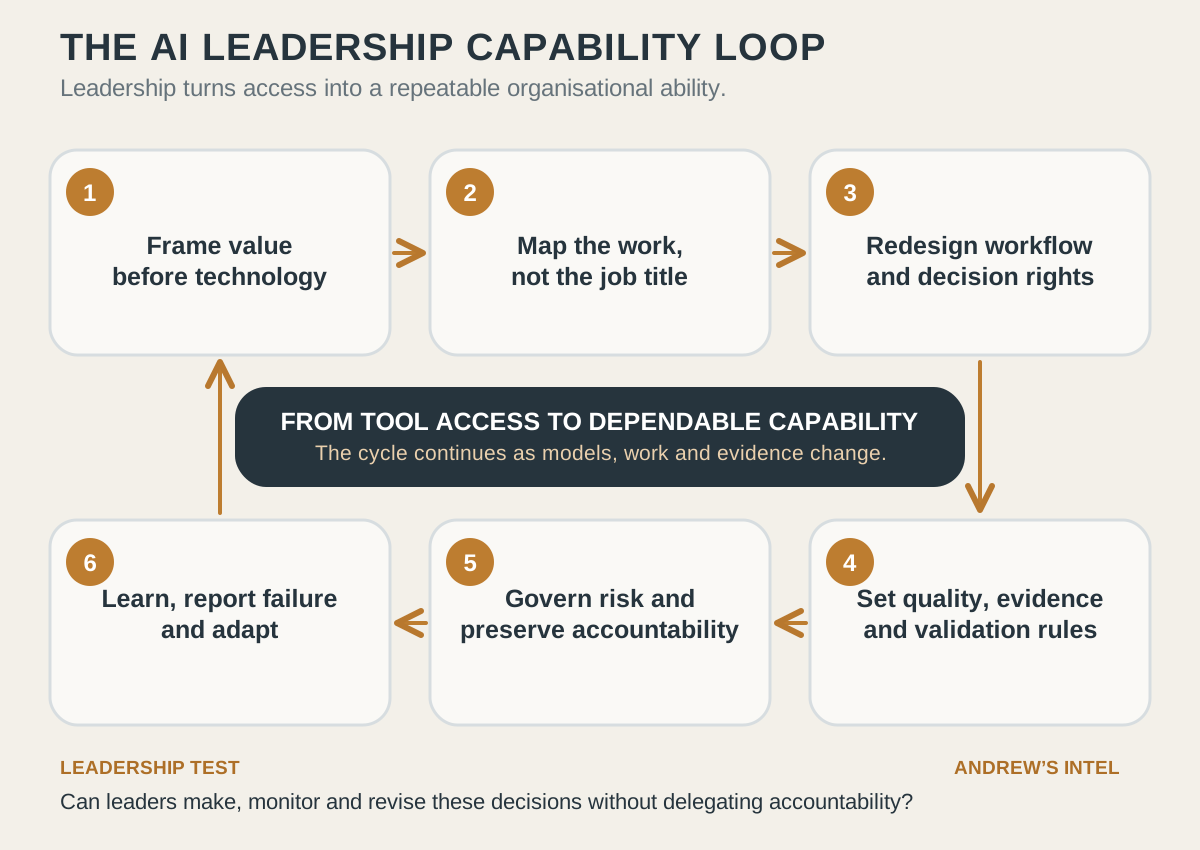
- 1Frame value before technology
- 2Map the work, not the job title
- 3Redesign workflow and decision rights
- 4Set quality, evidence and validation rules
- 5Govern risk and preserve accountability
- 6Learn, report failure and adapt
1. Frame value before choosing technology
Weak AI programmes begin with a product and search for uses. Stronger ones begin with a consequential organisational problem.
The problem might be slow case preparation, inconsistent quality, delayed customer response, expensive research, avoidable rework or an expertise bottleneck. The leadership task is to define the result that matters before anyone chooses a model or platform.
"Make everyone more productive" is not a result. "Reduce the time from a complete client brief to a reviewable first analysis while preserving evidence quality" is closer. It identifies a workflow, a boundary and a standard.
Without that framing, local experiments may still be useful, but they compete for attention without a common value logic. The organisation accumulates activity rather than capability.
2. Map the work, not merely the job title
AI rarely automates a whole role cleanly. It affects tasks unevenly.
A lawyer may use it effectively to compare clauses but not to decide the risk appetite behind a negotiation. A clinician may use it to prepare a structured summary but remain responsible for diagnosis and treatment. A procurement team may use it to screen documents but still need human judgement to interpret supplier risk. A manager may use it to generate options but should not outsource the decision.
Leaders therefore need a task-level picture of work: what is routine, what is judgement-heavy, what is evidence-sensitive, what depends upon tacit context, and what develops the expertise the organisation will need later.
This matters because an apparently efficient decision can create a capability debt. Removing junior tasks may save time today while weakening the path through which experienced professionals are formed. Automating an awkward hand-off may hide the fact that the underlying process should be redesigned. Accelerating a flawed step may simply deliver bad work faster.
3. Redesign workflows and decision rights
Giving people an AI assistant does not redesign work. It overlays AI on the existing process.
The larger opportunity often lies in changing the sequence: what information is collected, what the system prepares, what a person reviews, what exceptions are escalated, what evidence is retained and where a decision is made. That may change team boundaries, approval stages and the role of managers.
McKinsey's 2025 global survey — a commercially interested consultancy source, but a useful market signal — found that its small group of AI "high performers" were nearly three times as likely as others to report fundamental workflow redesign. They were also much more likely to report visible senior-leadership ownership.4
The important point is not that every organisation should copy the consultancy's maturity model. It is that access alone does not create a new operating capability. Someone must redesign the system around the work.
4. Define quality, evidence and human validation
AI can make weak work look finished. Leadership must therefore define what "good enough" means before scale makes ambiguity expensive.
For a low-stakes internal draft, an approximate answer may be useful. For a customer commitment, financial decision, regulatory submission, clinical action or public-service outcome, the threshold is different. The organisation needs explicit rules for evidence, review and escalation.
This includes deciding:
- which outputs require human validation;
- what the reviewer must check;
- what sources or records must be retained;
- when uncertainty must be disclosed;
- which errors are tolerable and which are not;
- who may override the system and on what basis.
These are management standards, not model settings. They determine whether AI is producing usable work or merely plausible material that someone else must repair.
5. Govern risk without turning governance into delay
Governance is often presented as the concern that arrives after innovation. In practice, it is part of capability design.
The NIST AI Risk Management Framework treats governance as a cross-cutting function across the AI lifecycle and the organisational hierarchy. It connects technical design and use to the organisation's values, policies, strategic priorities and risk tolerance. It also places tone-setting responsibility with senior leadership.5
That is a more useful frame than a single approval committee or a document prohibiting undefined "high-risk AI". Operational governance should help people know what they may do, what conditions apply, what needs review and how to escalate uncertainty.
The aim is not maximum control. It is proportionate control that makes responsible use easier than hidden use.
6. Build a learning system, not a one-off rollout
AI capability will not stay still long enough for a conventional implementation to remain complete.
The organisation needs a way to learn from real work: where the system helped, where it failed, where people ignored it, where review effort increased, where value appeared and where a new model changed the boundary. Lessons must move from individual users into shared practice.
That requires leaders to reward reporting, not just success. A team that discovers an AI use is unreliable has produced valuable information. A user who identifies an exception should not be treated as obstructive. A pilot that is stopped early may demonstrate better leadership than one kept alive to protect its sponsor.
The capability is therefore dynamic. It is the ability to make a reasoned decision now, observe what happens and revise the operating model without losing accountability.
What this capability is not
AI-capable leadership should not be confused with visible enthusiasm.
It is not:
- using the newest model before everyone else;
- mandating an assistant for every employee;
- asking each department to produce a list of use cases;
- appointing an innovation lead and delegating the subject;
- publishing a policy that nobody can translate into daily decisions;
- measuring success through licences, prompts, pilots or demonstrations;
- treating scepticism as resistance or experimentation as proof.
All of those activities may have a place. None demonstrates that the organisation can convert AI into dependable capability.
The AI leadership capability test
Use this test before approving the next substantial AI investment or workflow change.
On a narrow screen, swipe the table to see all three columns.
| Leadership question | Evidence of capability | Warning sign |
|---|---|---|
| Can we name the organisational result? | A defined outcome, baseline and owner | "Productivity" or "innovation" without a workflow |
| Have we mapped the work at task level? | Clear task boundaries, dependencies and exceptions | Decisions based only on job titles |
| Do we know where AI helps and where it may harm? | Testing across representative cases, including failure cases | Reliance on demos or average benchmark scores |
| Have we redesigned the workflow? | New sequence, hand-offs, review points and decision rights | AI added to the old process with no operating change |
| Is acceptable quality explicit? | Evidence, accuracy, review and escalation standards | "A human is in the loop" with no defined check |
| Is accountability preserved? | Named owners for use, review, risk and outcome | Responsibility diffused between user, vendor and IT |
| Will released capacity create value? | A plan for throughput, quality, service, cost or innovation | Time saved remains invisible and unreallocated |
| Can the organisation learn safely? | Feedback, incident capture, version review and stop rules | Success stories travel; failures remain local |
A leadership team that cannot yet answer these questions does not necessarily need to stop using AI. It does need to stop confusing access with capability.
Five questions for the next AI discussion
Before the next vendor presentation, internal proposal or board update, ask:
- What changes in the work if this succeeds? Not what the tool can do, but what the organisation will do differently.
- What must remain a human responsibility? Include judgement, explanation, exception handling and accountability.
- What evidence would justify trust? Specify representative tests, error thresholds and review requirements.
- What value will released capacity create? Identify the service, revenue, quality, resilience or cost outcome.
- How will we know when to change our mind? Define feedback, review dates and stop conditions.
Leadership begins where the tool decision ends
AI may be delivered through software, but its organisational consequences are not software decisions.
The leadership task is to decide what the technology is for, where it belongs, what standards surround it, how work and roles should change, how risk is governed and how the organisation will learn. Leaders do not need to know every model. They do need to remain capable of making those choices.
That is why AI is no longer just a tool. It is a leadership capability.
The companion article, The AI readiness gap is a leadership gap, turns this argument into a diagnostic: what an organisation looks like when the technology is available but the leadership capability is not yet sufficiently developed.
Sources and interpretation
Commercially interested surveys are treated as market signals rather than neutral proof. Effect sizes and associations are not generalised beyond their methods and contexts.
- Dell'Acqua et al. (2026). The Cybernetic Teammate: A Field Experiment on Generative AI and Teamwork. Organization Science. One preregistered experiment involving 791 professionals in one innovation setting; not a universal organisation-design prescription.
- Dell'Acqua et al. (2026). Navigating the Jagged Technological Frontier: Field Experimental Evidence of the Effects of Artificial Intelligence on Knowledge Worker Productivity and Quality. Organization Science. Task-specific findings from a field experiment with management consultants.
- OECD (2026). AI and Skills: What We Know So Far. A synthesis of studies; skill needs vary by occupation, sector and adoption stage.
- McKinsey & Company (2025). The State of AI in 2025: Agents, Innovation, and Transformation. A self-reported consultancy survey, used as a market signal rather than independent causal proof.
- US National Institute of Standards and Technology (2023). Artificial Intelligence Risk Management Framework (AI RMF 1.0). A voluntary framework to be adapted to organisational context.
This article provides general decision support. It is not legal, regulatory, employment or professional advice.