
The Capability-First Resourcing Test
Figure 3 gives seven questions for a hire, AI pilot, software purchase or outsourcing choice. The sequence in Figure 2 shows where AI belongs in that decision. Both are editorial decision aids, not validated scoring models.
Most formal AI programmes begin with a hunt for use cases. Leaders ask which department should pilot a tool, which process can be automated, or which vendor can demonstrate a quick win. It sounds practical. It also quietly lets the technology frame the problem.
The more useful starting question is older and less glamorous: what is the organisation trying to accomplish, and what does it need in order to do that reliably?
Once that question is answered, AI may be part of the response. So may a better-trained team, cleaner data, a simpler approval route, a specialist supplier, conventional software, a process redesign, or the decision to stop doing work whose value no longer justifies its cost.
This is resourcing in the broad management sense. It is not recruitment, workforce scheduling or the allocation of people to projects, although those may sit inside it. It is the assembly of capability.
AI changes the category, not just the cost
For most of software history, the categories were relatively stable. People exercised judgement and performed work. Software stored, calculated and routed. Suppliers rented expertise or capacity. Capital bought more of each.
AI blurs these boundaries. A model can draft, classify, compare, translate, summarise, search, recommend and coordinate parts of a workflow. It can sometimes give a non-specialist access to patterns or language that previously required specialist help. It can also act inside software or a supplier's service without appearing as a separate purchase.
That does not make AI an employee. It has no legitimate organisational purpose of its own, no moral or legal accountability, and no durable relationship with a customer or colleague. But it does mean that bounded cognitive capability can increasingly be sourced in a new way.
As a result, AI changes more than capacity. It changes the relative value of other resources. A senior specialist may be able to oversee more work. Junior staff may produce sooner but need a different learning path. Contractor demand may fall in one area and rise in another. Data quality, review capacity or exception handling may become the new constraint. A software purchase may bring something resembling analytical labour; a consulting service may embed models that were never named in the contract.
AI does not remove the resourcing problem. It changes the menu.
Resource the capability, not the job title
Job titles are compressed solutions to capability problems. A manager asks for an analyst because the organisation needs research, extraction, comparison, interpretation, challenge and an accountable recommendation. Those functions have been bundled into one role because, historically, that was the practical way to supply them.
Task-based labour research helps explain why AI's effects are uneven. The International Labour Organization's 2025 global index analyses occupations as bundles of tasks and concludes that transformation is more likely than complete automation because most occupations still contain work that requires human input.2
The management implication is not to fragment every job until people become task queues. It is to stop treating the existing job description as the natural unit of resourcing.
The early evidence looks like recombination, not replacement
New OECD survey evidence from more than 5,000 small and medium-sized enterprises in seven countries gives a useful, if necessarily limited, picture. Among firms using generative AI, roughly a third reported lower staff workload and 14 per cent reported less reliance on external contractors. Yet 83 per cent reported no change in overall staff need. Twice as many said generative AI increased the need for higher skills as said it reduced it.3
- 32.7%
- reported lower staff workload
- 14%
- reported less reliance on external contractors
- 83%
- reported no change in overall staff need
- 20% vs 9%
- said skill needs increased rather than decreased
OECD survey of more than 5,000 SMEs in seven countries, fielded in late 2024. Self-reported evidence; not a causal headcount forecast.
These are self-reported 2024 survey results, not audited causal effects, and they should not be projected mechanically across larger organisations or every sector. Even so, the pattern matters. The early movement is not simply labour replaced by technology. It is work redistributed, external capability brought inside, and the skill and review mix altered before the total headcount changes.
That is a resourcing story.
AI often moves the bottleneck
A task can become faster without the organisation becoming more capable. The time saved in drafting may reappear as review. More analysis may create more decisions waiting for approval. Faster code generation may increase testing and integration demands. Lower contractor use may increase the need for internal expertise to verify work. A flexible model may create a dependency on one supplier's data, interface or pricing.
ILO researchers call this the aggregation paradox: strong gains at task and worker level have not yet translated consistently into firm, sector or economy-wide productivity gains. Their 2026 review points to complementary conditions such as work reorganisation, skills, workflow integration, data governance and quality assurance.4
Stanford's 2026 AI Index reaches a compatible conclusion from another direction: reported productivity gains are strongest in structured, measurable work where outputs are easy to monitor.5 That qualification is more useful than another universal promise.
A model can add capability only inside a system able to direct, evaluate and absorb it. Where work is poorly defined, information is inaccessible, quality is hard to judge or responsibility is disputed, AI may accelerate activity without improving the result.
The resourcing question must therefore include the resources AI itself requires:
- clear work and outcomes;
- legitimate access to data and knowledge;
- integration with the actual workflow;
- human judgement and exception handling;
- evaluation, monitoring and fallback;
- time to redesign roles, incentives and learning.
AI is not free capacity. It is contingent capacity.
AI has a second role: it can help diagnose resourcing
AI has two roles in this argument. It can become part of the resource mix. It can also help an organisation see that mix more clearly.
Used carefully, AI can help classify demand, summarise work histories, identify recurring bottlenecks, surface duplicated effort, compare scenarios and reveal where specialist knowledge is repeatedly requested. It can make patterns across projects, tickets, proposals, cases or documents easier to see.
But this diagnostic role has a boundary. A model can estimate and propose. It should not be allowed to decide which strategic objective matters most, whose workload is acceptable, which service risk should be borne, or which people deserve opportunity. Those are organisational choices with consequences, not optimisation variables floating free of purpose.
AI can improve the map. Management still chooses the destination and owns the route.
Do not write an AI strategy before you know what you are resourcing
This does not mean strategy is unnecessary. It means the order matters.
A grand AI strategy created before the organisation has defined its priorities and constraints often becomes a catalogue of technologies, policies and pilots. It can create pressure to find work for a chosen capability. Conversely, an organisation with no operating frame can allow a convenient experiment to become an unmanaged dependency.
The UK Government AI Playbook puts the sequencing plainly. Use cases should be led by business and user needs, pain points and inefficiencies, not by what the technology can do. It asks teams to compare AI with traditional approaches and decide whether they should train existing people, hire new talent or partner with providers.1
The same playbook says support structures do not need to be fully mature before a first project, because experience will shape them. But sufficient control must exist: principles, ownership, sourcing choices, training, monitoring, review and fallback.1
This is not bureaucracy before action. It is the minimum needed to learn without confusing activity with progress.
The capability-first resourcing sequence
A useful sequence keeps AI in its proper place. The organisation defines the outcome, identifies the capabilities and constraints, preserves the human core, compares the available resource mix, and then runs a governed test. If the test does not relieve the intended constraint, the mix changes.
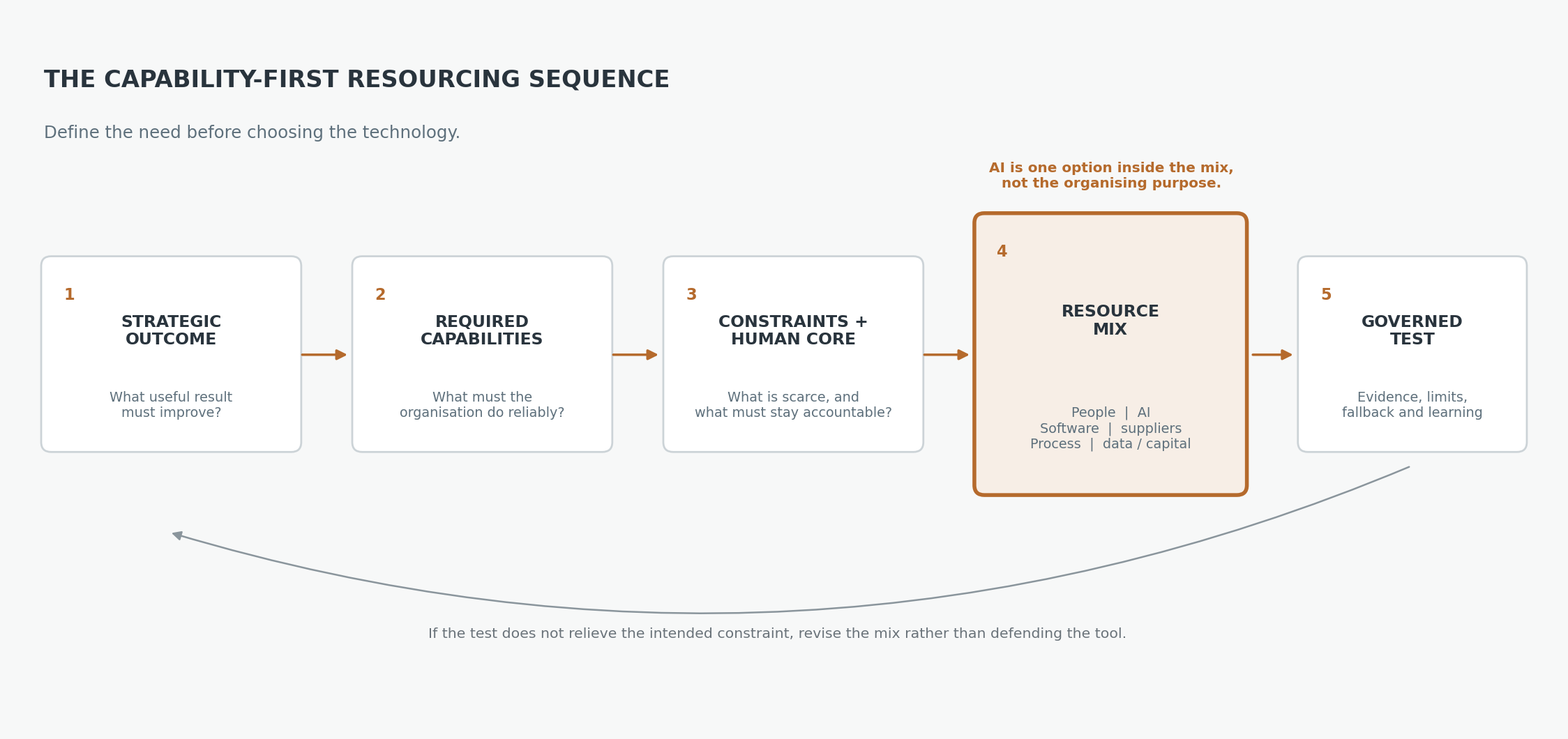
- Define the strategic outcome: what useful result must improve?
- Identify the required capabilities: what must the organisation do reliably?
- Locate constraints and the human core: what is scarce, and what must stay accountable?
- Compare the resource mix: people, AI, software, suppliers, process, data and capital.
- Run a governed test with evidence, limits, fallback and learning. If it does not relieve the intended constraint, revise the mix.
The Capability-First Resourcing Test
Before approving an AI pilot, a new post, a software purchase or an outsourcing decision, take the proposed work through these seven questions.
On a narrow screen, each test is shown as a separate card.
| Test | Question | What the answer should expose |
|---|---|---|
| 1. Outcome | What useful result must improve? | The organisational purpose and the baseline, before any technology is chosen. |
| 2. Capability | What must the organisation be able to do reliably? | The ability required, stated without assuming a job title, supplier or tool. |
| 3. Work | Which tasks, judgements and interactions produce that result? | Where AI may assist, where work must be redesigned and where human input remains essential. |
| 4. Constraint | What is scarce, slow, costly, fragile or risky? | The real bottleneck. Faster activity elsewhere is not automatically useful capacity. |
| 5. Human core | What requires accountable judgement, trust, tacit knowledge, relationship or physical action? | The work that should not be handed away merely because a model can produce an answer. |
| 6. Resource mix | Should the capability be trained, hired, bought, AI-assisted, outsourced, redesigned or stopped? | A comparison of options and dependencies rather than an AI use-case hunt. |
| 7. Evidence | How will we know the new mix is better? | Success measures, failure limits, review burden, fallback and the evidence required before scale. |
The practical action is simple: map first, test narrowly, measure the whole workflow and scale only when the intended constraint actually moves.
So, is resourcing the best place to start?
Yes, if resourcing is understood as the management lens through which the organisation assembles capability. No, if it means choosing a department called Resourcing as the default pilot, or handing consequential resource-allocation decisions to an AI system.
Every formal AI initiative should pass through this lens even if the first practical project sits in research, service delivery, finance, marketing, procurement or operations. It forces leaders to define the outcome, work, constraint, human core and evidence before a vendor demonstration makes the choices look obvious.
It also avoids a false choice between a complete enterprise AI strategy and no strategy at all. Organisational strategy tells you which capabilities matter. A minimum AI operating frame tells you how the technology may be used responsibly. A bounded pilot tells you whether the proposed mix works. The wider strategy can then grow from evidence rather than aspiration.
The best starting point is not a department. It is a better resourcing question.
AI belongs in the answer, not at the beginning
AI is changing what it means to resource a business because it can now supply fragments of capability that once arrived only through headcount, software or specialist suppliers. But those fragments do not assemble themselves into an organisation.
Leaders still have to decide what matters, where human responsibility must remain, how capability fits the workflow, what trade-offs are acceptable and how success will be recognised.
The mature question is therefore not, “Where can we use AI?” It is:
Organisations that answer that well may find AI in the solution. They will be less likely to mistake AI for the strategy.
Sources and evidence
All five primary source destinations were rechecked 31 October 2026. The ILO aggregation-paradox brief is dated 6 May 2026 on the publisher’s live record, correcting the April date in the approved Word source. OECD percentages refer to surveyed SMEs using generative AI, not to every firm or to causal deployment effects.
Source posture: This is a management argument, not a forecast of headcount or a claim that one resource mix is always best. The UK Government playbook is public-sector guidance used here for cross-sector decision logic. The 120-person proposal-team vignette, five-stage sequence and seven-question test are editorial devices, not empirical case studies or validated assessment instruments.
- UK Government, Artificial Intelligence Playbook for the UK Government, published 10 February 2025. See “Identifying use cases for AI”, “Creating the AI support structure” and “AI business cases”. UK Government AI Playbook Official public-sector guidance; used here for cross-sector decision logic, not as legal or procurement advice. Read source.
- International Labour Organization and NASK, Generative AI and Jobs: A Refined Global Index of Occupational Exposure, Working Paper 140, 20 May 2025. ILO Working Paper 140 Task-based occupational exposure research; supports transformation as the more likely broad effect than complete job automation. Read source.
- OECD, Generative AI and the SME Workforce: New Survey Evidence, 5 November 2025, DOI 10.1787/2d08b99d-en. OECD report Representative late-2024 survey of more than 5,000 SMEs in seven countries. Results are self-reported and not causal estimates. Read source.
- Cheuk Yu Cheryl Chan and Khatia Shedania, The Aggregation Paradox of AI: Why do micro-economic productivity gains from AI disappear at scale, ILO Research Brief, published 6 May 2026. ILO aggregation-paradox brief Used for the distinction between task-level gains and organisation-wide value, and the need for complementary investment and work redesign. Read source.
- Stanford Institute for Human-Centered Artificial Intelligence, The 2026 AI Index Report, Economy chapter. Stanford AI Index 2026: Economy Independent synthesis; used for the work-shape qualification that reported gains are strongest where outputs are structured, measurable and monitorable. Read source.