
The AI workflow maturity test
Six questions expose the organisational work a successful AI demonstration can leave out. This is an editorial decision aid, not a maturity certification.
This paper explains why widespread AI use can coexist with weak organisational results, and offers a practical test for moving one workflow from isolated assistance to reliable capability.
The piano problem
Give every employee a piano and you still do not have an orchestra.
You may have excellent instruments. Some people may become impressive players. A few may discover faster ways to perform familiar passages. But an orchestra requires more: a shared score, agreed timing, listening, rehearsal, leadership and a way to recover when someone comes in at the wrong moment.
Now substitute AI assistants for pianos. Tool access can spread quickly because it is easy to buy, easy to demonstrate and increasingly easy for employees to obtain without waiting for a formal programme. Organisational capability develops more slowly because work has to be redesigned around the tool.
That difference is the AI workflow maturity gap. It is the distance between people using AI and the organisation being able to produce a better result reliably because AI is part of the way work is done.
The gap is visible in current survey evidence. McKinsey's 2025 global survey found that 88 per cent of respondents said their organisations regularly used AI in at least one business function. Yet only 39 per cent attributed any enterprise-level EBIT impact to AI, and about 6 per cent met the survey's stricter definition of an AI high performer. The categories are not a conversion funnel, but the contrast is revealing: use is common; material enterprise value is not. 1
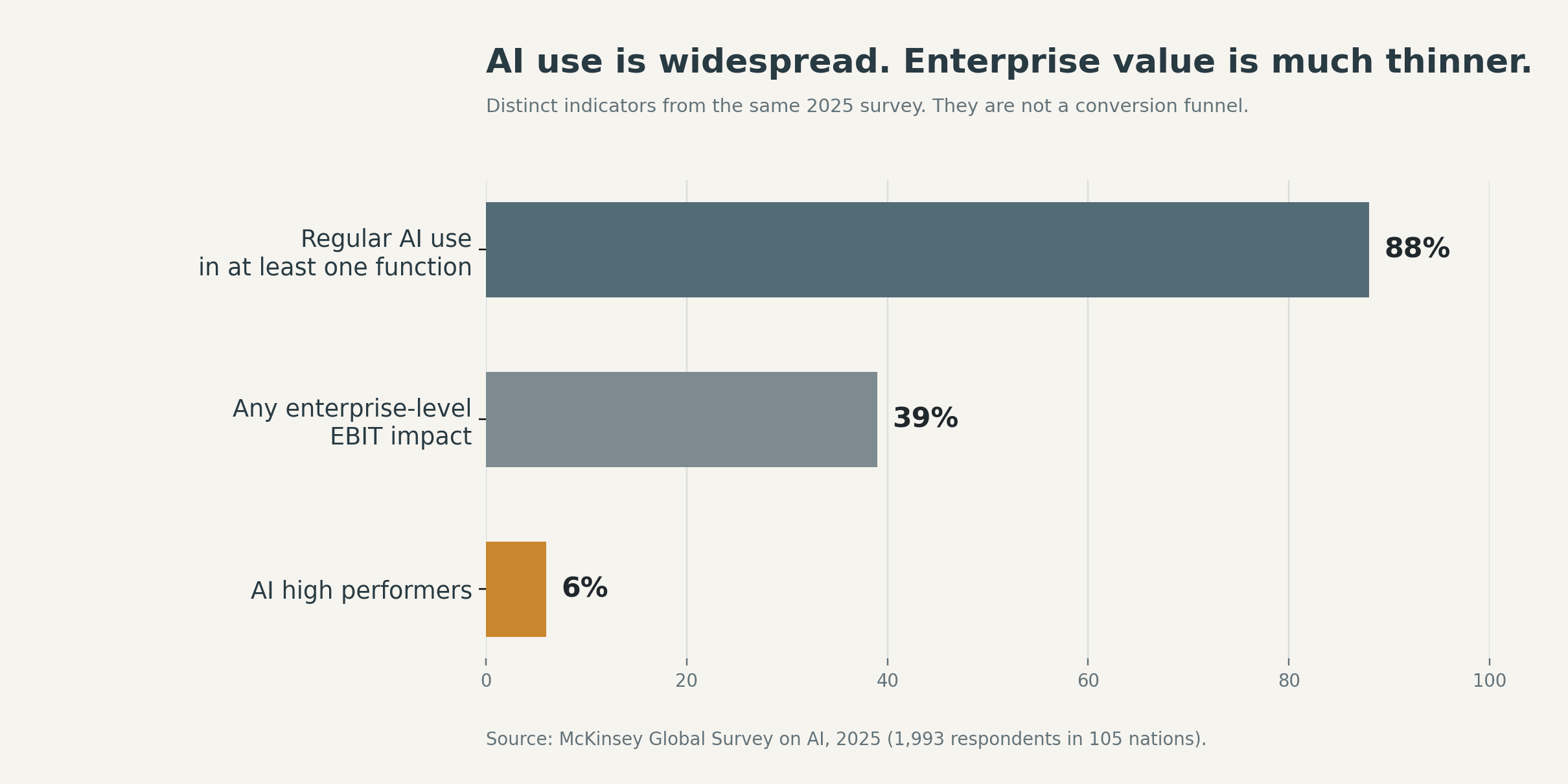
Read Figure 1 as text
- Regular AI use in at least one business function: 88%.
- Any enterprise-level EBIT impact attributed to AI: 39%.
- AI high performers under McKinsey's stricter definition: about 6%.
These are separate self-reported measures, not stages of one conversion funnel.
Access is the beginning, not the achievement
Tool access matters. It creates option value, helps people learn and allows useful local improvements to appear. The mistake is treating those early signs as proof that the organisation has matured.
A licence count measures availability. A prompt library records activity. A demonstration shows that a bounded task can be performed. None of those facts establishes that the surrounding workflow is faster, safer, more distinctive or more valuable from beginning to end.
Gartner's 2026 survey of 401 CMOs and marketing leaders illustrates the same tension within one business function. Seventy per cent said becoming an AI leader was a critical goal, but only 30 per cent reported mature or fully developed readiness. Seventy per cent also said their internal processes were not mature enough to implement and scale AI effectively. 2
This does not mean the tools have failed. It means the work of adoption and the work of integration are different. Adoption can happen person by person. Integration requires the organisation to coordinate people, information, decisions and consequences.
AI can succeed while the workflow fails
Imagine a sales team using AI to prepare proposals. The first draft that once took three hours now takes twenty minutes. The result looks impressive, and the time saving is real.
Then the draft enters the organisation. Someone checks whether the product details are current. A specialist rewrites an overconfident claim. Legal reviews a clause copied from an old bid. The account director notices that the language contradicts a promise made in yesterday's meeting. The proposal is faster to produce, but the review queue grows and the most experienced people become the final defence against context the system never received.
The visible task improved. The workflow may not have improved at all.
This is why a workflow is not merely a chain of prompts. Real work includes informal hand-offs, exceptions, relationship knowledge, local definitions of quality and practical judgement that may never have appeared in the process map. The formal procedure is evidence about the work, not the whole of the work.
A 2026 qualitative study of newsroom managers, editors and journalists in China found frequent individual use of generative AI but weak connection to shared team workflows. The study is small and specific, so it should not be universalised. Its mechanism is nevertheless useful: individual productivity does not automatically become collective capability. Shared routines, disclosure, coordination and learning have to be created. 3
NIST's voluntary AI Risk Management Framework approaches the issue from risk rather than productivity, but reaches a compatible systems conclusion. It emphasises clear roles, deployment context, input from domain experts and end users, feedback, monitoring and the ability to disengage systems whose outcomes do not match their intended use. 4
Four levels of workflow maturity
Workflow maturity is best treated as a progression in operating reality, not a score awarded for owning sophisticated technology. The following four levels are an Andrew's Intel editorial framework, not a validated assessment instrument.
Tool access
People can use AI. Activity and examples are visible; practice remains personal and uneven.
Bounded assistance
Defined tasks improve repeatedly. Local quality, time and cost can be measured.
Integrated workflow
Context, hand-offs, review and ownership work across the complete journey.
Adaptive capability
Evidence changes the work. Roles are redesigned and scale remains accountable.
1. Tool access
People can use AI, often through general assistants or features inside existing software. Success is demonstrated by examples, enthusiasm, time saved and output volume. Practice is personal and uneven. If a skilled user leaves, much of the capability may leave with them.
2. Bounded assistance
AI is used repeatedly for defined tasks such as summarising calls, drafting standard material, researching accounts or classifying enquiries. Inputs, review expectations and approved tools begin to stabilise. Local measures can show whether the task is faster or better, although the rest of the workflow may remain unchanged.
3. Integrated workflow
AI becomes part of an end-to-end process. Relevant context reaches the system; outputs arrive where decisions are made; exceptions and fallbacks are designed; human authority is explicit; and the complete outcome is measured. The organisation can repeat the result without depending on one unusually fluent individual.
4. Adaptive capability
Evidence from use changes the workflow. Overrides, complaints, errors and successful exceptions become learning signals. Roles, resources and decision rights are redesigned around what the combined human-AI system can now do. Scale follows evidence, and accountability remains visible.
The levels describe a profile, not a flattering average. A workflow with excellent automation but weak data, unclear authority or no learning loop is constrained by the weakness. A stronger model cannot automatically compensate for a missing organisational condition.
The hidden work moves rather than disappears
AI often removes work from the most visible stage and creates work elsewhere. Drafting shrinks while checking expands. Research accelerates while source verification becomes more important. An automated recommendation appears instantly, but someone must decide when it can be trusted, challenged or ignored.
This hidden work is easy to miss because it is dispersed among experienced staff. Ten minutes added to six reviewers may be less visible than two hours removed from one producer. The organisation celebrates the saved production time while the people carrying the verification burden feel the tempo rising.
The orchestra analogy helps again. A faster pianist does not necessarily make the performance finish sooner. If the rest of the ensemble cannot follow, speed becomes noise. The useful question is not how fast one component can play, but whether the whole system performs better together.
A conceptual model developed by Panagiotis Theodorou and Petros Theodorou for AI-enabled energy procurement expresses the same idea mathematically: technology, strategy, organisational readiness and external conditions interact. Andrew's Intel's broader interpretation is that AI value behaves like a weakest-link problem. Once the tool is capable enough, the next pound may be better spent on context, workflow, ownership or evidence than on another increment of model performance. The authors call for empirical validation, so the model is a lens rather than a settled law. 5
The AI workflow maturity test
Before scaling a pilot, ask six questions. The purpose is not to certify maturity. It is to expose the organisational work that a successful demonstration can leave out.
- Outcome: What useful result must improve?
Name the customer, operational or commercial outcome, its baseline, the trade-offs and the person who owns it. Faster output is not enough if the downstream result does not change.
- Real workflow: What actually happens from trigger to outcome?
Map hand-offs, workarounds, unofficial sequences and the points where people repair the formal process. Observe the work before automating its documented version.
- Context: What do experienced people know that the system cannot currently see?
Identify data gaps, relationship knowledge, tacit cues and local assumptions. Decide what should be encoded, what should be tested and what must remain with an accountable person.
- Exceptions and quality: What breaks the normal pattern, and how will failure be contained?
Test awkward and high-consequence cases. Define review thresholds, escalation, override and a workable non-AI fallback before scale.
- Authority and workload: Who may accept, challenge or stop the output, and whose work changes?
Make decision rights explicit. Count checking and coordination as part of the cost. Align incentives so the people carrying the quality burden are not punished for slowing an unsafe process.
- Learning: How will field evidence change the workflow?
Record errors, overrides, complaints and near misses. Set a review point and name who may scale, modify, pause or retire the system. Integration continues after launch.
The next credible move
Do not begin by trying to make the whole organisation more mature. Choose one consequential workflow with enough volume or importance to justify attention.
- Define the outcome and the current baseline before discussing the model.
- Map the real workflow with an AI-fluent builder and an experienced operator together.
- Use a bounded pilot to test the complete journey, including review time, exceptions and downstream effects.
- Name an integration owner with authority to connect capability, operational reality and accountable decisions.
- Review after a fixed period. Scale only what has earned transfer through repeatable evidence.
This is deliberately less dramatic than an enterprise transformation announcement. It is also more likely to produce knowledge the organisation can use. A pilot should not merely prove that AI can perform a task. It should reveal what the organisation must change to make the result dependable.
The maturity gap closes when AI stops being a collection of impressive solo performances and becomes part of a work system that people can understand, repeat and improve.
The question for leaders is therefore no longer, 'How much AI do we have?' It is, 'What can this organisation now do reliably because AI is inside the workflow?'
Sources and evidence
The 2025 McKinsey figures are retained as a dated snapshot and linked to that exact report, rather than the publisher's generic URL, which now opens the 2026 survey. The later wave is noted separately. Gartner is commercial analyst research; the newsroom study is a bounded 27-interview qualitative study; NIST is voluntary guidance.
Source posture: This is an evidence-led editorial briefing, not an academic paper or proprietary market census. The maturity ladder and six-question test are Andrew's Intel synthesis, not validated assessment instruments. The energy-procurement model is conceptual and requires empirical validation; no cross-sector law is inferred from it.
- McKinsey & Company, 'The state of AI in 2025: Agents, innovation, and transformation', 5 November 2025. Global survey of 1,993 respondents in 105 nations. Source Self-reported organisational indicators. The three percentages in Figure 1 are distinct measures and are not treated as a funnel. Read source.
- Gartner, 'Gartner 2026 CMO Spend Survey Finds CMOs Allocate 15.3% of Marketing Budgets to AI, But Only 30% Are Ready to Scale AI Capabilities', 11 May 2026. Survey of 401 CMOs and marketing leaders. Source Commercial analyst research with a large-enterprise skew, used as a directional readiness signal. Read source.
- Qing Xiao, Qing Hu, Jingjia Xiao, Hancheng Cao and Hong Shen, 'Can GenAI Move from Individual Use to Collaborative Work?', Proceedings of CHI 2026. DOI 10.1145/3772318.3790984. Source Qualitative study of 27 newsroom managers, editors and journalists in China; used as a bounded mechanism example. Read source.
- National Institute of Standards and Technology, Artificial Intelligence Risk Management Framework (AI RMF 1.0), NIST AI 100-1, January 2023; and Generative AI Profile, NIST AI 600-1, July 2024. Source Voluntary risk-management guidance, not a legal standard or maturity certification. Read source.
- Panagiotis Theodorou and Petros Theodorou, 'Artificial intelligence for strategic procurement in energy firms: a modeling framework', Academia Green Energy 3, 2026. DOI 10.20935/AcadEnergy8202. Source Conceptual model requiring empirical validation. The wider weakest-link interpretation is Andrew's Intel analysis. Read source.
- Michael Polanyi, The Tacit Dimension, originally published 1966; University of Chicago Press edition, 2009. Used for the established concept that important knowledge may be carried in practice and experience rather than fully stated as rules. Read source.
- McKinsey & Company, The state of AI in 2026: On the road to ROI, 25 August 2026. Separate later survey wave: 37% of respondents attributed some enterprise-level EBIT impact to AI and about 6% met its high-performer definition. It is not substituted into the dated 2025 figure.