
AI ethics reality test
Six operating levels trace a declared value to evidence, assurance and accountability; eight questions put the test to work.
The policy that cannot answer the meeting
Consider a familiar, hypothetical scene. A professional-services firm is preparing to deploy an AI assistant that can read client files, draft advice, update internal records and, eventually, carry out routine follow-up actions. The organisation already has a responsible-AI policy. It promises fairness, transparency, privacy, human oversight and accountability.
The procurement meeting starts well. The supplier demonstrates the system. The legal team recognises the policy language. The technology lead describes a controlled pilot. Then the practical questions begin: Who owns an incorrect recommendation? What may the assistant send externally? Which client files can it access? How will exceptions be logged? Who decides when human review is mandatory? What happens after a model update? Who has the authority to stop the system?
The policy contains admirable values. It cannot answer the meeting.
That gap explains both how far AI ethics has travelled since 2018 and why the problem remains unsolved. The field has moved from aspiration to infrastructure. Ethical principles have become standards, management systems, impact assessments, audit rules and legal obligations. Yet none of those instruments can substitute for an organisation that is willing and able to make difficult choices.
A paper from another AI age
John C. Havens’s 2018 paper, “Creating the Human Standard for Ethical Autonomous and Intelligent Systems”, is useful because it freezes the argument at an important moment. Havens recalled that, when he looked for formal AI ethics codes in 2014, interviewees repeatedly referred him to Isaac Asimov’s fictional laws of robotics. By 2018, IEEE’s Global Initiative on Ethics of Autonomous and Intelligent Systems was trying to replace that shorthand with something institutional: a globally informed body of guidance, a consensus process and a family of technical standards.[1]
The paper describes two connected outputs. The first was Ethically Aligned Design, then in its second draft, which sought to place human wellbeing and ethical values inside the design of autonomous and intelligent systems. The second was the P7000 series: thirteen standards projects covering ethical design processes, transparency, privacy, algorithmic bias, data governance, fail-safe design, wellbeing, trustworthy news and machine-readable privacy terms.[1]
It also records an early correction to the field’s confidence. Feedback from outside the United States and Europe challenged the idea that a largely Western expert group could define ethics in one sweep. IEEE widened participation and kept its recommendations explicitly provisional. That concern remains important: a “human standard” is not automatically universal merely because it has been written in global language.[1]
The article is not evidence that the programme produced ethical outcomes. It is partly an institutional progress report, written by the initiative’s executive director. Its value is historical. It shows the point at which AI ethics began to acquire machinery.
From principles to governance infrastructure
The path was neither linear nor uniform. Some instruments are voluntary; others are standards, management systems, regulatory duties or treaty obligations. Their scopes differ. Taken together, however, they show a clear migration from statements of value towards processes that organisations can implement, document, assess and, increasingly, be required to defend.
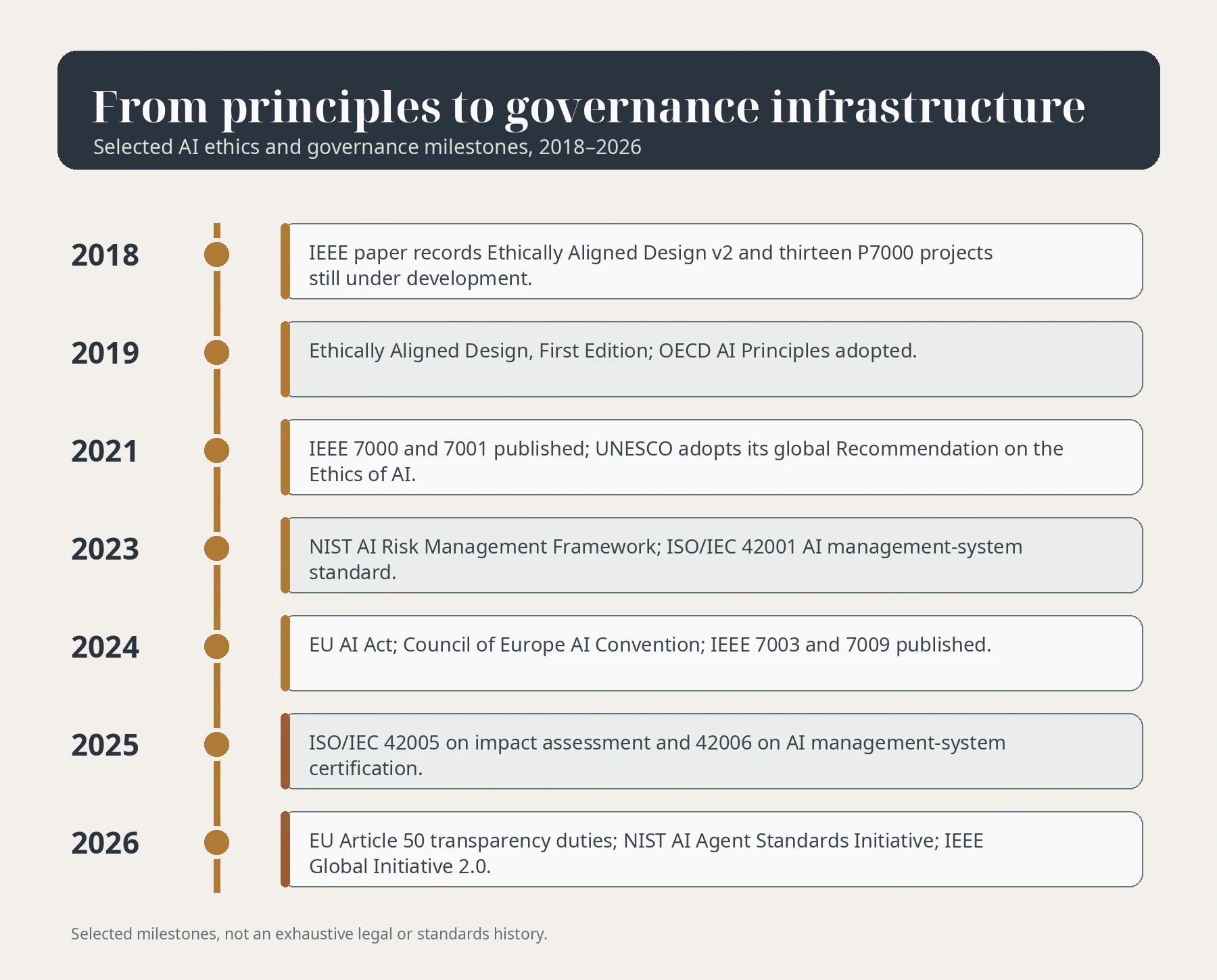
- 2018: IEEE paper records Ethically Aligned Design v2 and thirteen P7000 projects under development.
- 2019: IEEE publishes Ethically Aligned Design; OECD adopts AI Principles.
- 2021: IEEE 7000 and 7001 are published; UNESCO adopts its AI ethics recommendation.
- 2023: NIST AI Risk Management Framework and ISO/IEC 42001 AI management-system standard.
- 2024: EU AI Act and Council of Europe AI Convention; IEEE 7003 and 7009 published.
- 2025: ISO/IEC 42005 on impact assessment and 42006 on certification bodies.
- 2026: EU Article 50 transparency duties; NIST AI Agent Standards Initiative; IEEE Global Initiative 2.0.
In 2019, IEEE published the first edition of Ethically Aligned Design. In the same year, the OECD adopted the first intergovernmental AI principles, later updated in 2024. Research mapping 84 ethics guidelines found convergence around transparency, fairness, avoiding harm, responsibility and privacy, but substantial disagreement about what those principles meant and how they should be implemented.[2,3,4]
By 2021, IEEE 7000 had turned the broad idea of ethics-by-design into a traceable systems process: elicit stakeholder values, prioritise them, express them as requirements and carry them into design decisions. UNESCO’s Recommendation on the Ethics of Artificial Intelligence placed human rights, dignity, fairness, environmental concerns, oversight, impact assessment, auditability and traceability inside a global policy instrument.[6,7]
In 2023, NIST’s AI Risk Management Framework offered organisations a voluntary way to govern, map, measure and manage AI risk. ISO/IEC 42001 established an organisation-wide AI management system built around policies, objectives, processes, risk treatment and continual improvement.[8,9]
The legal layer strengthened in 2024. The EU AI Act entered into force, establishing a risk-based regulatory framework. The Council of Europe opened the first international legally binding AI treaty for signature, tying lifecycle activities to human rights, democracy and the rule of law. IEEE also completed standards on algorithmic bias and fail-safe design that had appeared only as projects in the 2018 paper.[10,13,17]
In 2025, ISO/IEC 42005 added guidance for AI system impact assessments across the lifecycle. ISO/IEC 42006 addressed the competence and consistency of bodies auditing and certifying AI management systems. The chain now extended from principle, to internal management, to impact evidence, to external assurance.[11,12]
By 2026, the field had begun adapting to generative and agentic AI. IEEE launched a second phase of its global initiative, NIST launched an AI Agent Standards Initiative, and IEEE approved P7022 to develop requirements and evaluation criteria for trustworthy generative and agentic AI in enterprise applications.[19,20,21]
What this infrastructure genuinely achieves
It is easy to dismiss governance as paperwork, particularly when organisations use it badly. That would miss what has changed. The new infrastructure gives different parts of an organisation a shared language and a sequence of work.
A board can ask for risk appetite and accountability. A product team can translate values into requirements. Procurement can demand evidence from suppliers. Legal and compliance teams can identify applicable duties. Internal audit can test whether controls exist and operate. Users and affected people can be given routes to challenge decisions. Regulators can ask for records rather than declarations of good intent.
The change is visible in the architecture of the frameworks themselves. IEEE 7000 asks organisations to trace ethical values into design. NIST treats governance as a cross-cutting function rather than a final approval step. ISO/IEC 42001 embeds AI in an ongoing management system. ISO/IEC 42005 expects impacts to be assessed and updated through the lifecycle. ISO/IEC 42006 recognises that even the auditors need specialised competence.[6,8,9,11,12]
This is more than the multiplication of acronyms. It creates interfaces between people who previously discussed AI in incompatible ways. “Fairness” can become a documented objective. “Human oversight” can become a defined intervention point. “Accountability” can become a named role with stop authority. “Transparency” can become records, notices, explanations and audit trails.
A standard is not an ethical outcome
The central caution was articulated early. Brent Mittelstadt argued in 2019 that principles alone could not guarantee ethical AI because the field lacked the shared professional aims, established norms, proven translation methods and accountability mechanisms found in mature professions such as medicine. The subsequent growth of standards and law addresses parts of that criticism. It does not remove it.[5]
A management system can establish that an organisation has a process. An impact assessment can identify foreseeable effects. An audit can test conformance against specified requirements. A regulator can enforce defined obligations. None of these instruments can prove that every value choice was wise, that every affected group was represented, or that a formally compliant outcome is substantively fair.
Conformance and ethics overlap, but they are not identical. Conformance asks whether a requirement has been met. Ethics asks whether the requirement, the trade-off and the resulting action are defensible. The first can be tested against a specification. The second depends on context, evidence, power and judgement.
Ethics is not a list of compatible virtues
High-level principles often look harmonious because the disagreement is hidden inside their application. Real systems force choices.
- Transparency and privacy: Explaining a system may require disclosure about data, logic or cases that must also be protected.
- Safety and autonomy: A control that prevents harmful actions may also limit legitimate user choice or exclude unusual but valid needs.
- Accuracy and fairness: A model can perform well on average while failing particular groups; different fairness measures can conflict with one another.
- Explainability and performance: The most interpretable method may not deliver the strongest performance, while a stronger model may be harder to inspect.
- Monitoring and dignity: Detailed monitoring may improve detection of misuse while creating surveillance of employees, customers or citizens.
- Human oversight and responsibility: Adding a human reviewer can create genuine control - or a ritual in which an overburdened person rubber-stamps machine output.
No universal checklist can decide these tensions without knowing the purpose of the system, who is affected, which rights and interests are at stake, what alternatives exist and who has authority to choose. Standards can structure the decision. They cannot make the moral and political disagreement disappear.
The hidden variable is organisational incentive
The hypothetical professional-services firm does not fail because nobody has heard of fairness or privacy. It fails when the operating incentives contradict the policy.
The product owner is rewarded for launch speed. Procurement is rewarded for price and contractual completion. The data team is measured on model performance. The commercial team has promised clients an efficiency gain. The governance function can advise, but cannot delay deployment. The supplier controls the information needed to assess the model. Everyone can point to a responsible-AI policy; nobody bears the cost of saying no.
Practitioner research has repeatedly found that responsible-AI work is hindered by weak accountability, poorly understood performance trade-offs and misaligned incentives. These are not peripheral “people problems”. They determine whether the technical and procedural controls survive contact with budgets, deadlines and internal politics.[18]
Ethics becomes operational only when it is connected to decision rights. Who can require more evidence? Who can change the use case? Who can suspend deployment? Whose budget absorbs the cost of remediation? What happens to the manager who raises an inconvenient risk? If the answer is that everybody is responsible but nobody has authority, the governance system is decorative.
When governance becomes theatre
The growing infrastructure creates a second risk: organisations may learn to produce the appearance of control more quickly than they learn to govern.
A policy can be copied from a template. An impact assessment can be completed after the design is effectively fixed. A human-oversight box can be ticked without giving the reviewer time, information or authority. A model card can document limitations that users never see. An audit can confirm that a management system exists while the most consequential decisions sit outside its scope.
This does not make certification, audit or documentation useless. It makes their boundaries important. Assurance should answer a precise question: which controls, for which system and use case, were tested against which criteria, at what time, with what evidence? A certificate is not a moral warranty. An impact assessment is not a permission slip. A risk register is not risk treatment.
The most useful governance therefore remains contestable. It records why choices were made, who made them, what evidence was considered, what uncertainty remained and how an affected person can challenge the result. It also assumes that the system will change. Data shifts, models are updated, suppliers alter services, employees invent new uses and the environment moves. Governance must continue after the launch meeting.
Agentic AI changes the unit of risk
Earlier AI governance often centred on predictions, classifications and recommendations. Generative AI added the production of text, images, code and other content. Agentic systems extend the problem again because they can plan, call tools, access internal data and carry out actions on behalf of a user or organisation.
NIST’s 2026 AI Agent Standards Initiative focuses on agents that act autonomously, interact with external systems and operate securely on behalf of users. IEEE’s P7022 project similarly targets the trustworthiness of generative and agentic AI in enterprise applications. These initiatives are early, but the direction is clear: identity, interoperability, security and authority are becoming ethical-governance questions as well as technical ones.[19,20]
The practical questions change. Which identity does the agent use? Which credentials can it inherit? What may it purchase, publish, delete, approve or commit? What actions require a second person? How are chains of tools and sub-agents recorded? Can an action be reversed? What happens when the model or a connected service changes? Who is accountable when no individual intended the final sequence of actions?
The unit of governance is no longer only the model. It is the whole delegated-action system: model, instructions, data, tools, permissions, interfaces, supplier dependencies, monitoring, escalation and the human authority that surrounds it.
The AI ethics reality test
Decision-makers do not need another statement of values. They need a way to test whether those values have travelled far enough into the operating system of the organisation. The following six-level test is deliberately simple. It is not a substitute for legal, technical or sector-specific assessment. It is a fast way to expose where ethical language stops.
| Level | Operating question | What it requires |
|---|---|---|
| Principle | What values have we declared? | State the values and interests that matter. Avoid generic language where the actual decision depends on a particular right, stakeholder or harm. |
| Policy | What decisions do those values constrain? | Define what those values permit, prohibit or require. A value that never constrains a decision is not yet a policy. |
| Process | Where are they built into design, procurement, deployment and use? | Place the requirement inside design, procurement, approval, deployment, monitoring, incident response and retirement. Make the intervention point visible. |
| Evidence | What records show the process was followed and controls applied? | Keep records that show what was tested, which trade-offs were considered, who approved the choice and what limitations remain. |
| Assurance | Who tests whether controls continue to work after deployment and change? | Test whether the controls operate in practice and continue to operate after changes in models, data, suppliers, users and context. |
| Accountability | Who can stop the system and answer when it causes harm? | Name the person or body that can stop the system, require remediation and answer to affected people, senior leadership and regulators. |
Andrew's Intel decision aid; not a legal, certification or technical standard.
The firm in the opening vignette begins to look different when it passes through this test. “Human oversight” becomes a defined review point before external communication. Privacy becomes scoped access to named data repositories. Accountability becomes a service owner with suspension authority. Evidence becomes test results, approval records, logs and incident data. Assurance becomes retesting after model and workflow changes. The organisation has not solved ethics, but it has made its choices visible and answerable.
Eight questions for the next AI governance meeting
These questions are intended for leaders, procurement teams, governance functions, developers and suppliers. Strong answers should be specific to the system and use case. General statements about “responsible AI” are not answers.
- What decision or action is the system actually influencing? Name the operational consequence, not merely the model feature. Include content, recommendations, approvals, transactions and delegated actions.
- Who benefits, who bears the risk, and who is missing from the room? Identify affected groups, indirect effects and people who may have little power to challenge the system.
- Which value trade-offs have been made explicitly? Ask where transparency, privacy, safety, autonomy, performance, fairness and cost conflict - and who approved the balance.
- What evidence supports the claims being made? Separate demonstrations, benchmarks, supplier assertions, controlled tests and live operational evidence. Record what remains uncertain.
- Where does human judgement remain necessary, and is it real? Define the reviewer’s information, time, skill, authority and escalation route. A nominal human in the loop can be weaker than an honest automated process.
- What authority and permissions does the system possess? For agentic systems, include identities, credentials, spending limits, external communication, tool access and irreversible actions.
- How will we know when the system or context has changed? Specify monitoring, incident thresholds, model-update review, drift detection, user complaints, audit logs and reassessment triggers.
- Who can stop it, and who answers afterwards? Name the accountable owner, suspension mechanism, remediation budget, redress route and reporting obligation.
What leaders should take from the last eight years
First, stop treating an ethics policy as the governance system. It is the top layer. The value lies in the chain beneath it.
Second, demand traceability. A decision-maker should be able to follow a material ethical concern from the affected stakeholder, through the requirement and control, to the evidence and accountable owner.
Third, distinguish certification from outcome. External assurance can improve discipline and trust, but its scope and criteria must be understood. Ask what was tested and what was not.
Fourth, treat incentives as part of the control environment. Governance will fail when the people expected to raise concerns are penalised for delaying delivery, while those who create risk keep the upside.
Fifth, widen the boundary for agentic AI. Governance must cover permissions, identities, tools, external actions, inter-agent interactions, reversibility and continuing monitoring - not only the model’s output quality.
Finally, preserve judgement. The purpose of standards is not to remove human responsibility. It is to make responsible decisions more structured, visible, repeatable and challengeable.
From aspiration to proof
The optimism in the 2018 IEEE paper now looks both justified and incomplete. Its authors believed AI ethics needed more than fictional laws and public anxiety. They were right. The work helped create a standards programme that has since produced operational methods for ethical design, transparency, privacy, bias, fail-safe behaviour and other concerns. Around it, a much larger governance ecosystem has emerged.
The difficult question has moved. In 2018 it was: can ethical values be placed inside the design of intelligent systems? In 2026 it is: can an organisation prove that those values change real decisions - including when the ethical choice is slower, more expensive, less convenient or commercially awkward?
The next phase will be judged less by the number of principles published than by the quality of the evidence, the honesty of the trade-offs, the strength of challenge and redress, and the clarity of human accountability. For agentic systems, it will also be judged by the discipline with which authority is delegated and withdrawn.
We have not solved ethical AI. We have industrialised the attempt. That is genuine progress - provided the machinery changes behaviour rather than merely documenting it.
Sources and evidence
The historical IEEE paper is treated as an account of ambitions, not proof of ethical outcomes. Standards and institutional material are distinguished from peer-reviewed research and Andrew's Intel editorial synthesis.
Source posture: This is decision support, not legal, compliance, certification or technical advice. The opening firm is hypothetical. The 2018 IEEE paper is a historical seed, not outcome evidence. Standards status and EU application dates were rechecked against the cited official sources on 31 October 2026; system-specific obligations and subsequent changes require fresh verification. The six-level reality test and eight meeting questions are editorial aids, not validated scales or formal standards.
- John C. Havens, “Creating the Human Standard for Ethical Autonomous and Intelligent Systems (A/IS)”, AI Matters, 4(1), 2018. Read source.
- IEEE, Ethically Aligned Design: A Vision for Prioritizing Human Well-being with Autonomous and Intelligent Systems, First Edition, 2019. Read source.
- OECD, AI Principles - adopted 2019 and updated 2024. Read source.
- Anna Jobin, Marcello Ienca and Effy Vayena, “The global landscape of AI ethics guidelines”, Nature Machine Intelligence, 2019. Read source.
- Brent Mittelstadt, “Principles alone cannot guarantee ethical AI”, Nature Machine Intelligence, 2019. Read source.
- IEEE 7000-2021, Standard Model Process for Addressing Ethical Concerns during System Design. Read source.
- UNESCO, Recommendation on the Ethics of Artificial Intelligence, adopted 2021. Read source.
- NIST, Artificial Intelligence Risk Management Framework (AI RMF 1.0), January 2023. Read source.
- ISO/IEC 42001:2023, Artificial intelligence - Management system. Read source.
- Council of Europe, Framework Convention on Artificial Intelligence and Human Rights, Democracy and the Rule of Law, opened for signature 5 September 2024. Read source.
- ISO/IEC 42005:2025, AI system impact assessment. Read source.
- ISO/IEC 42006:2025, Requirements for bodies providing audit and certification of AI management systems. Read source.
- European Commission, AI Act - application timeline and implementation. Read source.
- European Commission, “AI Omnibus enters into force”, 27 July 2026. Read source.
- European Commission, Code of Practice on Transparency of AI-generated Content - Article 50 obligations applicable from 2 August 2026. Read source.
- European Commission, Guidelines for providers of general-purpose AI models - enforcement powers from 2 August 2026. Read source.
- IEEE, Autonomous and Intelligent Systems standards portfolio, including the IEEE 7000 series. Read source.
- Bogdana Rakova, Jingying Yang, Henriette Cramer and Rumman Chowdhury, “Where Responsible AI Meets Reality”, Proceedings of the ACM on Human-Computer Interaction, 2021. Read source.
- NIST, “Announcing the AI Agent Standards Initiative for Interoperable and Secure Innovation”, 17 February 2026. Read source.
- IEEE P7022, Standard for Requirements and Evaluation Criteria for Trustworthy Generative and Agentic AI in Enterprise Applications, approved project, 2026. Read source.
- IEEE Global Initiative 2.0 on Ethics of Autonomous and Intelligent Systems. Read source.