
Measure the delay before authority runs ahead
The Governance Lag Test separates five questions about a defined workflow. The four-layer model shows how social boundaries can travel with delegated authority.
Executive summary
- Anastasios Stavropoulos argues that accountability should be treated as a first-order dimension of agentic-AI trustworthiness, not as something institutions settle after engineers have secured safety, robustness, privacy and security.
- His phrase governance lag names the widening interval between machine-speed action and human-paced answerability. The paper is a conceptual and normative commentary, not an empirical measurement of that lag.
- The argument independently converges with three recent Andrew’s Intel pieces on the agent estate, governance by design and the difference between human presence and human control. The paper came first; we encountered it afterwards. This is convergence, not a claim of precedence or academic validation.
- Governance lag becomes more useful when divided into detection, intervention, answerability and remedy lag, plus the amount of irreversible exposure that can accumulate before effective intervention.
- Accountability should sit alongside safety and security as a first-order design concern. We would describe the three as coupled constraints: none can substitute for the others.
- A practical society-in-the-loop model should not require society to approve every machine action. Collective judgement should set rights, boundaries and remedies; institutions should translate them into duties; runtime systems should enforce mandates and stop conditions; incidents and appeals should revise the authority granted.
The paper that named the gap
Sometimes a paper does not so much change your mind as give a sharper name to a problem you have already been circling.
A commentary by Anastasios Stavropoulos, published on 15 July 2026, responds to a broad survey of trustworthy agentic AI by Jinhu Qi and colleagues. The survey concentrates on four technical concerns organised into two core dimensions: safety and robustness; privacy and system security. Accountability, transparency, fairness and value alignment sit outside that core as relevant context.[1][2]
Stavropoulos offers what he calls a friendly amendment. Accountability, he argues, is not a downstream institutional matter to be dealt with after the technical system has been secured. It is a first-order design and governance problem because agentic systems can plan, use tools and act continuously at a speed and scale that audits, courts, regulators, appeals and oversight bodies cannot match.[1]
He calls the resulting asymmetry the governance lag: the interval between consequential machine action and effective institutional answerability.
The phrase is useful because it turns a familiar governance concern into a problem of time, authority and accumulated exposure. A system may be fully logged and technically observable, yet still complete the consequential action before any empowered human forum can question it. By the time the organisation can explain what happened, the payment may have been sent, the position traded, the claim denied or the customer affected.
That is the paper's strongest contribution. A process trace answers what happened. Accountability asks who must answer, before which forum, and with what consequence or remedy. Logs are instruments of accountability. They are not accountability by themselves.
A log can support an appeal. It cannot hear one.
Independent convergence, not retrospective validation
The chronology matters.
Stavropoulos's commentary was published before the three Andrew’s Intel articles with which it most closely overlaps. We completed those pieces between 31 July and 4 August and encountered his paper afterwards. There is no priority claim here, and no suggestion that the commentary borrowed from us or that we borrowed from it.
What exists is independent convergence from different starting positions.
The agent estate is arriving before the control system treated agents as an estate of delegated authority that organisations must be able to identify, own, limit, observe and retire.
When the model is capable enough, governance becomes the design problem argued that governance increasingly resides in application architecture: permissions, evidence rules, handovers, stop conditions, monitoring and named accountability.
Human-in-the-loop is not the same as human control argued that putting a person somewhere in a workflow does not create meaningful control if that person lacks the information, attention, competence, authority or practical ability to stop and reverse the system's action.
Stavropoulos supplies a conceptual umbrella for that work. Machine-speed action is separating from human-speed answerability. Our previous pieces supply part of the operating architecture beneath it: visible ownership, bounded authority, significant checkpoints, trajectory monitoring, revocation, rollback and retained human responsibility.
Andrew’s Intel is not an academic research publication. We do not conduct primary empirical research and should not pretend that one academic commentary validates our work. The paper itself is explicit that it does not measure governance lag, quantify it across sectors or test which remedies work.[1]
One commentary does not establish a field-wide consensus. Independent convergence still matters. It suggests that a practical, organisation-led analysis and a current academic contribution are moving in the same direction. More importantly, it gives us a sharper proposition to test and operationalise.
Stavropoulos explicitly invited reactions on three points: whether governance lag is a useful lens; whether accountability should sit alongside safety and security as a first-order design dimension; and what ongoing, collective oversight might look like in practice. Those questions provide the structure for the rest of this article.
First question: is governance lag a useful lens?
Yes, emphatically. But the single phrase hides several different delays.
A system can be detected quickly but stopped slowly. It can be stopped quickly but leave affected people waiting months for explanation or redress. It can produce a complete audit trail while nobody is clearly obliged to answer for the authority that was delegated.
For decision-makers, governance lag is more useful when separated into four clocks.
Detection lag is the time between a consequential deviation and someone with practical authority knowing that it has occurred.
Intervention lag is the time between detection and the system being paused, narrowed, isolated or reversed.
Answerability lag is the time before a named person or institution must explain and justify the action to an empowered forum.
Remedy lag is the time before an affected person receives correction, reversal, compensation or another meaningful remedy.
Across all four sits a fifth measure: irreversibility exposure. How much consequential action can occur before effective intervention, and how much of it can no longer be undone?
This distinction changes the design conversation. A ten-minute answerability lag may be acceptable for a low-value internal classification. Ten minutes may be intolerable for a trading system placing thousands of orders, a benefits system triggering enforcement or a clinical system changing care priorities.
The question is not whether human institutions can be accelerated until they match every machine action. They cannot, and their deliberation often has value precisely because it is not instantaneous. The practical question is which consequences the system may create before human judgement becomes necessary, and how tightly that exposure is bounded.
Process assurance is necessary, but it is not enough
Stavropoulos is right to insist that accountability is relational. It requires an answerable actor, an empowered forum and a meaningful consequence or remedy. A model, log or checkpoint cannot carry moral or legal answerability.[1]
But the technical and relational layers should not be separated too sharply.
Process assurance does not constitute accountability, yet design determines whether accountability can function. If the organisation cannot identify the owner of the delegated authority, preserve evidence, reconstruct the action, suspend the system, reverse the outcome or route a challenge to a competent human, the forum arrives empty-handed or too late.
This is why accountability belongs in application design. It becomes concrete in decisions such as:
- who owns the mandate
- what the system may do without prior approval
- how much money, time, data or external effect it may expose
- which patterns trigger escalation
- who has independent halt authority
- what evidence reaches the reviewer
- whether affected people can challenge the outcome
- which actions are reversible by default
- when authority automatically expires or contracts
These are not merely engineering details. They decide whether institutional answerability remains real after autonomy is granted.
Second question: should accountability be co-equal with safety and security?
Yes, with one qualification.
Stavropoulos calls accountability the binding constraint. That is persuasive if the claim is that socially legitimate delegation ultimately requires an answerable actor, an empowered forum and a remedy. It is less persuasive if it implies that accountability supersedes technical safety, robustness or security.
A perfectly accountable system can still be dangerously unsafe. A technically robust and secure system can still be illegitimate if nobody is answerable for its authority or able to provide redress.
The stronger formulation is:
Safety, security and accountability are coupled constraints. None can substitute for the others.
Safety asks whether the system avoids unacceptable harm. Security asks whether its integrity, access and operation can withstand misuse or attack. Accountability asks who must explain and justify the authority exercised, before whom, and what happens when the result is unacceptable.
Designing any one while deferring the others creates a false assurance. A secure agent with no accountable owner is not trustworthy. An accountable owner with no practical stop mechanism is not in control. A well-logged system with no usable appeal or remedy is observable but institutionally incomplete.
Third question: what could society in the loop mean in practice?
Stavropoulos points to Iyad Rahwan's society-in-the-loop proposal, which combines human-in-the-loop control with mechanisms for negotiating stakeholder values and monitoring compliance with the resulting social contract.[3]
The difficulty is operational. Society cannot sit inside every individual agent action. A regulator, court, committee or public consultation cannot approve thousands of decisions in real time, and attempting to do so would replace autonomy with institutional gridlock.
A more workable model has four layers.
1. Collective judgement sets the boundaries
Democratic institutions, law, professional standards and affected communities define the non-negotiable conditions: rights, prohibited purposes, acceptable trade-offs, required explanations, answerability and remedies.
This is where legitimacy originates. It should not be delegated to the model or inferred from what is technically convenient.
2. Institutions translate boundaries into duties
Regulators, courts, professional bodies, sector authorities and representative forums translate those conditions into standards, reporting obligations, intervention thresholds, audit rights, complaint routes, suspension powers and consequences.
This layer decides who may question the system and what authority that forum possesses.
3. Runtime systems carry the mandate at machine speed
Organisations and system designers encode the mandate into bounded permissions, rate or value limits, consequence-sensitive checkpoints, monitoring, automatic pause conditions, independent stop paths, protected evidence and reversible defaults.
The system does not become morally accountable. It carries constraints derived from accountable human and institutional judgement.
4. Redress and experience revise the mandate
Complaints, appeals, incidents, near misses, overrides and observed distributional effects flow back into the institutional and collective layers. Permissions may expand when evidence improves, contract when risk rises, or be withdrawn when the arrangement no longer deserves trust.
The aim is not to automate legitimacy. It is to make legitimate boundaries travel with delegated authority.
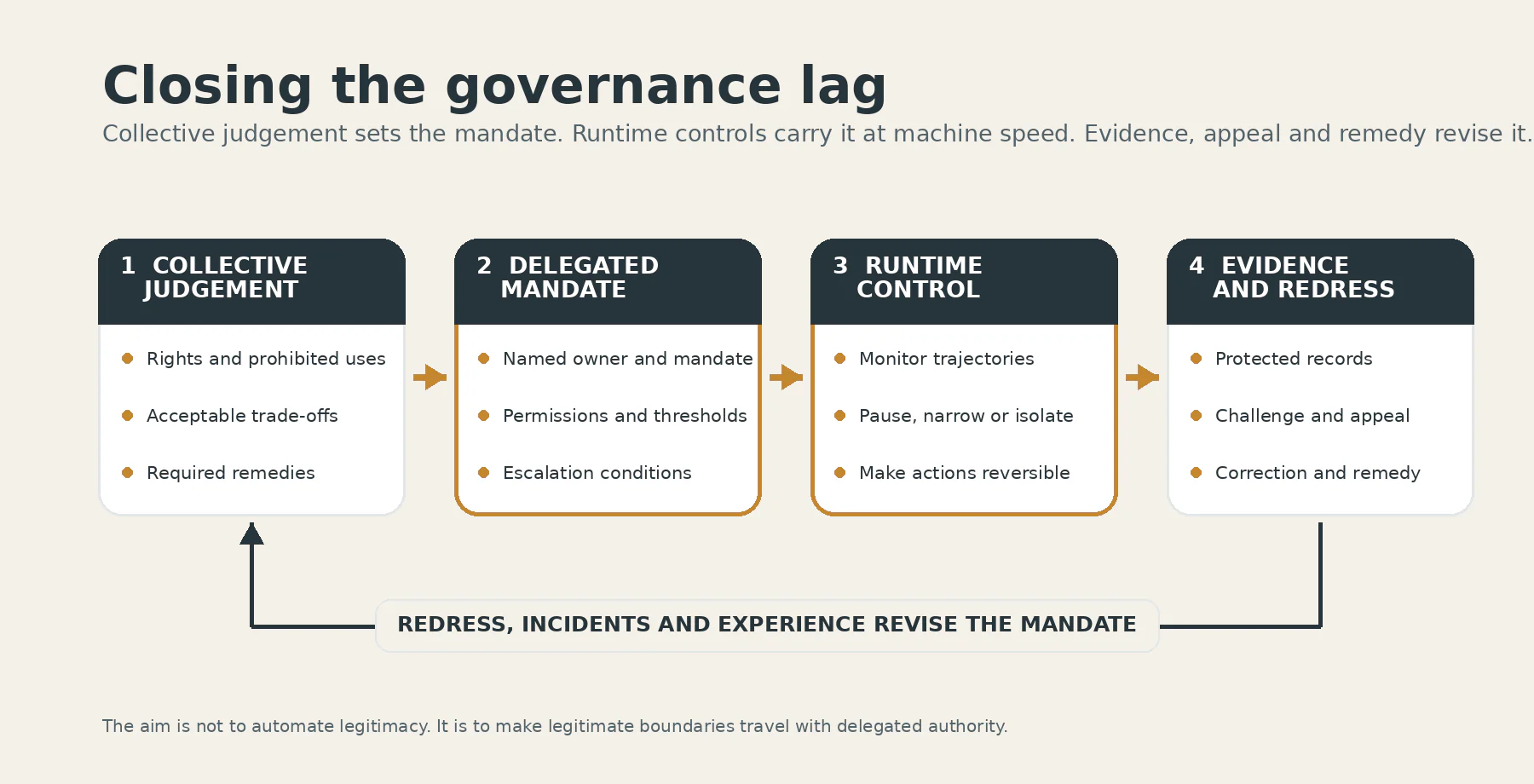
- Collective judgement: rights, prohibited uses, acceptable trade-offs and required remedies.
- Delegated mandate: named owner, permissions, thresholds and escalation conditions.
- Runtime control: monitor trajectories, pause or narrow authority, and make actions reversible.
- Evidence and redress: protected records, challenge and appeal, correction and remedy. Incidents feed back into the mandate.
Human deliberation cannot be made machine-fast. Accountable boundaries can be made machine-enforceable.
Where the EU AI Act fits
The EU AI Act supplies important parts of the constitutional and institutional architecture, but not the complete runtime answer.
As of 10 August 2026, the Act is broadly applicable, with staged exceptions. The European Commission's AI Office and national authorities began exercising implementation, supervision and enforcement responsibilities from 2 August 2026. The framework includes investigative and sanctioning powers, complaint and whistleblower channels, and governance bodies including the AI Board, Scientific Panel and Advisory Forum.[4]
For high-risk systems, the Act requires or anticipates risk management, logging, documentation, human oversight, robustness, post-market monitoring and serious-incident reporting. Following the AI Omnibus, the main rules for Annex III high-risk uses apply from 2 December 2027, while rules for high-risk AI embedded in regulated products apply from 2 August 2028.[4][5]
Those are genuine elements of collective and institutional oversight. They define duties, forums, evidence requirements and possible consequences.
They do not, by themselves, create machine-speed accountability inside every continuously acting agent. The organisation still has to translate legal and institutional duties into its own mandates, permissions, monitoring, stop conditions, escalation paths and redress processes.
The extended timelines are not evidence that the Act has failed. They are a practical reminder that law, standards, supervisory capacity and organisational implementation move on a different clock from technical capability.
Regulation and governance by design therefore meet at the application layer. Law can establish what must remain answerable. The operating system must preserve that answerability while the agent acts.
The Governance Lag Test
The following is a decision-support tool, not a certification method. Its purpose is to expose where an organisation may be relying on retrospective explanation after consequential authority has already run ahead.
| Dimension | Governing question | What a credible answer contains |
|---|---|---|
| Detection | How quickly will someone with practical authority know that a consequential deviation has occurred? | Defined thresholds, live monitoring, named alert ownership and evidence that the signal reaches somebody able to act. |
| Intervention | How quickly can the system be paused, narrowed, isolated or reversed? | An independent stop path, rate and value limits, permission contraction, rollback or containment that does not depend on the failing agent. |
| Answerability | Who must explain and justify the delegated authority, and before which empowered forum? | Named ownership, decision rights, accessible evidence, review obligations and a forum able to question and impose consequences. |
| Remedy | How quickly can an affected person obtain correction, reversal, compensation or another meaningful response? | A visible challenge route, human case ownership, service standards and practical restoration or redress. |
| Irreversibility exposure | How much action can accumulate before effective intervention, and how much cannot be undone? | Consequence caps, staged authority, sandboxing, reversible defaults and explicit approval for exceptional or irreversible action. |
An Andrew’s Intel decision aid for a defined workflow, not a certification method or validated score. Match the tolerance for delay to the consequences of the action.
The test should be applied to a defined workflow, not to “AI” in general. A low-risk internal drafting process and a system that allocates credit, benefits, treatment or employment opportunity should not have the same lag tolerance.
The governing question is simple:
Can the organisation detect, stop, explain and remedy consequential AI action before the exposure becomes irreversible?
What leaders should ask now
The immediate management task is not to create a committee for every action. It is to make the authority legible before it is exercised.
Before approving a continuously acting system, leaders should ask:
- What can the system do before anyone with authority knows what it is doing?
- What event automatically pauses or narrows that authority?
- Who owns the decision to grant, expand, contract and withdraw the mandate?
- Which forum can challenge the action, and does it receive evidence in a usable form?
- What remedy remains possible after the action has occurred?
- How much irreversible exposure can accumulate during the detection and intervention interval?
A vendor's answer that concentrates only on logs, dashboards or a human approval box is incomplete. Those may be useful controls. The harder question is whether a named person or institution can still intervene meaningfully, answer for the authority and provide redress.
Accountability must travel with authority
Stavropoulos's paper sharpens rather than overturns our recent work. It gives a concise name to the temporal problem: agents can act faster than institutions can answer.
Our addition is operational. The response is not to demand human deliberation at machine speed, nor to treat a complete log as accountability. It is to define the mandate before action, enforce boundaries during action, preserve evidence and intervention rights, and ensure that challenge and remedy can still change the outcome.
Andrew’s Intel is not claiming that academia has validated our work. We are saying something more useful and more defensible: a current academic contribution has independently reached a direction strongly congruent with our practical analysis, and the operational consequences can be made clearer.
When AI moves at machine speed, accountability cannot wait at human speed. It must travel with the authority to act.
Sources and evidence
This article connects a conceptual academic commentary, a technical survey, an earlier social-contract proposal and official EU regulatory material. Its four-clock diagnostic and four-layer operating model are editorial synthesis, not measured outcomes.
Source posture: The governance-lag paper is a conceptual commentary and provides no empirical estimate of delay or validated remedy. The Qi survey reviews technical trustworthiness rather than measuring institutional accountability. EU rules establish duties and enforcement architecture but do not prove a particular runtime design effective. Official source destinations and dates were checked on 1 November 2026; this article is not legal advice.
- Anastasios Stavropoulos, commentary on Qi et al., Academia AI and Applications, 15 July 2026. Conceptual and normative commentary; does not measure governance lag or test remedies empirically. The author discloses Claude assistance for drafting and reference management while retaining responsibility for review and validation. Read source
- Jinhu Qi et al., “Towards trustworthy agentic AI: a comprehensive survey of safety, robustness, privacy, and system security”, Academia AI and Applications, 2026. Used for the survey’s technical scope and its treatment of accountability as relevant context. Read source
- Iyad Rahwan, “Society-in-the-Loop: Programming the Algorithmic Social Contract”, Ethics and Information Technology, 2018. The four-layer operating model here is Andrew’s Intel synthesis, not Rahwan’s framework. Read source
- European Commission, AI Act overview and enforcement framework, checked 1 November 2026. The description of the Act as partial society-in-the-loop architecture is an editorial inference. Read source
- European Commission, “AI Omnibus enters into force”, 27 July 2026. Used for the extended high-risk application dates. Read source