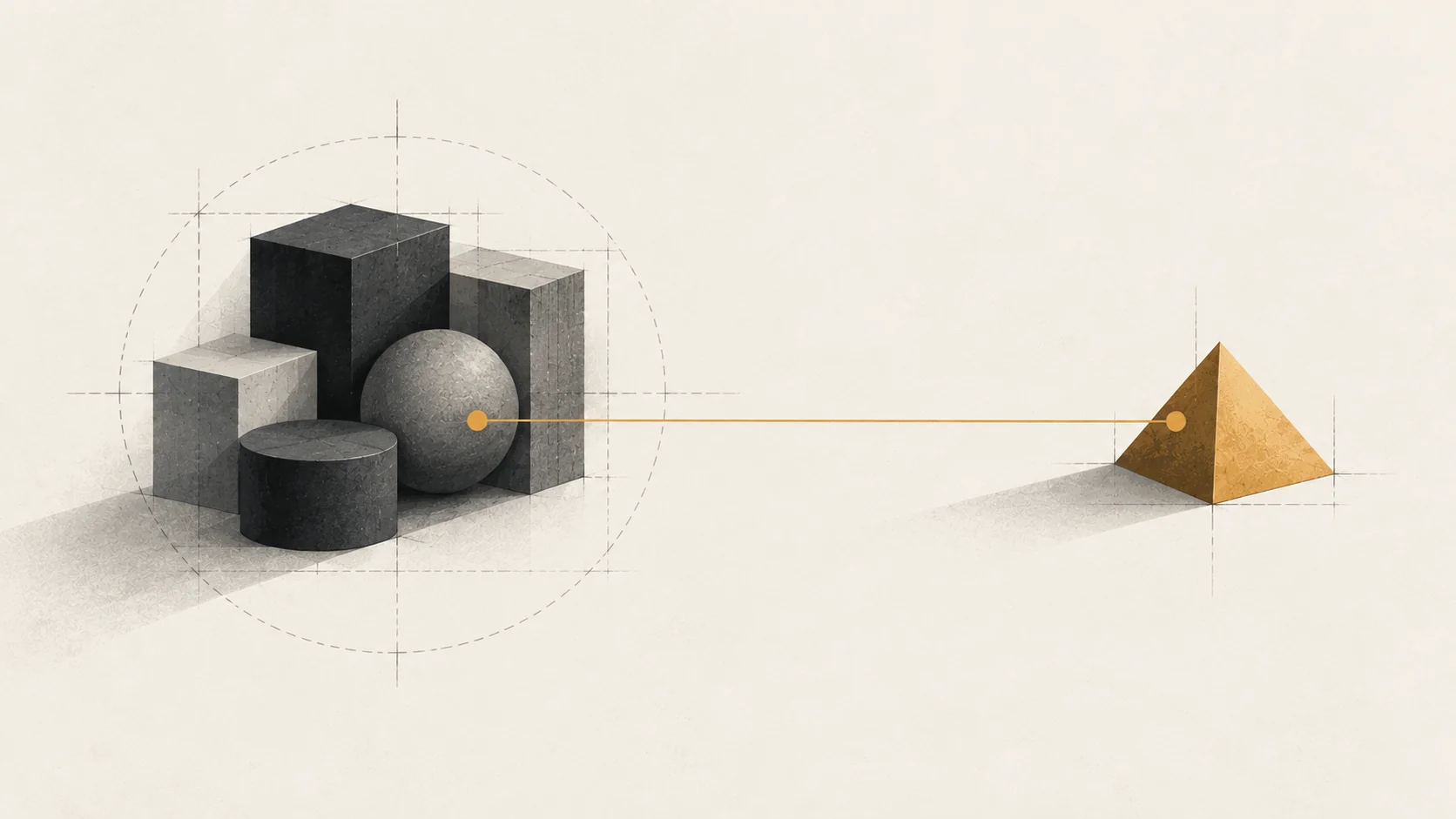
A boundary check for useful curiosity
The four discussion questions help a team keep room for unexpected connections while making deliberate choices about priorities. This is an editorial discussion guide, not a curiosity scorecard or validated instrument.
We cannot always judge the relevance of an unfamiliar subject before exploring it. Broad curiosity can provide material for unexpected connections, while judgement determines which deserve further work. That is not a case for abandoning priorities or treating every novelty as valuable. It is a case for allowing some interests to exist without requiring a professional justification—and for remembering that understanding something can be worthwhile even when it produces nothing else.
I was not looking for an article about artificial intelligence. I was reading about the 2008 financial crisis, a subject that interests me.
The piece was a Facebook reflection by Genny Harrison. She had returned to the 2011 film Margin Call and was looking beyond the film’s dramatic discovery of financial danger towards the way institutions handle information. As I read, her discussion of compression caught my attention: what happens to a complicated problem as it is reduced to something a senior decision-maker can act upon? 1
That connected with a concern I had already encountered while developing Andrew’s Intel’s publishing system. What might an AI meeting summary leave out—and how would someone reading it know?
I had arrived for one subject and found a useful question about another. Then I found myself thinking about the journey between them.
The connection was not something I could have put in a research brief. I needed to encounter the observation before I could see where it belonged. Had I required an obvious connection to AI before reading, I might never have reached the passage that made the connection possible.
Relevance is sometimes discovered
“Is this relevant to my work?” is a reasonable question. There are more things to read than there is time to read them. We need ways of choosing.
But the question has a limitation. Before we explore something unfamiliar, we have to judge it using the understanding we already possess. The encounter may be valuable precisely because it changes that understanding.
A subject can therefore fail our initial relevance test for the very reason it deserves a little attention: we have not yet seen what it might illuminate.
In Harrison’s piece, the connection was not simply that finance and technology both involve numbers. It was a shared problem of selection. Someone receives a reduced account and has to make a judgement without seeing everything that went into it. Recognising that mechanism made the apparent distance between a financial institution and a meeting-summary tool much smaller.
That is the kind of connection I find worth pursuing. Not two things that can be made to sound alike, but an idea in one setting that helps me ask a better question in another.
Looking elsewhere does not mean knowing less here
I would not make this an argument against specialisation. Some understanding of the publishing problem was what gave Harrison’s observation somewhere to land.
Without depth, it is easy to collect appealing comparisons that do not survive examination. Without breadth, it is possible to become very good at answering the questions that a familiar field already knows how to ask. I would rather leave room for the two to support each other.
There is a suggestive parallel in research on scientific work. Brian Uzzi and colleagues examined 17.9 million papers and found that the highest-impact work tended to combine a strong conventional foundation with unusual combinations of prior research. This was an analysis of scientific publications and citation impact, not a controlled test of reading habits or a promise that curiosity improves management. Its useful reminder is narrower: unfamiliar connections need not displace established knowledge. They can work with it. 2
For my own purposes, a new connection begins an enquiry. It does not finish one. The next question is where the comparison breaks down, what evidence supports it and whether it makes the original problem clearer.
Being open to surprise is not the same as being easily impressed.
Interest should not need a business case
There is a danger in defending curiosity entirely through the useful work it sometimes produces. We end up allowing ourselves to explore, provided the exploration can eventually be shown to have paid for itself.
That seems a rather narrow permission.
Had Harrison’s piece produced no article idea, I could still have enjoyed it. I might have understood an institution differently or thought differently about how organisations make decisions. That would have been enough.
The professional connection is welcome. It is not what retrospectively makes the reading legitimate.
I do not want every interest to become a project, every conversation to produce a lead or every book to justify its place through something extractable. There is personal value in becoming acquainted with an unfamiliar subject. There is intellectual value in discovering that an explanation I thought adequate was incomplete.
Sometimes the best result is simply having a larger understanding of the world than I had before. It does not need to appear in an output report.
Curiosity and commitment are different decisions
None of this removes the need to finish things.
An attractive new idea can be a reason to investigate. It can also be a very agreeable way of avoiding a difficult task already under way. The fact that something is interesting does not tell us which of those is happening.
The distinction I find useful is between permission to explore and permission to commit. I can read the piece, retain the source and note the connection without deciding that it must become this week’s priority. A possible article still needs an argument, evidence and a reason for a reader to care.
My preference is to be generous about what I explore and selective about what I take on.
Applied to a team, that would mean allowing an unexpected observation to enter a discussion without immediately demanding a project plan. It would also mean being able to say that an idea deserves to be kept, but not developed now. Neither response requires pretending that every suggestion is a discovery.
And curiosity should reach beyond material likely to confirm our existing views. A different account may improve the question without persuading us of its answer. We can listen seriously and still reject the conclusion.
AI can help—but it should not choose the whole horizon
There is a modest AI connection here, though the argument does not depend on it.
When I ask an assistant to find material relevant to a defined subject, I am giving it a useful boundary. If I then rely entirely on that selection, I have also made my current definition of relevance a boundary around what I encounter.
I would therefore use AI for more than tightly specified searches. I could ask it to investigate how a different discipline handles a similar problem, or to find evidence that challenges the explanation I currently favour. Any suggested connection would still need checking; a fluent comparison is not proof of a shared mechanism.
But I would also leave some reading outside that system. I would be reluctant to delegate all my encounters with unfamiliar ideas, even to a tool that follows my instructions well. Part of the pleasure is finding something I did not know to ask for.
The aim is not to manufacture surprise on demand. It is to avoid designing all possibility of it away.
A small check on the boundaries
For a professional discussion, I would ask four questions:
- What have we encountered recently that changed the question, rather than merely supplying another answer?
- Can someone bring an unfinished connection into the room without first having to sell it as a project?
- Where does our latest comparison break down, and have we looked for that deliberately?
- Which interesting idea can we preserve without allowing it to displace a commitment we need to finish?
Those are not a curiosity scorecard. They are a way to make room for exploration while retaining judgement about what follows.
The next stone
I do not expect a diamond beneath every stone. Most reading will not become an article. Most unexpected connections will not support a new direction. Nor would I want to turn the search into another obligation to be productive.
What I want to preserve is the willingness to look before I know what I am looking for.
This time, an interest in the financial crisis led me to a question about AI meeting summaries. Another time, an unfamiliar subject may simply remain an unfamiliar subject that I understand a little better.
Both seem good reasons to keep turning over stones.
Sources and evidence
The author’s reading experience and the cited social reflection are the origin of the essay. The bibliometric study offers a bounded research parallel; it does not test whether curiosity improves management decisions.
Source posture: The Facebook post could not be independently reopened in the current check and is treated as an attributed inspiration, not independent evidence. Uzzi and colleagues analyse combinations in 17.9 million scientific papers and their citation impact, not the effects of reading habits, team discussion or AI-assisted discovery. The four questions are Andrew’s Intel editorial synthesis, not a validated scorecard.
Research abstract and source links checked 30 October 2026.
- Genny Harrison. Facebook reflection on Margin Call, information compression and institutional judgement. Descriptive attribution; no publication date asserted. Original source.
- Brian Uzzi, Satyam Mukherjee, Michael Stringer and Ben Jones (2013). “Atypical Combinations and Scientific Impact.” Science 342(6157), 468–472. DOI: 10.1126/science.1240474. Research abstract.