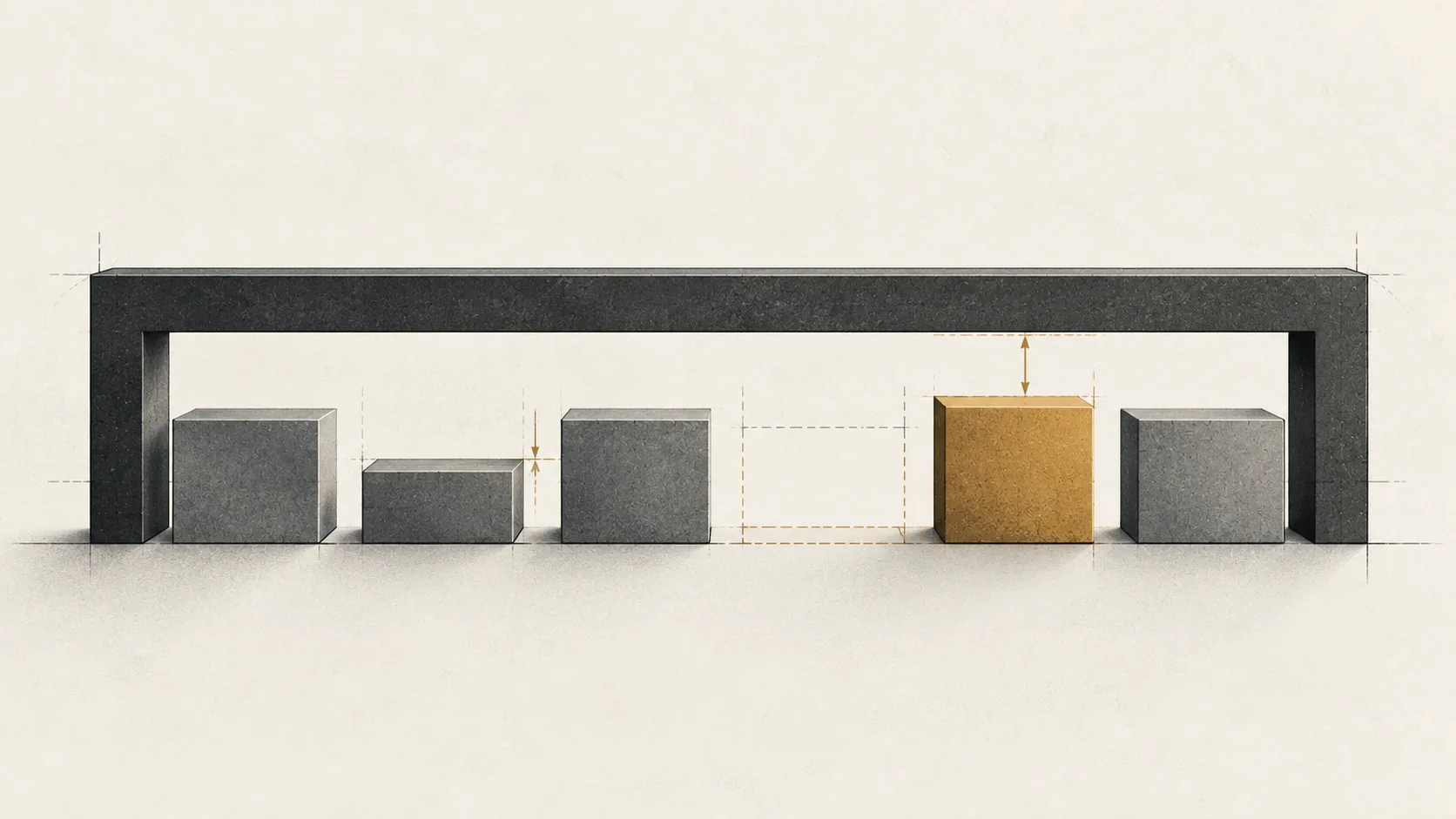
“Will AI take my job?” sounds like a question with two possible answers. The role survives, or it disappears. That is too coarse for the change now becoming visible. A job can retain its title while the tasks inside it become faster, cheaper or less scarce. One person can cover more work. Hiring can slow. Routine assignments can shrink. The route from junior practice to experienced judgement can narrow before anyone says that a role has been automated.
The earliest useful signal may therefore be a change in the price, volume, staffing or learning value of a recurring task. That signal is not the same thing as job loss. Demand, workflow design, customer preference, risk and management choice determine whether a productivity gain expands a service, compresses hours or fees, reduces hiring, changes the mix of junior and senior work, or eventually removes a role.
Recent evidence illustrates why the layers must be kept separate. MIT FutureTech reports substantial improvement on bounded, text-centred tasks. The US Census Bureau finds adoption spreading through firms but still concentrated in a limited number of functions and task types. The International Labour Organization estimates potential occupational exposure rather than realised employment outcomes. Stanford’s early payroll analysis finds a relative shortfall among younger workers in highly exposed occupations, but does not claim that AI caused it. 1 2 3 4
A job can remain while its economics change
An occupation is a bundle of activities performed under one title. Some are easy to specify and evaluate. Others depend on history, relationships, authority, physical presence, tacit knowledge or repeated interaction. AI does not need to perform every responsibility to change the economics of the bundle. It needs only to alter enough recurring work for an organisation, customer or worker to behave differently.
The result may initially look benign. A backlog falls. Drafting takes less time. A small team handles more requests. A service becomes affordable for customers who previously went without it. Those are extension effects. The same capability can also create compression: vacancies are not refilled, fees fall, one role absorbs work previously spread across several people, or less time is available for the routine assignments through which expertise was built.
Displacement is a further step. It occurs when the task bundle and operating model are redesigned so that a defined role or unit is no longer required. That outcome cannot be read directly from a capability result. It depends on whether adoption works in practice, whether the economics persist after review and exceptions, whether demand expands and what management chooses to do with the released capacity.
Monitor the economics of your task bundle, not only the continued existence of your job title.
Keep four signals separate
The public discussion often compresses four different questions into one. Separating them does not make the employment question less important. It makes the evidence needed to answer it visible.
On a narrow screen, each signal is shown as a separate card.
| Signal | Question | Evidence required | Do not infer |
|---|---|---|---|
| Capability | Can a system produce an acceptable output for this bounded task? | Representative inputs, an explicit quality threshold and experienced evaluation. | That the system is affordable, adopted or safe in live work. |
| Adoption | Has the organisation integrated the system into a real workflow? | Usage, workflow, control, exception and operating data. | That deployment changed demand, staffing or progression. |
| Task economics | Has cost, speed, volume or human effort changed? | Before-and-after task measures, including review, rework and failed attempts. | That the whole occupation will disappear. |
| Workforce effect | Have hiring, staffing, pay, hours or progression changed? | Workforce and labour-market data with plausible alternatives tested. | That AI caused the change without causal evidence. |
A capability study can show that a model now completes a defined task to a stated threshold. It cannot show whether firms will deploy it, whether the complete workflow becomes cheaper or whether demand and staffing change. Adoption data can show that firms are using AI. It cannot establish that every use is effective or consequential. Workforce data can reveal a change in hiring or employment. It still needs a credible account of cause.
What rising-tide evidence does and does not say
MIT FutureTech’s Crashing Waves vs. Rising Tides, revised on 23 July 2026, evaluates 6,648 O*NET tasks using 41 language models and 60,845 experienced-worker evaluations. For bounded, mainly text-centred tasks estimated at about 1.5 hours, minimally sufficient no-edit success rose from roughly 60% in the second quarter of 2024 to more than 70% by the third quarter of 2025. Across the study, 60% of outputs were judged minimally sufficient without edits, 49.7% reached average-worker quality and 27% were judged superior. 1
That is a broad capability signal, not an employment forecast. The study evaluates self-contained tasks screened for at least 10% potential time saving. Work requiring physical action, navigation through external systems or repeated interpersonal interaction is underrepresented. The paper was supported by Open Philanthropy and an unnamed technology company. Its useful message is that capability can improve across many tasks as a rising tide rather than arriving as one dramatic occupational wave.
The Census Bureau’s October 2026 CES-26-25R revision provides a different signal. For the November 2025 to January 2026 reference period, 18% of all firms on a firm-weighted basis reported using AI in at least one business function; the employment-weighted share was 32%. Among functional adopters, 57% used AI in one to three functions. Nearly 65% of firms reporting worker-level generative-AI use limited it to one to three task types. 2
The denominators matter. The reported 66% augmentation figure applies only among firms that reported any task effect and describes augmentation alone. The employment result has another denominator: 2.0% of AI-using firms on a firm-weighted basis reported an AI-attributed employment decrease, compared with 2.4% on an employment-weighted basis. These are firms’ descriptive survey responses, not causal estimates and not evidence that AI had no effect elsewhere. They show adoption spreading through relatively narrow parts of organisations while reported workforce reductions remain uncommon.
The ILO’s refined global exposure index adds an occupational view. It estimates that one in four workers is in an occupation with some generative-AI exposure and 3.3% are in the highest exposure category. The ILO judges transformation more likely than complete automation. 4 Exposure describes where task content may be affected. It does not establish that a system has been adopted, that the exposed work can be performed dependably or that employment has fallen.
Three outcomes hidden inside “automation”
“Automation” can conceal materially different outcomes for a worker and an organisation. The distinction is most useful when applied to a defined task bundle rather than to an occupation in the abstract.
On a narrow screen, each outcome is shown as a separate card.
| Pattern | What changes | Early workplace signals | Personal response |
|---|---|---|---|
| Extension | AI increases the amount, range or quality of work that can be performed. | Demand rises, backlogs fall, new services appear or difficult cases receive more attention. | Learn to direct the system and own the higher-value decisions it makes possible. |
| Compression | The same output needs less human time or a smaller team while the role remains. | Expectations rise, vacancies are not refilled, and routine assignments or fees shrink. | Move towards context, judgement, integration, relationships and accountability. |
| Displacement | A task bundle is redesigned so that a role or defined unit is no longer required. | Positions are sustainably removed and the operating model changes. | Test adjacent roles and make transferable evidence visible before change is compulsory. |
The three patterns can coexist inside one team. AI might extend the service offered to customers, compress the routine work needed to deliver it and displace one narrowly defined support role. The mix can also change over time. A short period of extension while a backlog is cleared may be followed by compression once demand stabilises.
The first warning may appear in hiring
A career can change before redundancies appear. Graduate openings may fall. A vacancy may require more prior experience. Routine assignments may be absorbed into a more senior role. An organisation can preserve its current workforce while narrowing the route by which the next cohort learns the work.
Stanford Digital Economy Lab’s paper Canaries in the Coal Mine?, revised on 12 August 2026, analyses payroll records through June 2026. It reports that employment for 22- to 25-year-olds in highly exposed occupations was 19% below the level it would have reached had it kept pace with less-exposed comparison occupations, with the difference appearing mainly through lower hiring. The paper does not claim that AI caused the gap. It notes attenuation when education is controlled, pre-trends in some specifications and differences between the payroll sample and national survey evidence. 3
The result is an early indicator, not proof of a junior-employment collapse. It matters because hiring is a flow. A lower intake can change a profession’s experience base years before it changes the number of experienced people working today. Managers should therefore watch vacancy approvals, entry requirements, junior-to-senior ratios and the amount of practice work available—not only reported headcount reductions.
Use a Task Tide Map
A Task Tide Map converts an abstract employment debate into an evidence plan for the work you actually do. Choose recurring tasks, record what current systems can do on representative examples, identify the economic signal that would matter and decide which human advantage or development path must be strengthened.
On a narrow screen, each task is shown as a separate card.
| Task | Evidence today | Economic signal | Human advantage | Next 90 days |
|---|---|---|---|---|
| Routine drafting | Accepted-draft rate, edit time and recurring error types on representative work. | Output becomes faster while expectations rise and routine assignments shrink. | Context, audience judgement, responsibility and the decision to publish or act. | Measure editing and accepted work rather than prompt counts. |
| Search and synthesis | Representative queries, source coverage, citation accuracy and missed evidence. | Research volume rises while verification becomes a larger share of the work. | Source judgement, problem framing and knowing what evidence would change the conclusion. | Build and test a verified source process. |
| Analysis | Compare conclusions, sensitivity, assumptions and decision usefulness. | Producing an analysis is compressed while testing and integration become more valuable. | Challenge assumptions, interpret uncertainty and act on the result. | Move from producing analysis towards testing and using it. |
| Stakeholder decisions | Track where persuasion, negotiation, authority and trust determine the outcome. | Preparation becomes faster but ownership of the decision remains scarce. | Relationships, legitimate authority, trade-offs and visible accountability. | Seek work with real decisions and attributable outcomes. |
| Learning work | Identify the tasks that build pattern recognition, judgement and progression. | Answers become cheap while the practice needed to create expertise declines. | Experience built through comparison, correction and consequences. | Protect deliberate practice even where AI can supply an answer. |
The map is deliberately practical. It does not require a confident forecast of the occupation. It asks which task evidence is changing, what workplace signal would follow and what the worker or team can do before the result becomes obvious in a job description or hiring plan.
What to do before the water is obvious
- Measure accepted work, not tool activity. Prompts, licences and demonstrations show access. Track accepted outputs, correction time, failures and the work that moved to another person.
- Build complements rather than generic “AI skills”. Context, accountability, trusted relationships, problem framing and integration become more valuable when generating a first answer becomes cheaper.
- Protect the practice that creates expertise. If AI removes the routine work through which judgement was learned, design an explicit replacement rather than assuming people will become senior without it.
- Watch the flow measures. Vacancy approvals, team spans, junior-to-senior ratios, service prices and turnaround expectations may move before total employment.
- Create adjacent options without predicting catastrophe. Practise a related responsibility, gather evidence of transferable work and build relationships outside the narrowest version of the role.
Questions for the next career or team conversation
- Which outputs in this role are becoming materially cheaper, faster or more abundant?
- Does the saved time create higher-value work, greater volume or simply a lower staffing requirement?
- Are vacancies, graduate openings or routine assignments changing before headcount?
- Which evidence would show extension, compression or the removal of a task bundle?
- Which human advantages remain scarce because they depend on context, authority, relationships or accountability?
- How will people develop those advantages if AI performs more of the work through which they were previously learned?
- Which adjacent responsibility can be practised within the next 90 days?
What would change the judgement?
The task-level view should not become a presumption that every capability improvement will weaken employment. Evidence of sustained demand expansion, new services, broader access, rising hiring or more valuable human work would support an extension case. Workflow data showing that AI use adds review, rework or exception cost without changing accepted output would weaken the claim that the task’s economics had changed.
Stronger causal labour-market evidence could also change the assessment. Consistent results across representative datasets, credible comparison groups and time periods would make workforce conclusions more secure. Firm-level evidence linking a defined deployment to hiring, staffing, pay, hours or progression would clarify mechanisms that aggregate exposure measures cannot.
At the personal level, the test is not whether AI can produce an answer once. It is whether the economics of recurring accepted work change, whether the organisation redesigns around that change and whether demand absorbs the released capacity.
A rising tide gives you more time than a crashing wave. It does not guarantee that you will notice the water rising.
Evidence note
Evidence and version status were rechecked on 30 October 2026. The MIT paper is arXiv version 3, revised 23 July 2026; the Census source is the October 2026 CES-26-25R revision; the Stanford paper is the 12 August 2026 revision with payroll evidence through June 2026; and the ILO index was published on 20 May 2025. Capability, firm adoption, occupational exposure and observed employment are different measures with different denominators and should not be combined into a single automation rate.
MIT evaluates bounded, self-contained and mainly text-centred tasks. Census reports descriptive survey evidence and firms’ own assessments of effects. Stanford reports an early relative employment gap in one payroll dataset and does not claim causation. The ILO measures potential exposure, not realised adoption or job loss. The Task Tide Map and the extension, compression and displacement framework are editorial synthesis.
Sources and evidence
Evidence and links were rechecked on 30 October 2026. This article provides personal and management decision support, not employment, career, investment, legal, human-resources or workforce-restructuring advice. Working papers can be revised, and early labour-market patterns may change as adoption, demand and economic conditions develop.
Source posture: This article separates model capability, firm adoption, occupational exposure and observed workforce change. MIT’s arXiv paper, the Census CES-26-25R revision and Stanford’s August 2026 paper are working papers rather than settled causal evidence: MIT evaluates bounded, self-contained, text-centred tasks; Census reports descriptive survey evidence and firms’ own assessments of AI-attributed effects; Stanford reports an early relative employment gap in one payroll dataset and explicitly does not claim causation. The ILO estimates potential occupational exposure, not adoption, redundancy or realised employment loss. The Task Tide Map and the extension, compression and displacement framework are Andrew’s Intel editorial synthesis.
- Crashing Waves vs. Rising Tides: MIT FutureTech, arXiv 2604.01363v3, revised 23 July 2026. Working-paper capability evidence covering 6,648 O*NET tasks, 41 language models and 60,845 experienced-worker evaluations. The evaluated tasks are bounded and mainly text-centred; the study does not measure firm adoption or employment outcomes. Funding includes Open Philanthropy and an unnamed technology company. arXiv record
- The Microstructure of AI Diffusion: US Census Bureau, Center for Economic Studies Working Paper CES-26-25R, October 2026 revision. Descriptive survey evidence on functional adoption, worker task use and firms’ own assessments of task and employment effects; not a causal estimate. Official revised paper
- Canaries in the Coal Mine? Six Facts about the Recent Employment Effects of Artificial Intelligence: Stanford Digital Economy Lab, revision dated 12 August 2026, with payroll evidence through June 2026. The paper reports a relative employment gap for younger workers in highly exposed occupations and explicitly does not claim causation. Stanford publication page
- Generative AI and Jobs: A Refined Global Index of Occupational Exposure: International Labour Organization, published 20 May 2025. Estimates potential occupational exposure and concludes that transformation is more likely than complete automation; it does not measure firm adoption, redundancy or realised employment loss. ILO publication
Editorial construct: The Task Tide Map and the extension, compression and displacement framework are diagnostics for examining recurring work. They are not validated labour-market models, forecasts, occupational classifications or guarantees of an individual career outcome. Apply them to representative task, workflow and workforce evidence and preserve plausible alternative explanations.