
Two maps for the discussion
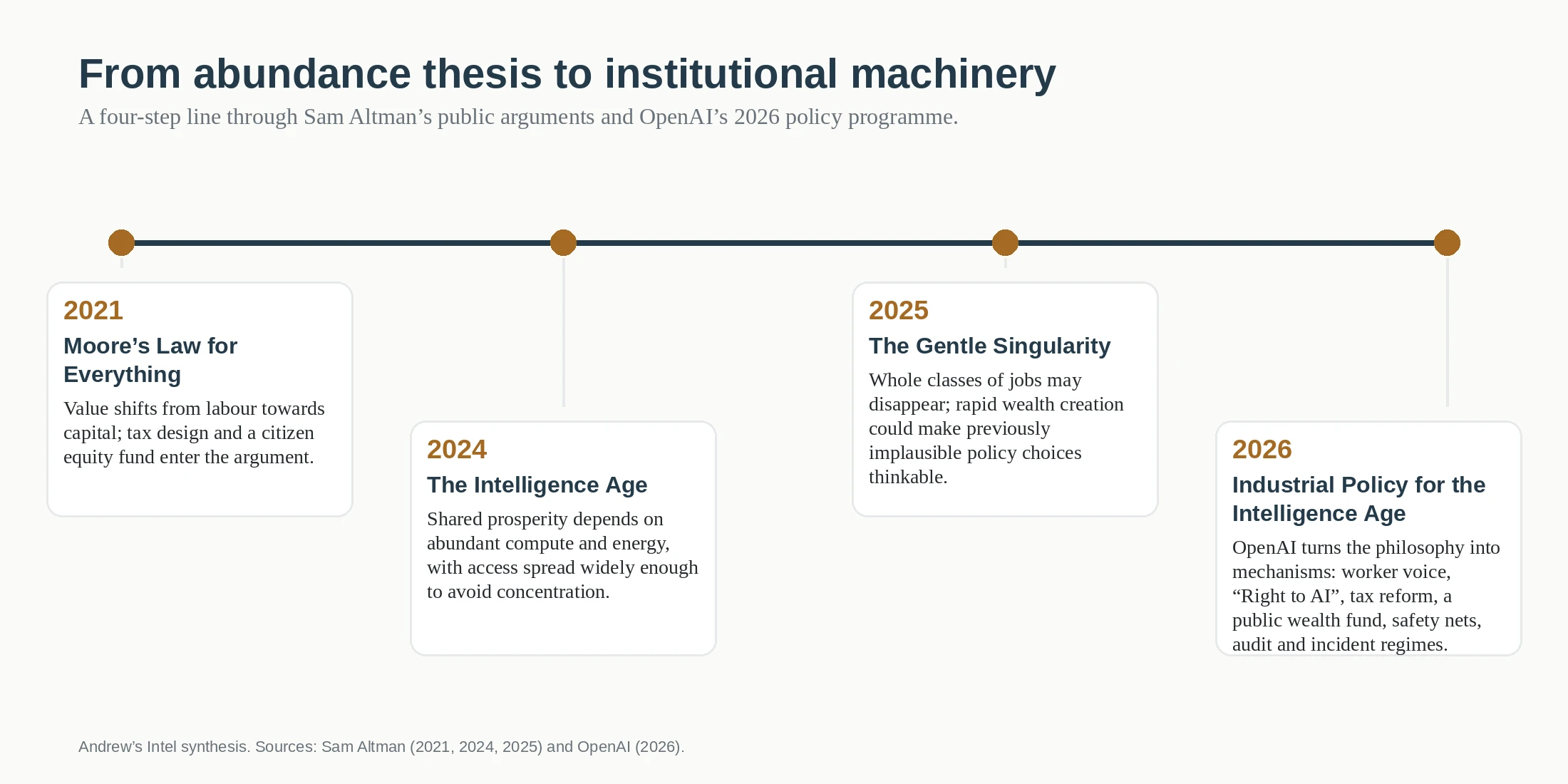
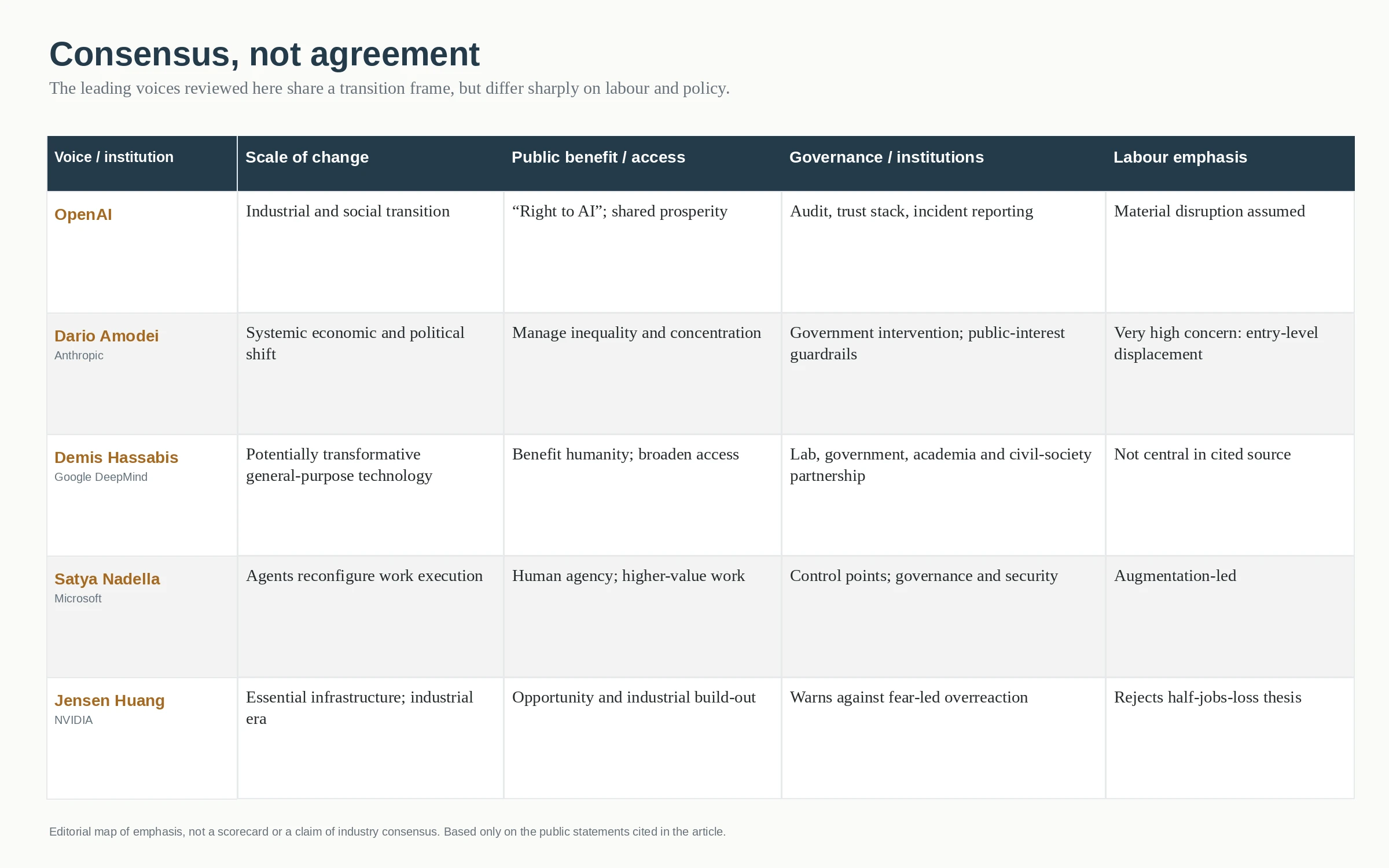
Figure 1 traces the shift in Sam Altman's and OpenAI's public arguments. Figure 2 compares five builders' positions without treating them as a consensus or forecast.
The Signal
The most interesting part of OpenAI’s paper is not any one tax, benefit or safety proposal. It is the scale of the future the organisation now considers plausible enough to design institutions around.
If a frontier AI laboratory publishes a paper proposing worker participation in deployment decisions, a “Right to AI”, a tax base less dependent on labour income, a public wealth fund, four-day-week trials, adaptive safety nets, grid expansion, audit markets and incident reporting, the useful question is not whether every proposal is good policy. It is why the laboratory thinks these are now sensible things to discuss.1
OpenAI’s Industrial Policy for the Intelligence Age begins from an unusually large premise. It says a transition towards superintelligence is beginning; it asks readers to imagine systems moving from tasks that take humans minutes or hours towards projects that currently take months; and it argues that existing institutions may not be able to absorb the resulting changes to work, knowledge and production without deliberate redesign.1
That is not evidence that the forecast will come true. OpenAI is a commercially interested source with a direct stake in how governments, companies and the public interpret the technology it builds. The paper is more useful as an institutional signal: evidence of what OpenAI thinks is plausible enough to plan around, rather than proof that superintelligence, mass displacement or a particular policy settlement is on schedule.
The policies are less interesting than the planning horizon
Its contents are striking precisely because they move beyond the familiar frontier-lab language of model safety and access. OpenAI asks governments and employers to consider how AI-created productivity gains might be shared; whether workers should have a formal voice in deployment; how benefits might become portable across jobs; how care, education and other human-centred work could absorb displaced labour; and how automatic safety-net expansions might be tied to measurable disruption. It also sketches an “AI trust stack” of provenance, privacy-preserving logs, auditability, assigned organisational accountability, monitoring and escalation.1
The paper is exploratory, and OpenAI says so. Yet it has not been treated as a disposable thought experiment. By June the company said it had received more than 400 responses. In August it announced grants to 14 independent projects intended to test, challenge or develop the economic-opportunity and resilience ideas further.12
That moves the signal one step up the maturity ladder. The proposals are not policy, and the outcomes are not evidence. But the planning premise has become a programme rather than a one-off essay.
This did not come out of nowhere
The institutional paper also makes more sense when read against the public arguments of OpenAI chief executive Sam Altman over the preceding five years.
In 2021, Moore’s Law for Everything argued that increasingly capable software would shift economic power from labour towards capital. Altman proposed taxing companies and land more heavily and distributing part of the resulting wealth through an American Equity Fund. The mechanism was specific, but the larger proposition was already visible: if AI changes where value accrues, the social contract and tax base may have to follow.3
By 2024, The Intelligence Age had moved the argument towards abundance. Altman wrote about shared prosperity, abundant compute and energy, broad access to AI and significant labour-market change, while remaining optimistic that people would continue to find useful things to do.4
In 2025, The Gentle Singularity became more explicit about transitional pain. Altman acknowledged that whole classes of jobs could disappear and argued that sufficiently rapid wealth creation might make previously implausible policy choices possible. He expected a new social contract to emerge gradually rather than through one clean political settlement.5
The 2026 OpenAI paper is therefore less a philosophical break than a change in level. The argument has moved from “large distributional effects may require new rules” to a menu of institutions that might actually carry those rules.
Read Figure 1 as text
- 2021, Moore's Law for Everything: value shifts towards capital; tax design and citizen equity.
- 2024, The Intelligence Age: shared prosperity requires compute, energy and broad access.
- 2025, The Gentle Singularity: possible job-class disruption and new policy choices.
- 2026, Industrial Policy for the Intelligence Age: worker voice, access, tax reform, public wealth, safety nets and auditing.
This is an editorial synthesis of the four cited public statements.
The other builders are not saying the same thing
The more interesting comparison is not whether other prominent AI leaders endorse OpenAI’s proposals. They do not. It is whether they still describe AI as an ordinary software transition.
Institutional position matters here. None of these figures is a neutral labour-market forecaster: Dario Amodei leads Anthropic, Demis Hassabis leads Google DeepMind, Satya Nadella leads Microsoft, and Jensen Huang leads NVIDIA. Their organisations occupy different parts of the AI value chain and have different commercial and strategic interests in how adoption, regulation and disruption are understood. The point is not to disqualify their arguments for having interests; it is to read the forecasts with those interests visible.
Dario Amodei, co-founder and chief executive of Anthropic, speaks from a frontier-model developer that sells its own AI systems and places safety at the centre of its public mission. He is the closest to OpenAI’s willingness to contemplate macroeconomic intervention, but considerably darker about the labour path. In The Adolescence of Technology, he restated a warning that AI could displace half of entry-level white-collar jobs within one to five years. He argues that severe inequality could require government intervention and progressive taxation, and worries that extreme wealth concentration could damage the economic basis of democratic power.6
Demis Hassabis, co-founder and chief executive of Google DeepMind, speaks from Google’s frontier AI research and model-development organisation. He uses a different register. In a 2026 Google DeepMind partnership announcement, he and his co-authors described AI as potentially the most transformative technology in human history, said it should benefit all humanity, and argued for collaboration between frontier laboratories, governments, academia and civil society. In the sources reviewed for this article, the emphasis is science, education, resilience, public services and access - not a detailed programme for labour redistribution.7
Satya Nadella, chairman and chief executive of Microsoft, speaks from a global software and cloud supplier selling AI infrastructure and Copilot products across the enterprise market. He is closer to the operating layer. In March, he described AI moving from answering questions towards executing multi-step tasks with clear user control points. The managerial opportunity, in his framing, is to reduce manual coordination while increasing human agency, with governance and security controls built around the work. That is a substantial organisational transition, but it stops well short of OpenAI’s proposed redesign of the tax-and-benefit system.8
Jensen Huang, founder, president and chief executive of NVIDIA, speaks from a leading supplier of the accelerated-computing hardware and platforms used to build and run AI systems. He supplies the clearest dissent on employment. NVIDIA frames AI as essential infrastructure for a new industrial era, something every company will use and every nation will build. But Huang has explicitly rejected the proposition that AI will destroy half of American jobs, arguing instead that automation increases the amount of economically useful work and the jobs required around it.910
Those institutional interests do not make any of the arguments wrong. They do tell us what not to mistake them for: neutral forecasts. The positions come from people and companies with different commercial exposures, technical bets and policy preferences. Nor are five prominent voices a proxy for economists, workers, policymakers or the AI industry as a whole.
But the comparison does reveal a useful pattern. They disagree sharply about how fast labour substitution will arrive, how painful it will be and how interventionist the response should become. They are much closer on a different proposition: advanced AI is likely to spill beyond the software budget into infrastructure, organisational design, access, governance and the distribution of economic gains.
Read Figure 2 as text
| Voice | Scale of change | Public benefit | Governance | Labour |
|---|---|---|---|---|
| OpenAI | Industrial and social transition | Right to AI and shared prosperity | Audit, trust stack and incident reporting | Material disruption assumed |
| Dario Amodei / Anthropic | Systemic economic and political shift | Manage inequality and concentration | Government intervention and public-interest guardrails | Very high concern about entry-level displacement |
| Demis Hassabis / Google DeepMind | Potentially transformative general-purpose technology | Benefit humanity; broaden access | Lab, government, academia and civil-society partnership | Not central in cited source |
| Satya Nadella / Microsoft | Agents reconfigure work execution | Human agency and higher-value work | Control points, governance and security | Augmentation-led |
| Jensen Huang / NVIDIA | Essential infrastructure; industrial era | Opportunity and industrial build-out | Warns against fear-led overreaction | Rejects half-jobs-loss thesis |
Based only on the public statements cited here.
The disagreement is about the slope, not the category
This is where the signal becomes useful to a decision-maker. The public argument is often presented as a binary choice between “AI will take all the jobs” and “AI will merely make people more productive”. The leading builders reviewed here are actually arguing across several layers at once.
- Capability: how far AI can move from assistance into delegated execution, scientific discovery and increasingly long-horizon work.
- Infrastructure: how much compute, energy, network and institutional capacity must be built to make those capabilities widely available.
- Organisation: how roles, approval, accountability and workflow change when software can execute rather than merely advise.
- Distribution: who receives productivity gains, what happens to labour income, and whether access to capability becomes concentrated.
- Governance: how actions are logged, audited, monitored and escalated once AI is embedded in consequential systems.
Huang is markedly more optimistic about employment than Amodei. Nadella frames the transition through empowerment and work redesign rather than redistribution. Hassabis emphasises scientific and public-purpose deployment. OpenAI now carries the argument furthest into institutional policy. The disagreement matters, but none of these frames looks much like “buy some software and train the staff”.
What boards should take from this without buying the premise
A board does not need to believe that superintelligence is imminent to find this useful. It does need to notice that several organisations closest to frontier capability are planning or speaking as though second-order effects could become large.
The practical question is therefore not “Which CEO is right?” It is “Which assumptions are already embedded in our own AI strategy?” Five deserve to be surfaced explicitly.
- Are we assuming AI productivity is mainly additive to existing roles, or are we planning for meaningful task and role substitution?
- Are our control systems designed for tools that advise people, or for systems that can execute multi-step work with delegated authority?
- Do we assume access to capable models will remain cheap and widely available, or could compute, energy, regulation and supplier concentration change the economics?
- If entry-level work changes first, what happens to training, succession and the pipeline through which people acquire judgement?
- If productivity gains become material, who captures them - the supplier, the organisation, the workforce, the customer, the state, or some combination?
These are not predictions. They are strategy assumptions. Making them visible now is cheaper than discovering later that an operating model was built around one unexamined view of the transition.
Read the paper as a signal, not a prophecy
OpenAI’s paper claims that the transition towards superintelligence is already underway. The document itself does not prove that claim. Nor does it establish that its proposals are politically viable, economically optimal or necessary. The “Right to AI”, public wealth fund, automated-labour taxation and four-day-week pilots are policy ideas, not observed outcomes.1
What the paper does evidence is OpenAI’s own planning posture. It sees labour disruption, concentration of wealth and power, energy infrastructure, public access, organisational accountability, auditing and post-deployment monitoring as sufficiently plausible consequences to justify institution-building now. The follow-on grant programme shows that OpenAI wants those ideas explored outside the company as well.12
That is also where the comparison with other leaders helps. Amodei makes the strongest near-term displacement case. Huang rejects it. Nadella emphasises human agency and governed execution. Hassabis stresses scientific benefit and national partnership. Their forecasts are not converging into one policy prescription. Their field of concern is expanding in a similar direction.
For decision-makers, that is the early signal worth keeping. The people closest to frontier AI increasingly talk not only about what models can do, but about the institutions, infrastructure and organisational rules that may have to change around them.
The Useful Conclusion
You do not need to accept OpenAI’s forecast to notice the size of the question it is preparing for. The most useful signal in the paper is not its answer. It is the scale of the transition the industry has started to treat as plausible.
Sources and evidence
The cited statements establish the organisations' and leaders' public positions; they do not establish which forecast will occur. Links and dated claims checked 30 October 2026.
Source posture: The article compares public statements by commercially interested technology leaders. Their statements are evidence of their own beliefs, strategy and positioning; they are not treated as independent evidence that any forecast about superintelligence, labour displacement or policy outcomes will occur.
- Industrial policy for the Intelligence Age. OpenAI, April 2026; page updated 9 June 2026. Primary institutional policy source. Treated as commercially interested evidence of OpenAI’s own policy position, not neutral proof of the forecast. Original source.
- New policy ideas for the Intelligence Age. OpenAI, 17 August 2026. Primary follow-up on 14 independent grants and the earlier response process. Original source.
- Moore’s Law for Everything. Sam Altman, 16 March 2021. Primary essay establishing the labour-to-capital, tax and citizen-equity argument. Original source.
- The Intelligence Age. Sam Altman, 2024. Primary essay on shared prosperity, compute, energy, access and labour-market change. Original source.
- The Gentle Singularity. Sam Altman, 2025. Primary essay on job-class disruption, wealth creation and gradual social-contract change. Original source.
- The Adolescence of Technology. Dario Amodei, 2026. Primary essay. Used for Amodei’s labour-displacement warning, progressive-taxation argument and concerns about concentrated economic power. Original source.
- Accelerating discovery in India through AI-powered science and education. Google DeepMind, 18 February 2026. Primary institutional statement co-authored by Demis Hassabis, Lila Ibrahim and Pushmeet Kohli. Original source.
- Announcing Copilot leadership update. Microsoft, 17 March 2026. Primary corporate statement containing Satya Nadella’s framing of multi-step execution, control points, agency, governance and security. Original source.
- NVIDIA CEO Jensen Huang and Global Technology Leaders to Showcase Age of AI at GTC 2026. NVIDIA, 3 March 2026. Primary corporate statement establishing NVIDIA’s “AI industrial era” and infrastructure framing. Original source.
- Nvidia CEO: How AI could actually create jobs. Axios, 24 July 2026. Independent interview source for Huang’s explicit rejection of the “half the jobs” displacement thesis. Original source.