
Do this first
Define one repeatable AI job, the quality standard and deadline it must meet. Then use the six-question comparison to test whether local ownership serves that job better than the current contract.
For occasional AI work, paying for access can preserve flexibility. Once the same work runs every day, a different question becomes reasonable: would dedicated local capacity serve this particular job better?
The question becomes concrete when a team establishes repeatable document processing, classification or an internal information service. A recent study of moving GroundX, a document-processing and retrieval system, onto local hardware provides a useful example. It is a feasibility case, with significant limits, rather than a general recommendation to bring AI in-house.1
Consider an illustrative operations team that processes supplier documents overnight. The formats are reasonably stable, the next morning is an acceptable deadline, and staff review exceptions. Its hosting decision could differ substantially from that of a customer service that needs immediate answers and receives unpredictable surges in demand.
The first team's repeatable workload gives it something concrete to assess: a known job, a service requirement and a forecast of demand. Those are better starting points for a hosting decision than enthusiasm for owning the technology.
What the GroundX study establishes
Mohamed Farag, Andrew Dai and Sara Elhamouly moved GroundX onto a local workstation and demonstrated that the tested document-ingestion path worked. Their cost model placed break-even at roughly four to five months under its stated assumptions.1
The limitations matter. The hardware environments were not matched, the benchmarks were single runs, and the cost and performance comparisons used different cloud baselines. Local ingestion was slower. A request to list documents was faster locally, but that test did not measure the speed or quality of generated answers. Functional parity was checked on a single-page document. The authors also flag an unsupported software version and a legacy deployment path in the archived setup.1
The useful management signal is that relocation can be technically feasible for a defined workload. The reported payback period belongs to that model. It is a reason to examine an equivalent local option, rather than a figure to insert into another organisation's business case.
First establish what you are replacing
“Cloud AI” can describe quite different purchases. An organisation may buy access to a managed model service, rent computing capacity and run its own models, or buy hardware and operate it locally. The work retained by the buyer differs in each case.
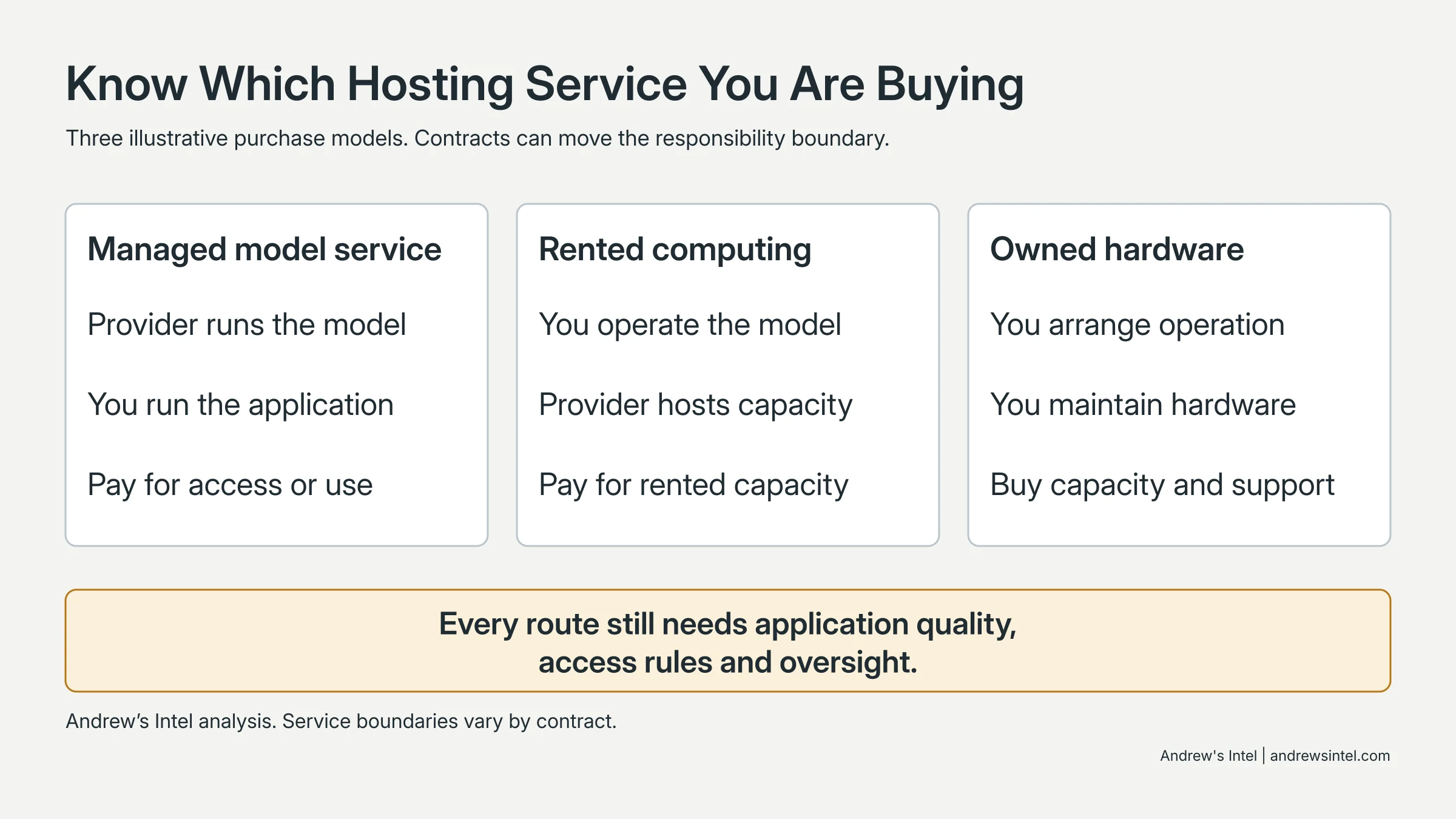
Every route still needs application quality, access rules and oversight. Service boundaries vary by contract.
The distinction prevents a misleading comparison. Replacing a managed service with a server can move model operation, monitoring and maintenance onto the buyer's budget. Replacing rented computing capacity may leave much of that work unchanged. Conversely, a managed local service can put equipment on the premises while keeping substantial operational responsibility with a supplier.
Physical location and operational ownership are separate decisions. Ask who runs the service, who fixes it and what the contract includes before comparing the prices.
There is a commercial example beyond the GroundX research. Lenovo describes a 40-day validation pilot in which Onetera tested its government-service AI workloads on local hardware, including document processing and generation. That is a named vendor/customer account, with a clear sales interest. It establishes a practical investigation, rather than independently verified savings for municipal customers.2
Predictability must translate into useful utilisation
Owned hardware carries costs while it is idle. A workload that arrives regularly may help spread those costs across enough useful work to make ownership worthwhile. But regularity alone does not establish that the equipment will be well used.
The overnight document team needs to know how many documents arrive, how demanding they are, how much processing can wait and whether the busiest night still finishes before staff need the results. Capacity bought for an occasional peak may sit unused for much of the week.
Sharing equipment with other work can improve the economics, provided competing jobs do not undermine deadlines or data separation. Existing spare capacity also has an opportunity cost if the new workload displaces something else.
A separate preprint by Sheng-Wei Peng, Yi-Hsun Lin and Yi-Pei Lee illustrates the sensitivity. In a study following one developer over two consecutive 28-day periods, their modelled total cost favoured local deployment under shared equipment allocation, but favoured the cloud service when the local capacity was reserved exclusively. Caching, which reuses eligible previously processed input, also reduced the effective cloud bill.3
The local configuration was associated with more code changes labelled as repairs. That is a warning to include rework, rather than proof that local models cause more defects: the study was non-randomised and used different model and tool combinations. It is a bounded counterpoint, not a universal ranking.3
For a buyer, the implication is straightforward. Test the comparison against actual utilisation and the available cloud pricing arrangements. A business case that works only with a full server and an undiscounted alternative is fragile.
Price the service your organisation needs
A useful comparison starts with an accepted unit of work: a document processed to the required standard, with exceptions handled, by the deadline. It then counts the resources needed to deliver that result.
For local hosting, that may include equipment and financing over the planning period, installation, power and cooling, storage, software licences, support, security, maintenance, upgrades and recovery arrangements. Staff time belongs in the comparison even when no additional person is hired. Keep additional cash spending and the value of existing staff capacity visible as separate figures.
For cloud provision, include the actual contract and consumption pattern: model use, rented capacity where relevant, storage, data movement, support commitments and the internal work the organisation still performs. Check whether caching, scheduled processing or a different service configuration could improve the existing option before buying a replacement.
Quality and service must remain visible alongside cost. A lower computing bill may leave staff correcting more output. A fast demonstration may conceal a queue when several departments use the system at once. Ask for time to an acceptable result, including retries and review, under a representative workload.
This need not become an elaborate modelling exercise. Early assessment can use ranges and identify which assumptions could reverse the decision. Procurement needs firmer evidence where the commitment becomes substantial or the service consequential.
Local control brings operating responsibilities
Keeping processing within a chosen boundary can be valuable where an organisation has a specific confidentiality, connectivity or control requirement. That value may justify a premium. It should be stated explicitly so the proposal can be judged on its actual purpose.
Locality by itself does not establish security or compliance. The assessment still needs to cover access, software updates, logs, backups, support access and any information sent to external services. Model and software licence conditions also need checking for the intended use.
Reliability requires similar care. Kubernetes, software used to manage applications across computing resources, can restart failed components and replace some failed workloads. Its documentation also makes clear that application errors and storage failures can require separate intervention.4 Restarting software does not provide a spare physical machine or restore a missing backup.
Return to the overnight document team. If processing stops, can staff use the previous day's information, handle urgent files manually or move work to another approved service? Who notices the failure, and who is responsible for restoring the morning deadline?
The answer determines how much spare capacity, support and recovery provision the local option needs. A service that can wait until Monday is a different purchase from one on which Monday's operations depend.
Take these questions to the hosting discussion
Use this as an assessment checklist. It is intended to expose assumptions before a purchase, rather than produce a score that automatically selects a winner.
| Question | What the proposal should make visible |
|---|---|
| What exactly are we moving? | The workload, model and service components; the current managed-service or rented-capacity baseline. |
| What counts as an acceptable result? | Output quality, review effort, deadline, peak demand and acceptable interruption. |
| How much capacity will we use? | Typical and peak demand, idle periods, shared capacity and a credible planning horizon. |
| What does each option really cost? | Capital and running costs, staff time, licences, maintenance, support and recovery; current cloud terms. |
| Who owns operation and failure? | Named responsibility for monitoring, updates, security, backup, restoration and supplier escalation. |
| What would change the decision? | Lower demand, additional rework, a better cloud offer, a new model requirement or an unsuccessful recovery test. |
For the illustrative team, a proportionate next step would be a bounded comparison using representative documents and the actual overnight deadline. Agree the quality threshold, review allowance, operating owner and fallback before interpreting the cost results. Include a low-demand case and a failure scenario, rather than testing only a busy, trouble-free night.
The outcome may support local hosting, continued cloud use or a selective split, with routine work handled locally and other work sent to an approved external service. Such a split needs its own data and failure rules; it is an option to assess, rather than an automatic compromise.
The decision to commission that comparison can be modest and reversible. Buying equipment should follow evidence that the organisation can use it productively and operate the required service. A predictable workload makes the question worth asking. It does not answer it.
Sources and evidence
The approved article was written on 31 October 2026. Its four originating sources were rechecked on 1 November 2026. The operations-team example is illustrative. The hosting framework and checklist are Andrew's Intel analysis, not findings claimed by the cited studies.
Source posture: GroundX is a bounded feasibility study with unmatched hardware, single-run benchmarks, different cloud baselines, slower local ingestion and a limited parity check; its four-to-five-month payback is model-specific. Lenovo's Onetera pilot is a commercially interested vendor/customer account, not independently verified savings. The coding-agent preprint is one developer in sequential periods with different models and tools; only its accessible abstract was used. Kubernetes self-healing does not replace hardware redundancy, backups or service recovery.
- Farag, M., Dai, A. and Elhamouly, S. “Cost-effective on-premises multimodal RAG deployment with Kubernetes: a GroundX case study”, Academia AI and Applications, 9 October 2026. Publisher article. RAG means retrieval-augmented generation, which supplies retrieved information to a language model. The study is a bounded feasibility demonstration, not a matched comparison of complete production services. Read source
- Lenovo. “Slashing the cost of AI-powered local government services”, Onetera customer case study. Case study. Vendor/customer pilot account. Its headline savings and compliance claims are not adopted here as independent findings. Read source
- Peng, S.-W., Lin, Y.-H. and Lee, Y.-P. “Inference Economics of Enterprise Coding Agents: A Case Study of Cloud vs. On-Premise LLMs”, arXiv:2607.13080, submitted 13 July 2026. Author abstract. LLM means large language model. This article uses the accessible abstract; the full manuscript was not inspected. Single developer, sequential periods and differing model/tool bundles limit generalisation. Read source
- Kubernetes documentation. Kubernetes Self-Healing. Used to distinguish automated component recovery from the wider responsibility for maintaining a service. Read source