
Read or download
This is the complete web edition of the white paper, with all four original figures and the age-blind AI readiness test. Download the PDF edition.
Age is not a credential. Neither is youth.
The argument in five lines
- The age gap in AI use is real, but it is a snapshot of exposure and opportunity as well as individual capability.
- Older workers are often given less training and less voice just when organisations decide they are less adaptable.
- Many experienced workers carry technology-transition capital: practical knowledge of what happens after the demonstration.
- AI can compress some experience curves and lend non-specialists bounded expertise. That raises, rather than removes, the value of judgement and context.
- The sensible unit of AI capability is often an intergenerational team, not a young technologist or an experienced manager standing alone.
EXECUTIVE VIEW
The anti-ageist case is operational, not charitable
The fashionable story of AI at work is brutally simple. Young people understand the new tools. Older people do not. Therefore the future belongs to the young, while the old hands should either catch up quietly or get out of the way.
There is one awkward fact inside that story: younger workers have adopted generative AI faster. In a nationally representative US survey from August 2024, workplace use was about 34 per cent among workers under 40 and 17 per cent among those aged 50 and over.1 Older workers also participate in less training on average, report less learning-by-doing and score lower on some information-processing measures.3 Anti-ageism does not require statistical dishonesty.
But use is not readiness, and speed at the interface is not depth in the institution. The evidence suggests that age differences in adoption are entangled with confidence, technical support, perceived usefulness, training opportunity, consultation, occupation and prior experience.2416 A slower start is not proof of a lower ceiling. During the computer revolution, older workers adopted later but, within occupations, eventually converged towards similar levels of use.5
The deeper error is to treat current tool fluency as the whole of AI competence. Organisations need people who can use the machine. They also need people who understand the work, the exceptions, the customers, the politics, the controls, the history and the consequences. Generative AI may make codified expertise progressively cheaper to rent from the machine. It does not make organisational judgement cheap.
OPENING CASE
The synthetic organisation beside the swimming pool
Picture the headquarters. There is a laptop, a chair and a swimming pool. The workforce has no office, no payroll and no agreed headcount. Yet it contains something resembling a research desk, an editorial department, a document-production team, a visual unit, a quality-control function and a small strategy shop.
At the centre is not a twenty-seven-year-old founder in a black T-shirt. It is a pensioner with decades of commercial experience, an early background in software and no claim to be a contemporary AI engineer. He describes himself more cheerfully as an old duffer renting expertise because he cannot get his head around the new-fangled technology any other way.
The joke lands because the mechanism is serious. He does not become a researcher, developer, information architect, editor, designer and analyst in turn. He assembles bounded versions of those competences through AI, gives them jobs, writes operating rules, checks the work, connects the outputs and redesigns the system when it fails. In conventional language, he is managing specialists. The unusual part is that many of the specialists are synthetic.
This is not evidence that older people are naturally better at AI. It is an existence proof of a possibility: falling access costs for technical and codified expertise can increase the reach of accumulated judgement. The limiting factor shifts from personally possessing every specialist skill to knowing what should be built, what good looks like, what the system has missed and when the machine is talking nonsense.
1 THE STEREOTYPE
The lazy age story is attractive because it is easy to manage
Management likes proxies. They turn a difficult diagnosis into a quick sorting rule. Youth becomes a proxy for curiosity, adaptability and digital fluency. Age becomes a proxy for resistance, obsolescence and the sentence that begins, 'We tried something like this before.'
There are certainly incurious older workers. There are also young employees whose technical confidence runs several miles ahead of their judgement. Neither observation justifies managing a workforce by birth year.
The phrase 'digital native' has done particular damage because it sounds like biology. Yet research on internet use found that generation was only one predictor of advanced engagement. Breadth of use, experience, education and other factors could matter as much or more, and adults could acquire the relevant skills.6 The native was made, not born.
Generative AI intensifies the temptation to use age as shorthand. The interface is conversational; the demonstrations are quick; confident users can look competent within minutes. That visibility favours the person who is willing to experiment in public. The knowledge needed to decide whether the experiment belongs in a live workflow is quieter. It tends to reveal itself later, when the output meets an exception, a regulator, a supplier contract, an angry customer or the one database field everybody knows not to trust.
2 THE AWKWARD EVIDENCE
Yes, older workers started more slowly
A serious anti-ageist case should begin by conceding what the data show. Younger workers have been quicker to adopt generative AI. The August 2024 US survey below found roughly a two-to-one age gap in workplace use.1 The absolute numbers have since moved quickly - work-related use was about 41 per cent by November 2025 - but the early distribution matters because it shapes who gains practice, visibility and influence first.17
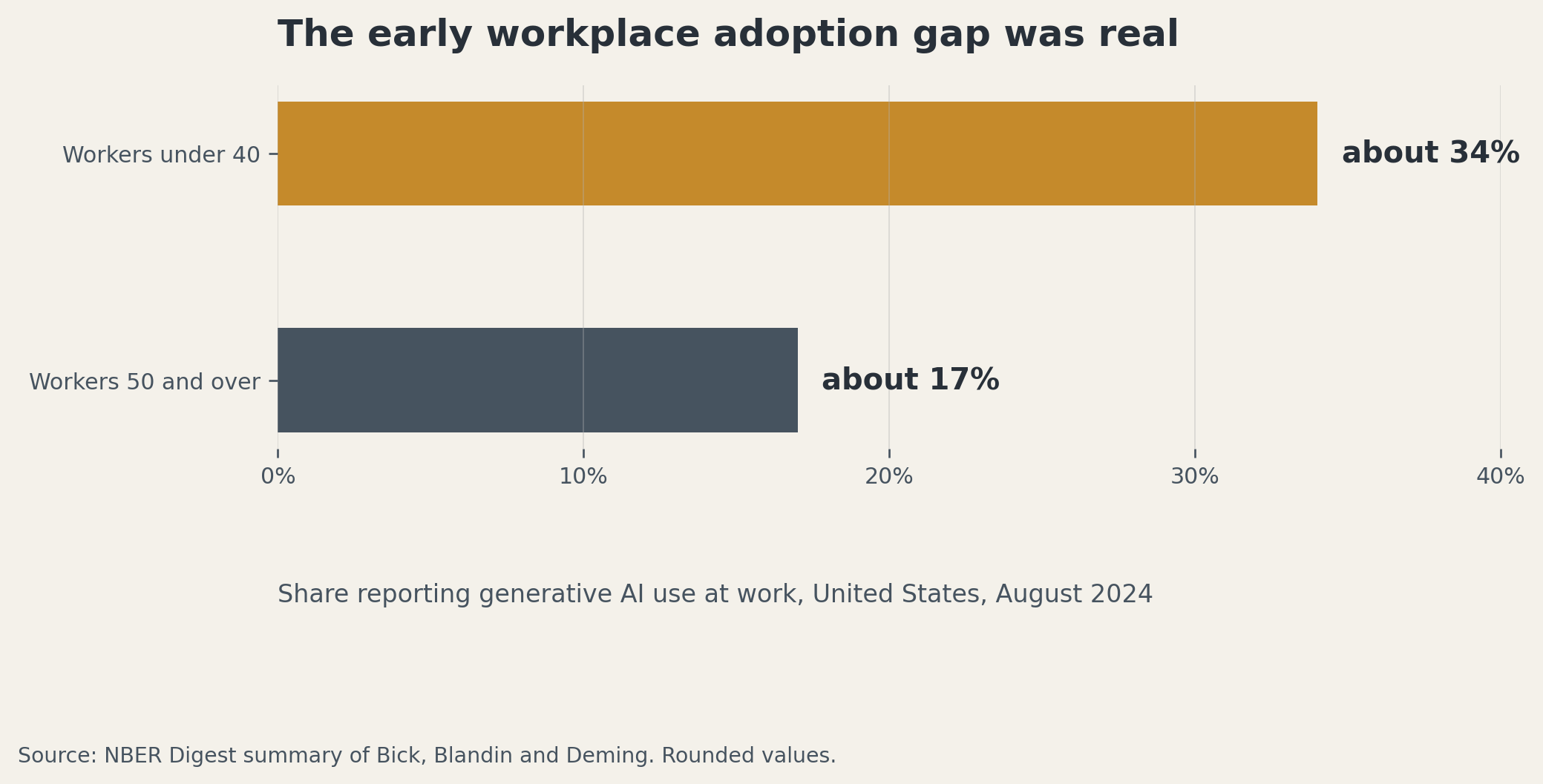
These figures measure reported use, not proficiency or organisational value.
A 2025 review of 51 studies on technology adoption at work found a recurring age pattern in intentions and use, alongside important differences in confidence and support needs.2 The OECD's 2025 employment outlook is equally uncomfortable reading for anyone tempted to replace evidence with flattery. Across OECD countries, older adults scored lower on average in literacy and adaptive problem-solving, and learning participation fell with age.3
That matters. An old hand who refuses to learn the minimum language of AI is not a repository of wisdom. He is a bottleneck with stories. Experience is not a hall pass. Organisations should expect every decision-maker, at every age, to develop enough AI literacy to use systems, question them and recognise their limits.13
But the same OECD chapter reports that only about a third of 60-65-year-olds participated in adult learning in 2023, compared with more than half of 25-44-year-olds. Employer-funded non-formal training among employed people fell from about 35 per cent at ages 30-44 to 25 per cent at 60-65.3 We should be cautious about diagnosing a personal inability after rationing the opportunity to practise.
3 THE MANUFACTURED GAP
Sometimes the organisation teaches the stereotype to come true
Technology adoption is not an exam conducted in a vacuum. It happens inside an environment that decides who receives a licence, a training place, a safe project, patient support and permission to make beginner's mistakes.
The workplace-technology review found that older workers were more concerned about facilitating conditions, felt less confident and placed greater weight on IT knowledge and technical support.2 Those findings can be read lazily as evidence of frailty. They can also be read as a design instruction: support matters more, so design the support.
The organisational contribution is visible in AI-specific evidence too. An OECD study of the Japanese workplace found lower rates of employer consultation among older AI users: 38.9 per cent said they were consulted, compared with 50.6 per cent of younger users.16 Consultation is not a kindness. It is how an organisation discovers what its systems are about to collide with.
There is also a psychological loop. Experiments with older adults have found that stereotype threat - the fear of confirming the belief that older people are bad with technology - can reduce perceived ease of use and actual engagement, partly through anxiety.4 Tell somebody often enough that the room expects them to be slow and you may make cautious behaviour look like proof.
History offers a useful warning. Between 1984 and 2017, older workers in the United States tended to adopt computers later than younger colleagues. Yet computer use within occupations eventually converged across age groups. The delay still carried costs, including poorer labour-market outcomes for some workers.5 The lesson is not that every gap closes automatically. It is that an early gap can be a transition problem rather than a fixed capacity problem.
4 THE LONGER VIEW
You have managed revolutions before
A manager in their late fifties today may have entered work when the personal computer was still becoming ordinary. They may have watched spreadsheets move calculation from specialist departments onto managers' desks; email and the web collapse communication cycles; ERP and CRM integrate processes; Business Intelligence turn operational records into dashboards; cloud software change ownership and deployment; and mobile tools make work permanently reachable.
Each transition was sold as unprecedented. Each produced genuine capability. Each also produced familiar wreckage: vendor promises that outran implementation, processes copied into new software without being redesigned, staff trained too late, controls added after the first fright and legacy systems that refused to die on schedule.
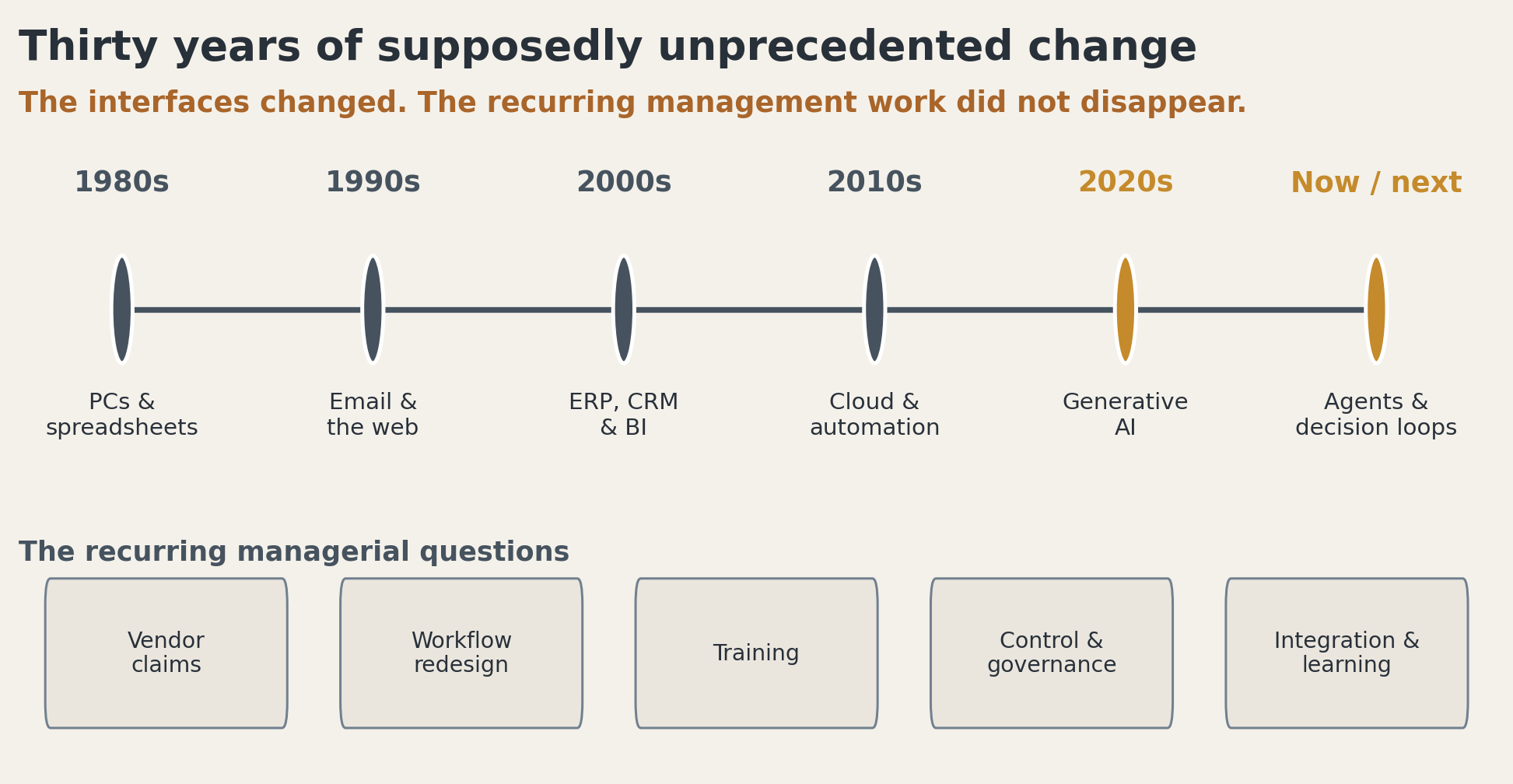
Across these transitions, vendor claims, workflow redesign, training, governance and integration recurred.
The intellectual lineage of today's AI systems is longer than the chatbot era. A 2006 book on Adaptive Business Intelligence described systems combining prediction, optimisation and adaptability to answer two managerial questions: what is likely to happen, and what is the best decision now?7 A 2014 paper in the supplied Academia bundle summarised the same architecture through prediction, optimisation and adaptive modules.8
The ambition was recognisable. The interface, cost and generality were not. Today's models can work through ordinary language, generate rather than merely classify, cross media and increasingly act across software. AI is not just another dashboard. But the managerial problem did not arrive from Mars. It still asks whether an impressive technical capability can become a dependable organisational one.
A 2017 review of Business Intelligence and organisational agility reached an especially useful, if cautious, conclusion: the relationship appeared positive in both directions. Better intelligence systems could support agility, while agile organisations made better use of those systems. The literature was not strong enough to settle causality.9 That uncertainty strengthens rather than weakens the management point. Technology and organisational capability are complements.
5 THE HIDDEN ASSET
Technology-transition capital
Andrew's Intel proposes a useful name for the experience that accumulates across those collisions: technology-transition capital.
It is not the number of years served. It is not a certificate for surviving the fax machine. It is the accumulated ability to recognise patterns in technological change: where demonstrations mislead, where workflow redesign becomes expensive, which exceptions matter, why users resist, how vendor incentives shape claims, when controls will be required and what tends to break after the project team has declared victory.
Some older workers possess a great deal of it. Others possess almost none. Some younger workers acquire it unusually quickly. The point is not that age confers the asset. The point is that organisations often fail to look for it when the technology changes, precisely because current tool fluency is easier to see.
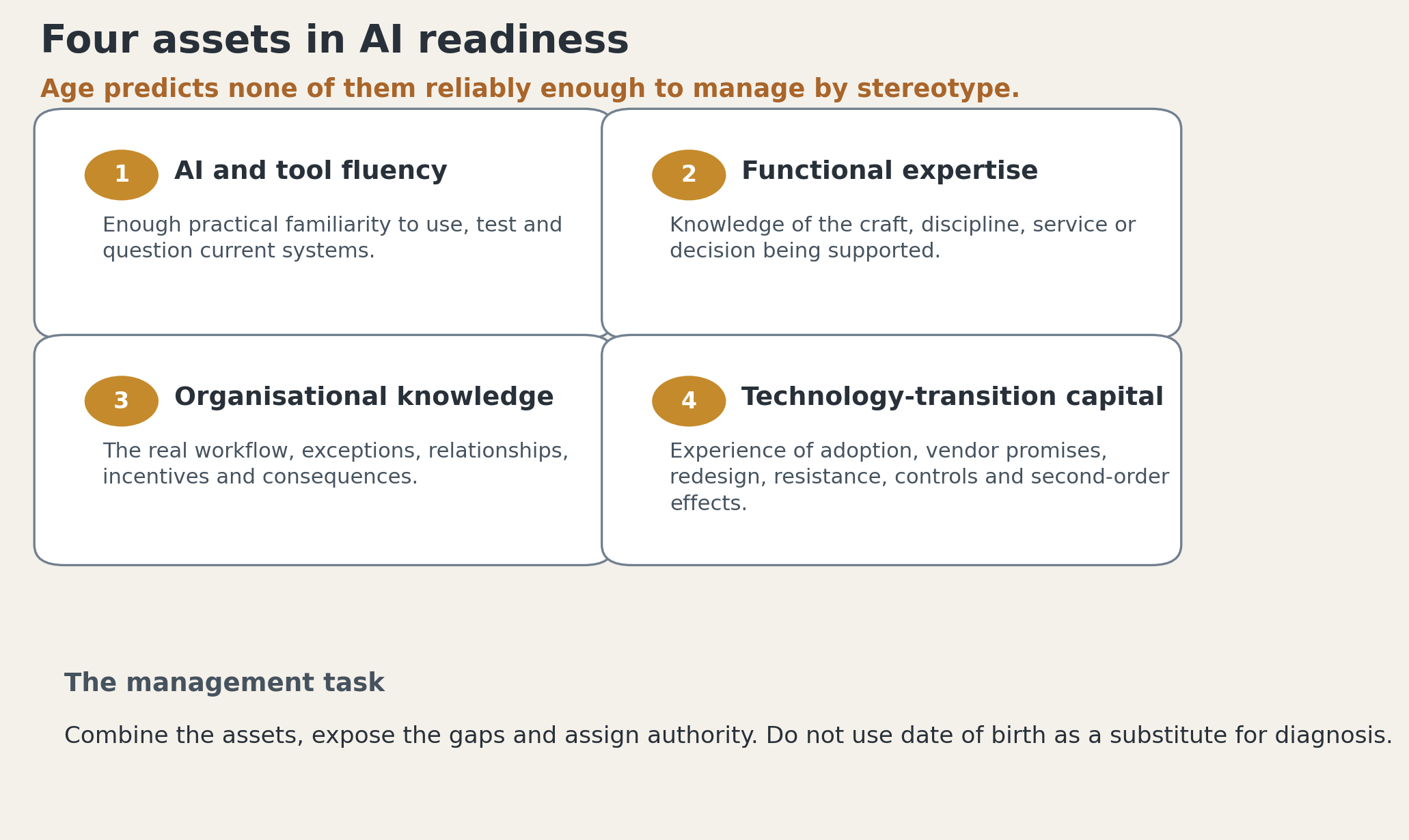
Tool fluency gets the attention because it produces visible movement. Domain expertise and organisational knowledge reveal whether that movement is useful. Technology-transition capital helps the organisation distinguish the genuinely new from the newly packaged, and leadership decides what consequences it is prepared to own.
6 THE ECONOMIC INVERSION
The machine can rent you technique
Generative AI complicates the traditional relationship between expertise and experience. It can put a plausible first version of specialist knowledge into the hands of somebody who has not served the usual apprenticeship.
In a large study of customer-service agents, AI assistance increased productivity by 15 per cent on average, with the largest gains among less skilled and less experienced workers. Agents with two months of tenure and AI performed as well as untreated agents with more than six months.10 That is one company and one kind of work, not a universal law. It nevertheless demonstrates the mechanism: a machine can distribute patterns captured from stronger performers and compress part of an experience curve.
A 2026 field experiment involving 791 Procter & Gamble professionals found something related. Individuals working with AI matched the performance of human teams without AI on real product-innovation challenges, and AI helped bridge functional silos.11 Here, too, the result was not 'humans no longer matter'. Human teams without AI were better at identifying their own best idea, selecting it about half the time compared with roughly 37 per cent in the AI-assisted conditions. AI lifted the quality of the field; evaluative judgement remained a distinct problem.11
This is the economic inversion at the heart of the paper. If AI can lend a novice some of the language, structure and patterns that used to require years of exposure, then parts of technical and codified expertise become cheaper. The relative scarcity moves towards the ability to frame the objective, recognise consequences, choose among plausible answers and integrate the result into a living organisation.
The conclusion is not that experience wins. Some accumulated expertise will indeed be devalued. A person whose advantage consisted entirely of knowing where to find a standard answer may find the machine catches up quickly. But judgement grounded in domain conditions, relationships, failure history and accountable authority is a different asset.
7 WHAT THE MACHINE CANNOT SEE EASILY
The organisation is larger than its documentation
Formal organisations are tidy. They live in process maps, policies, software fields, job descriptions, reporting lines and board papers. Working organisations are untidy. They contain negotiated exceptions, early warning signs, customer promises, workarounds, informal dependencies, local definitions of quality and decisions that are sensible only because somebody remembers what happened last time.
Andrew's Intel has previously described this as the gap between implementation and integration. Implementation asks whether the AI solution works. Integration asks whether the organisation still works when the AI solution is inside it.15
The experienced operator may know that a stock figure is technically correct but commercially unusable, that a client will tolerate delay only if called before lunch, that a rule exists because of a failure no current employee witnessed or that the apparently inefficient review stage is where accountability actually lives. None of this makes the veteran infallible. Tacit knowledge can preserve bias, status and obsolete workarounds. It must be surfaced and tested, not worshipped.
But treating domain experts as a late sign-off stage is a waste. Their knowledge should enter while the system is being framed, while the data are being chosen and while the exceptions can still change the design. The person who knows the machine and the person who knows the work are not rival claimants to authority. They hold different parts of the problem.
8 TWO FORMS OF OVERCONFIDENCE
Where the old hands - and the young pups - get it wrong
A combative paper should be even-handed about its targets.
The old hand can be wrong in familiar ways. Experience may become a collection of reasons nothing can change. A manager can mistake survival for foresight, confuse a workaround with a principle and use institutional memory as a veto. Someone who refuses to acquire basic AI literacy cannot ask good questions of the people who have. Curiosity remains compulsory.
The young technologist can be wrong in newer-looking but equally familiar ways. A fluent interface creates the impression of mastery. A beautiful prototype conceals an incomplete description of reality. Technical possibility is mistaken for organisational permission. The model is optimised while the workflow, incentives, authority and downstream burden remain somebody else's problem.
Age is not the useful dividing line. One form of overconfidence says, 'I have seen this before, so I know what it is.' The other says, 'I can make this work, so I know where it belongs.' Both statements can be dangerously incomplete.
The fair bargain is demanding. Experienced workers are not excused from learning. Younger specialists are not excused from context. Leadership is not excused from deciding who has authority when the two disagree.
9 THE PRACTICAL ANSWER
Build the intergenerational AI unit
The sensible unit of AI capability is often not a person. It is a small combination of roles.
- The AI-fluent builder sees what the technology can now do, prototypes quickly and challenges assumptions about the limits of software.
- The experienced operator knows how the work actually moves, where the exceptions live and which consequences do not appear in the data.
- The accountable leader defines the outcome, allocates time, resolves conflicts, sets decision rights and owns what happens after deployment.
Sometimes one person can cover two roles. Occasionally a rare individual spans all three. The architecture matters more than the ages attached to it.
There is evidence that age-diverse workforces can create complementarities in skills, knowledge and experience, with particularly strong potential between younger and older workers.14 That is not permission to assemble a mixed-age team and wait for magic. A 2026 field experiment on age-diverse coworker training found that benefits depended on conditions including a partner's enthusiasm for technology.12 Diversity creates potential; design releases it.
A useful operating model is reciprocal apprenticeship. The technically fluent colleague demonstrates possibilities and reduces the cost of experimentation. The experienced colleague exposes the real decision environment and the history embedded in the workflow. Both are authorised to challenge the other. The leader turns disagreement into a better specification rather than a status contest.
The practical steps are prosaic, which is usually a good sign:
- Choose one consequential workflow, not a grand transformation slogan.
- Map the documented process and the process people actually follow.
- Pair an AI-fluent builder with an experienced operator from the beginning, not at sign-off.
- Give older workers real access, time and support to experiment without public embarrassment.
- Record exceptions, overrides and near misses as design evidence rather than resistance.
- Name who may accept, challenge, stop and improve the system.
- Judge contributions by the quality of the resulting workflow, not by who types the fastest prompt.
10 ILLUSTRATIVE CASE
A pensioner manages a synthetic organisation
11 MEETING-READY ARTEFACT
The age-blind AI readiness test
Before deciding that somebody is too old, too young or just right for an AI-enabled role, ask eight questions about the person and the work:
- Can they define the organisational outcome, rather than merely name a tool?
- Can they distinguish a demonstration, an early signal, a usable workflow and a procurement-ready capability?
- Do they understand the domain, including exceptions, consequences and the people affected?
- Can they interrogate evidence and recognise when a plausible answer is not a reliable one?
- Do they use AI enough to understand its strengths, failure modes and operating burden?
- Can they explain what should remain human and who stays accountable?
- Can they learn from a colleague whose expertise and age profile differ from their own?
- Have we given them access, time, support and authority before judging their readiness?
None of these questions asks for a date of birth. That is the point.
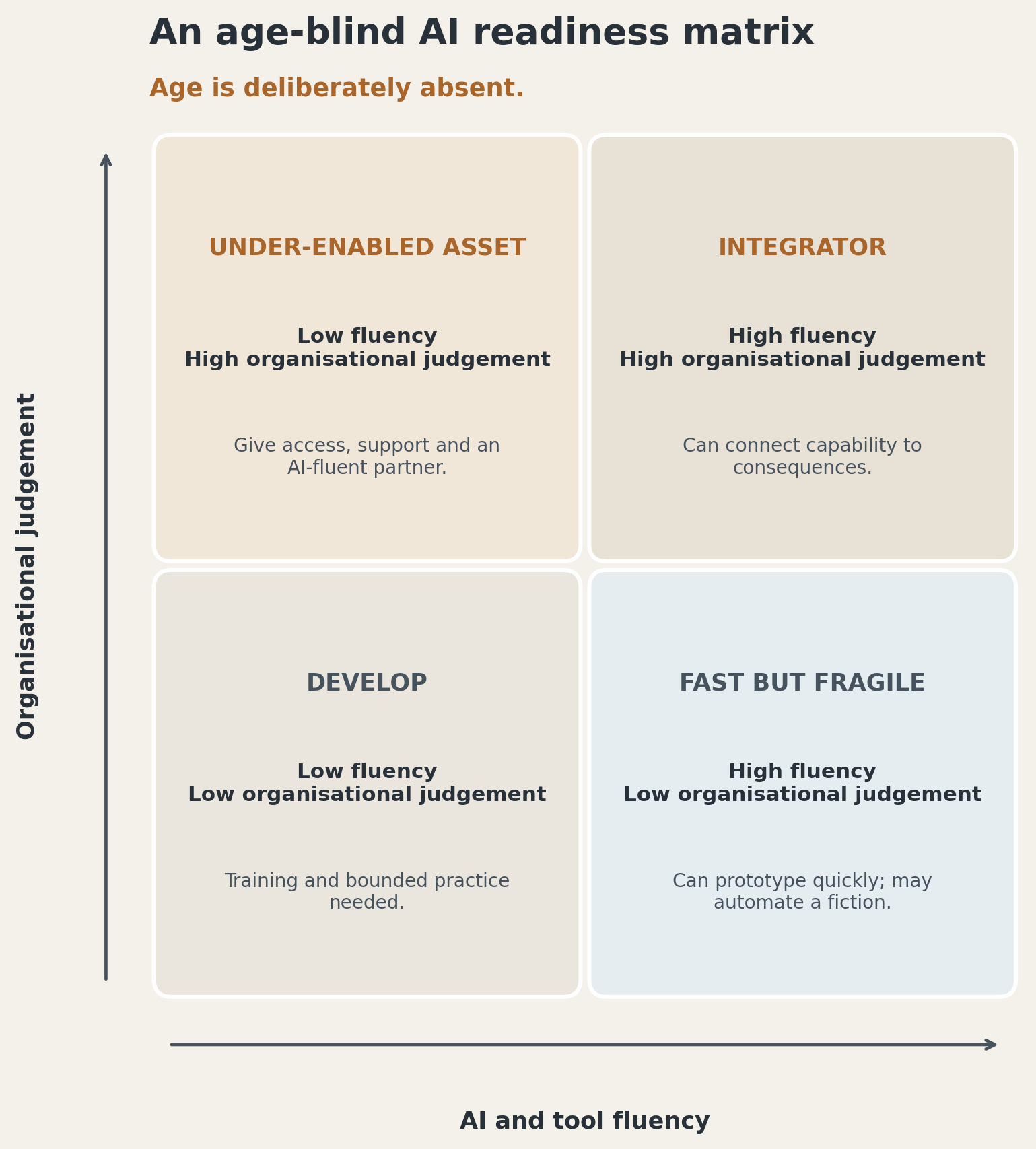
Age is deliberately absent from the matrix.
CONCLUSION
Keep the old hands. Make them learn
The anti-ageist case for experienced workers is not that they deserve a ceremonial seat at the AI table. It is not that long service turns prejudice into wisdom, or that every person who survived an ERP installation is secretly an AI strategist.
It is a harder claim. Organisations that confuse youth with AI readiness may discard the domain knowledge, organisational memory, transition experience and accountable judgement needed to make AI useful. They may also deny older workers the training and participation that would close the visible fluency gap, then congratulate themselves for predicting the result.
AI will remove some of the scarcity that traditionally protected expertise. It will help novices travel faster, let individuals borrow capabilities once found only in teams and make some hard-won knowledge cheaper. That makes curiosity essential at every age. It also makes the remaining scarce assets easier to see: judgement, context, consequence, trust and the ability to integrate a technical answer into a human system.
The future does not belong to the young or the old. It belongs to organisations that stop forcing the choice. Give the young technologist the experienced hand. Give the experienced hand access to the machine. Then judge them both by whether the organisation becomes more capable.
Age is not a credential. Neither is youth.
METHOD AND SCOPE
What this paper supports - and what it does not
This is a research-backed editorial white paper, not a systematic review or a validated assessment instrument. It combines peer-reviewed studies, OECD and Federal Reserve evidence, historical Business Intelligence material and an illustrative author case. The cited studies use different countries, occupations, technologies and definitions; findings should not be treated as one pooled estimate.
The paper supports a bounded conclusion: age is associated with differences in adoption and some skills on average, but it is a poor standalone proxy for individual AI readiness. Training, support, consultation, job context, prior experience, domain knowledge and team design materially shape the result. The paper does not claim that older workers are inherently wiser, more productive or better at AI, nor that intergenerational teams automatically outperform other teams.
The term 'technology-transition capital', the four-assets model and the age-blind readiness matrix are Andrew's Intel editorial frameworks. They are offered as management tools for discussion, not as psychometric measures.
Sources and evidence
This paper was written on 1 September 2026. Key adoption, training, productivity and teamwork sources were rechecked on 1 November 2026. The four figures reproduce the approved Word source; the managerial framework and author case remain editorial synthesis.
Source posture: Age-group averages are not individual readiness measures. The studies below cover different countries, occupations and technologies and are not a pooled estimate. The customer-service and product-innovation field experiments are bounded to their settings. The age-blind matrix is a discussion aid, not a validated assessment instrument.
- Bick, A., Blandin, A. and Deming, D. J. (2026), "The Rapid Adoption of Generative AI", Management Science. The age comparison is from the NBER Digest summary of the August 2024 survey. 10.1287/mnsc.2025.02523 Read source
- Fazi, L., Zaniboni, S. and Wang, M. (2025), "Age differences in the adoption of technology at work: a review and recommendations for managerial practice", Journal of Organizational Change Management, 38(8), 138-175. 10.1108/JOCM-12-2024-0767 Read source
- OECD (2025), OECD Employment Outlook 2025, chapter "Staying in the game: Skills and jobs of older workers in a changing labour market". 10.1787/194a947b-en Read source
- Mariano, J. et al. (2022), "Too old for technology? Stereotype threat and technology use by older adults", Behaviour & Information Technology, 41(7), 1503-1514. 10.1080/0144929X.2021.1882577 Read source
- Hudomiet, P. and Willis, R. J. (2022), "Computerization, Obsolescence and the Length of Working Life", Labour Economics, 77, 102005. 10.1016/j.labeco.2021.102005 Read source
- Helsper, E. J. and Eynon, R. (2010), "Digital natives: where is the evidence?", British Educational Research Journal, 36(3), 503-520. 10.1080/01411920902989227 Read source
- Michalewicz, Z., Schmidt, M., Michalewicz, M. and Chiriac, C. (2006), Adaptive Business Intelligence, Springer. 10.1007/978-3-540-32929-9 Read source
- Torres Cerda, E., Castillo Navarrete, J. and Osses Villegas, P. (2014), "Aplicaciones de la Inteligencia Artificial en la actualidad", Universidad de La Serena. Used as a historical index to Adaptive Business Intelligence, not as contemporary evidence.
- Gonzalez Calderon, J. L., Palacios Rozo, J. J. and Perea Sandoval, J. A. (2017), "La inteligencia de negocios y su rol en la agilidad organizacional", Criterio Libre, 15(26), 239-258. Used as a cautious literature review; it did not establish causality.
- Brynjolfsson, E., Li, D. and Raymond, L. R. (2025), "Generative AI at Work", The Quarterly Journal of Economics, 140(2), 889-942. 10.1093/qje/qjae044 Read source
- Dell'Acqua, F. et al. (2026), "The Cybernetic Teammate: A Field Experiment on Generative AI and Teamwork", Organization Science, 37(4), 1217-1242. 10.1287/orsc.2025.20702 Read source
- Vestner, P., Pfrombeck, J., Hampel, K. and Burmeister, A. (2026), "A dyadic training to promote technology-related learning and development among age-diverse employees: The power of coworkers’ enthusiasm", Journal of Occupational and Organizational Psychology, 99, e70137. 10.1111/joop.70137 Read source
- OECD (2026), "Skills in the AI age", OECD Artificial Intelligence Papers, No. 60. 10.1787/972bd15e-en Read source
- OECD (2020), Promoting an Age-Inclusive Workforce: Living, Learning and Earning Longer, chapter "Good for business: Age diversity in the workplace and productivity". 10.1787/59752153-en Read source
- Wilson, A. (2026), "The Prompt Worked. Then It Met the Organisation", Andrew's Intel working article. Used for the implementation/integration distinction and the complementary roles of AI fluency and operational knowledge. Read source
- OECD (2025), Artificial Intelligence and the Labour Market in Japan. Consultation findings are country-specific and are not treated as a universal age effect. 10.1787/b825563e-en Read source
- Allen, J. S. (2026), "Monitoring AI Adoption in the US Economy", FEDS Notes, Board of Governors of the Federal Reserve System, 3 April 2026. Read source
About Andrew’s Intel
Andrew's Intel is an editorial intelligence publication for decision-makers. It looks for commercially and organisationally meaningful AI signals before they are flattened into hype, and turns them into clearer judgements, better questions and practical meeting-ready artefacts.
This white paper was researched and produced through the Andrew's Intel AI-assisted publishing system. AI extended the research, drafting, visual and production reach; Andrew Wilson supplied the editorial purpose, governing argument, case context and publication authority.