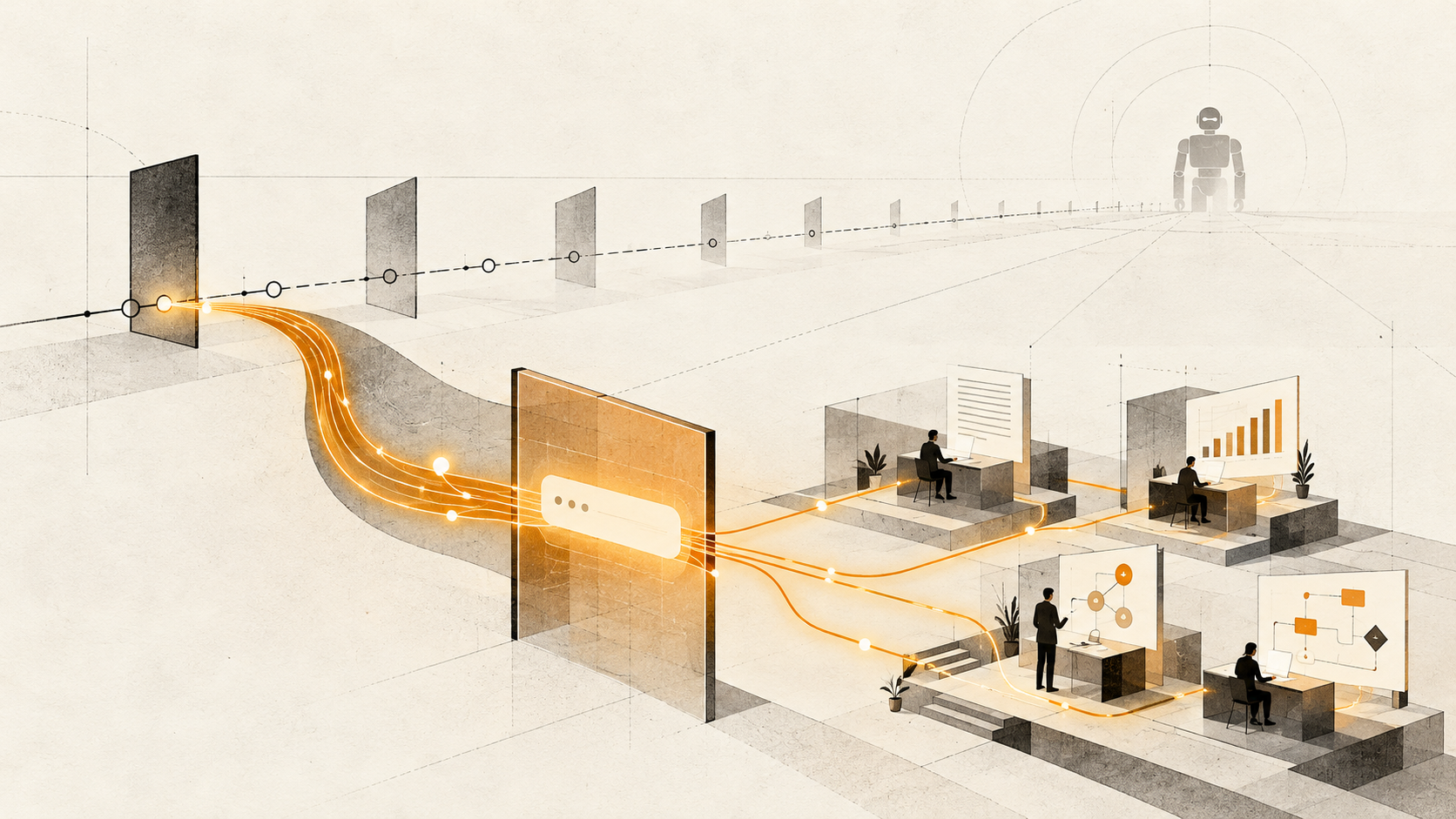
The future arrived through an unexpected door
Imagine an AI strategy discussion in late 2020. The agenda would probably have included industrial automation, autonomous vehicles, facial recognition, predictive systems, customer-service bots and the labour consequences of intelligent machines. A serious organisation might have expected AI to arrive through capital projects, specialist teams and visibly automated equipment.
By 2026, the most widely felt change has often entered through a text box.
General-purpose models now draft, summarise, translate, code, search, analyse documents and operate software. Stanford's 2026 AI Index reports that 88 per cent of surveyed organisations use AI in at least one business function, while 58 per cent of employees globally report using AI at work at least semi-regularly. Those numbers come from surveys rather than a census, but the direction is difficult to dispute: AI has spread through ordinary knowledge work faster than many organisations have developed a coherent operating model for it. 2
That makes The Future of Artificial Intelligence and its Social, Economic and Ethical Consequences an unusually revealing source. Published in conference proceedings in November 2020 and posted to arXiv in January 2021, the short paper reviewed the social, economic and ethical problems its authors believed AI would bring. It discussed unemployment, inequality, social chatbots, unreliable systems, bias, security competition, misaligned problem-solving and economic growth. 1
It should not be treated as a controlled forecasting exercise. It assembled existing concerns and predictions, some already several years old. Its value is historical. It captures the map of AI that an informed general reader might have carried just before large language models redrew the route.
The most useful judgement is not that the paper was right or wrong. It is that the categories were often right, but the route was wrong.
A map from another AI age
The paper's everyday examples were Google Assistant, Amazon Alexa, Roomba vacuum cleaners and chatbots. Its technical examples included image recognition, medical diagnosis, automated scheduling and autonomous vehicles. The main economic narrative was automation: machines performing human work, destroying or polarising jobs, concentrating income and perhaps making citizen income necessary. The main security narrative was a race between powerful states over autonomous weapons. 1
That framing now feels both familiar and distant.
It was familiar because the paper understood that AI would be more than another software category. It could redistribute work, power, income, trust and responsibility. It was distant because it still pictured intelligence as a collection of specialist systems advancing towards more human-like behaviour. It did not anticipate that one broad interface would make advanced capabilities accessible across thousands of tasks, or that adoption would often begin with employees using public tools before their organisations had decided what AI policy meant in practice.
The change matters because route determines management. A factory robot creates a visible capital decision. A general-purpose model embedded in browsers, office suites and personal accounts creates a distributed operating-model decision. One can be procured and fenced. The other can spread through work before procurement, governance or training has caught up.
What 2020 broadly got right
The paper identified five pressures that remain central in 2026.
First, it expected AI to become economically significant across manufacturing, professional services, finance and retail. That direction was sound. What it did not see was how quickly a single family of models would cross sector boundaries. The same underlying capability can now prepare a legal summary, analyse a spreadsheet, generate code, draft a marketing brief and support a service interaction. The category is no longer defined by one application at a time.
Second, it expected labour disruption and inequality. Those concerns have not disappeared. The International Labour Organization estimates that one in four workers globally is in an occupation with some exposure to generative AI, although only 3.3 per cent of global employment sits in its highest exposure category. Its central conclusion is transformation rather than automatic replacement because most exposed occupations still contain tasks requiring human input. 3
Third, it expected AI to reproduce human bias. The examples in the paper focused on criminal-risk assessment and facial recognition. The problem has widened rather than vanished. In 2026, bias can enter through training data, language coverage, model behaviour, retrieval systems, automated rankings and repeated use of the same underlying models across many products. Stanford's AI Index reports large performance gaps across languages and dialects, while its Foundation Model Transparency Index fell from an average of 58 in 2024 to 40 in 2025, leaving major gaps in disclosure about training data, computing resources and post-deployment effects. 2
Fourth, it expected chatbots to affect human relationships. That prediction came closer than its Turing-test framing suggested. The 2020 question was whether a bot could appear human and form an emotional connection. The 2026 question is what happens when a highly available system becomes a persistent adviser, confidant or companion. A four-week randomised study involving 981 participants and more than 300,000 messages found that usage patterns and design choices could affect loneliness, real-world social interaction, emotional dependence and problematic use. The results were nuanced and do not show that ordinary chatbot use inevitably causes harm, but they make the relational issue operational rather than speculative. 4
Fifth, it expected security and geopolitical competition to become defining concerns. That was correct. What changed was the public face of the risk. Autonomous weapons remain important, but many visible harms have arrived through synthetic media, impersonation, phishing, fraud and cyberattack. An OECD analysis of media-reported AI incidents found that synthetic-media reports more than doubled as a share between 2022 and 2025, while the share linked to cyberattacks and fraud nearly tripled. The dataset measures reported attention rather than the true prevalence of harm, but it shows which risks have become socially and commercially visible. 5
Jobs: disruption without the predicted shape
The paper cited the famous estimate that 47 per cent of US employment was at risk of computerisation and entertained the possibility that people might eventually be paid simply for being citizens. 1
That is not the labour market visible in 2026.
There is no settled evidence of economy-wide mass unemployment caused by AI. Exposure is not the same as displacement, and a task that can be automated does not automatically remove an occupation. Organisations change more slowly than demonstrations. Work must be integrated with data, systems, permissions, quality controls, customer expectations and legal responsibility.
Stanford Digital Economy Lab researchers using high-frequency payroll data now estimate that employment for workers aged 22 to 25 in the most AI-exposed occupations is 19 per cent below a counterfactual path. The revised analysis points to reduced hiring as an important mechanism, while older workers and less-exposed occupations remain comparatively stable. The authors describe the result as early and descriptive rather than causal evidence of economy-wide displacement. 6
The practical issue for leaders is therefore not simply the number of jobs that disappear. It is where pressure appears first.
Entry-level hiring may weaken before whole professions contract. Routine drafting may be automated while senior review becomes more valuable. Productivity can rise while apprenticeship opportunities disappear. A team may retain the same headcount but redistribute tasks, authority and accountability. The labour effect can arrive through hiring, career progression and work design long before it appears as a dramatic redundancy announcement.
The 2020 forecast correctly identified the pressure. It assumed a more visible mechanism: machines replacing workers. The emerging mechanism is often quieter: software absorbing selected tasks, changing the economics of junior work and forcing organisations to redesign how people acquire expertise.
Artificial stupidity became jagged intelligence
One of the paper's most perceptive sections was titled "Artificial Stupidity". It argued that systems trained on incomplete examples could fail in ways that humans would not, including being fooled into seeing patterns that were not there. 1
The 2026 version is more powerful and more difficult to manage.
Frontier models can perform extraordinarily well on demanding benchmarks while failing at simple tasks. Stanford describes this as jagged intelligence. A leading model achieved a gold-medal score in the 2025 International Mathematical Olympiad, yet the best model on a benchmark for reading analogue clocks was correct only 50.1 per cent of the time, compared with 90.1 per cent for humans. Agents completing structured computer tasks improved to 66.3 per cent accuracy, but still failed roughly one attempt in three. 2
That combination is more commercially dangerous than uniformly weak performance. A system that is obviously poor is easy to reject. A system that is excellent most of the time can accumulate authority, permissions and workflow dependence before its boundaries are properly understood.
The management question is no longer whether the machine is intelligent. It is whether the organisation knows where its intelligence becomes unreliable, who detects the exception, what the system may do without approval, and how work can be recovered when the normal path fails.
A benchmark score does not answer those questions. A persuasive demonstration does not answer them either. The missing layer is operational evidence: repeatability, exception handling, traceability, escalation, reversibility and accountable ownership.
The social chatbot arrived more completely than expected
The paper's chatbot section centred on imitation and interaction. It cited Eugene Goostman, immigration-support bots and Microsoft's Tay, then asked whether bots might form their own social layer or shape human behaviour. 1
Generative AI changed the scale of that question. People are no longer interacting only with narrow customer-service scripts. They can hold open-ended conversations with systems that remember context, adapt their tone, simulate empathy and remain available when people are lonely, anxious or unwilling to speak to another person.
The important threshold is not whether a user mistakes a machine for a human. It is whether the machine acquires a human role.
That distinction matters to organisations as well as individuals. Employers may introduce assistants for coaching, wellbeing, training or customer support. Product teams may optimise for engagement without fully understanding emotional dependence. Managers may assume that a conversational interface is a neutral delivery channel when its tone, availability and responsiveness alter the relationship around the service.
The sensible position is not that social AI is inherently harmful. The evidence is too mixed for that. It is that relational effects should be treated as a product and governance property, not as an accidental side issue.
Security arrived through the mass market
The 2020 paper pictured security principally through autonomous weapons, cyber conflict and competition among the United States, China and Russia. 1
Those risks remain. The route into ordinary organisations, however, has been more mundane and more immediate.
A finance team can receive a plausible voice message from an apparent executive. A public figure can be placed in a fabricated video. A customer can be persuaded by personalised fraud. A phishing campaign can be produced more cheaply, in more languages and with fewer obvious errors. The threat is not a robot soldier standing at the office door. It is the declining cost of credible deception.
This changes the decision-maker response. Security cannot sit only with national governments or specialist defence organisations. It becomes part of payment controls, identity verification, communications policy, staff training, incident response and supplier assessment.
The paper was right that AI would magnify security competition. It underestimated how quickly the capability would become available to ordinary criminals, propagandists and opportunists.
Physical autonomy is real, but bounded
Autonomous vehicles provide a useful example of a prediction that is neither fulfilled nor disproved.
The paper treated vehicle automation as a prominent ethical and economic case. In 2026, commercial robotaxis are real. Waymo said in February that it was providing more than 400,000 rides each week across six US metropolitan areas. That is a vendor claim, but it describes a substantial operational service rather than a laboratory demonstration. 7
Yet the US National Highway Traffic Safety Administration still states that no fully automated or self-driving vehicle is available for consumers to buy, and that current deployments operate in limited, restricted or designated locations and conditions. 8
The prediction did not fail. It diffused differently.
Autonomy has become a geographically bounded service before becoming a universally available product. It works through mapped territories, fleet operations, remote support, regulatory permissions and defined operating conditions. The complementary system matters as much as the vehicle.
This is a wider AI lesson. Capability rarely becomes a market by itself. It needs an operating environment that makes failure manageable and responsibility assignable.
What the 2020 map largely missed
The paper did not foresee several developments that now shape the commercial and political landscape.
The first was the foundation-model interface. A single model family could become a general-purpose layer across writing, coding, search, analysis, image generation and software operation. This created a new diffusion path: AI could spread through existing devices and applications rather than waiting for new machines.
The second was infrastructure concentration. The 2026 AI Index counts 5,427 data centres in the United States, more than ten times the number in any other country, and identifies TSMC as a critical dependency for leading AI chips. 2 The strategic conversation now includes computing access, electricity, cloud concentration, chip supply, national capability and AI sovereignty. These are not background technical issues. They shape who can build, buy, govern and benefit from advanced systems.
The third was the ownership conflict around training data and generated content. Generative AI made copyright, provenance and disclosure central because the system's capability depends on large-scale ingestion and synthesis of human-created material. In the European Union, Article 50 transparency obligations under the AI Act began applying on 2 August 2026, including duties around interaction disclosure, machine-readable marking and certain deepfakes and public-interest text. 9
The fourth was agentic authority. The 2020 paper considered intelligent agents in the technical sense, but it did not anticipate the management problem created by systems that can use tools, access accounts, move information and take external actions. The issue is no longer only whether an answer is correct. It is what authority has been delegated, under whose identity, with which limits, and how that authority can be withdrawn.
The fifth was governance as an operating capability. In 2020, the paper called for collaboration among governments, researchers and communities. By 2026, broad principles have been joined by the NIST AI Risk Management Framework, ISO/IEC 42001 for AI management systems, OECD due-diligence guidance and binding regulation such as the EU AI Act. 9101112 The governance question has moved from "should society act?" to "can this organisation show who is responsible, what is monitored and what evidence supports deployment?"
The AI Future-Assumption Audit
The purpose of a forecast is not to win a retrospective scorecard. It is to improve present decisions. Before using an AI prediction in strategy, test it against six questions.
The AI Future-Assumption Audit is not intended to turn every organisation into a forecasting unit. Its more practical use is to help planners and decision-makers test the assumptions hidden inside ordinary strategy, procurement and investment discussions.
On a narrow screen, each row is shown as a separate card.
| Audit question | What to examine |
|---|---|
| 1. What underlying pressure has been identified? | Labour cost, capability expansion, concentration, security, trust, inequality, regulation or another durable force. |
| 2. What mechanism is being assumed? | Robot, chatbot, agent, embedded software, infrastructure, market rule or organisational behaviour. The pressure can be right while the mechanism is wrong. |
| 3. What complementary conditions must exist? | Data, integration, skills, power, procurement, governance, user trust, regulation, exception handling and accountable ownership. |
| 4. Where will the effect appear first? | A task, hiring pipeline, profession, customer interaction, region, supplier relationship or capital market. Aggregate effects may hide concentrated disruption. |
| 5. What evidence would mark the next maturity threshold? | Research result, repeatable capability, usable workflow, implemented service or procurement-ready market. Do not treat them as interchangeable. |
| 6. What remains on the watchlist if the forecast appears late? | A delayed prediction is not necessarily a failed prediction. State which change would make it live again. |
Meeting line: Do not ask only whether the old prediction was right. Ask which pressure it detected, which route it assumed, and what changed the route.
The forecasting lesson for decision-makers
Technology forecasts often fail at the noun and succeed at the verb.
They correctly anticipate that work will be reorganised, power will concentrate, trust will be strained, people will form relationships with machines, and states will compete. They are less reliable at naming the product, interface, institution or sequence through which those changes will happen.
That is why organisations should avoid building strategy around a single vivid future. A robot-dominated workplace and a language-model-dominated workplace can both reduce the cost of selected tasks, but they create different procurement choices, skills requirements, risks and governance structures. The pressure may be shared. The operating response is not.
A useful foresight process should therefore track three things separately:
1. The durable pressure - what economic, social or organisational force is likely to persist.
2. The changing route - which interface, workflow, business model or institution is carrying it now.
3. The maturity threshold - what evidence would justify moving from watching to testing, from testing to deployment, or from deployment to scale.
This is especially important in AI because the route can change faster than an annual strategy cycle. A capability that was confined to a specialist model can become a feature inside ordinary software. A private experiment can become an informal team workflow. A vendor claim can become a procurement category before evidence of organisational value is mature.
Conclusion: the categories were right, the route was wrong
The 2020 paper deserves neither ridicule nor a high prediction score.
It saw that AI would create economic value while redistributing work and power. It saw that human bias would travel into machines, that intelligent systems would fail unexpectedly, that chatbots could affect relationships, and that security competition would intensify. Those were durable categories.
What it could not see was the route: foundation models, natural-language interfaces, general-purpose assistants, synthetic media, employee-led adoption, cloud and chip concentration, agentic permissions and governance as an operating discipline.
Nor did it see the sequence. Knowledge work was exposed before general-purpose robotics. Social interaction scaled before physical autonomy became universal. Organisational adoption raced ahead of organisational readiness. Security risk became a mass-market deception problem as well as a military one.
The future did not fail to arrive. It entered through an unexpected door.
Good AI foresight is not mainly the ability to name the winning machine. It is the ability to identify the pressure, test the assumed mechanism, and recognise when the conditions for a usable workflow have changed.
The categories were often right. The route was wrong.
Sources and evidence notes
Evidence posture: The 2020 paper is a historical seed rather than a rigorous forecasting study. Current comparisons distinguish surveys from censuses, exposure from displacement, vendor reporting from independent measurement, and media attention from true incident prevalence. All links and time-sensitive claims were rechecked on 29 October 2026.
- Hussein, Halimu and Siddique, ‘The Future of Artificial Intelligence and its Social, Economic and Ethical Consequences’, ICACT 2020 Proceedings; arXiv:2101.03366, posted 9 January 2021. Used as a historical seed and representative map, not as a controlled forecasting study.
- Stanford Institute for Human-Centered Artificial Intelligence, The 2026 AI Index Report. Official chapter material supports the adoption, workplace use, transparency, infrastructure and benchmark comparisons. The analog-clock result is 50.1%, corrected from 50.6% in the archive source.
- International Labour Organization, Generative AI and Jobs: A Refined Global Index of Occupational Exposure, Working Paper 140, 20 May 2025. Exposure is not treated as automatic job replacement.
- Fang et al., ‘How AI and Human Behaviors Shape Psychosocial Effects of Chatbot Use’, MIT Media Lab, March 2025. Four-week randomised controlled study involving 981 participants and more than 300,000 messages; the findings are nuanced and do not establish inevitable harm from ordinary chatbot use.
- OECD, Trends in AI Incidents and Hazards Reported by the Media, 10 February 2026. Its AIM dataset measures the share of media-reported incidents and hazards, not the underlying prevalence or severity of harm.
- Brynjolfsson, Chandar and Chen, ‘Canaries in the Coal Mine?’, Stanford Digital Economy Lab, revised 12 August 2026. The web edition uses the revised 19% estimate and preserves the authors’ descriptive, early-evidence caveat.
- Waymo, ‘Accelerating our global growth’, 2 February 2026. Vendor source used only for its reported deployment scale of more than 400,000 weekly rides across six US metropolitan areas.
- US National Highway Traffic Safety Administration, ‘Automated Vehicle Safety’. Official consumer guidance used to distinguish bounded commercial deployments from generally available consumer self-driving capability.
- European Commission, ‘AI Act’. Official implementation timeline and transparency guidance; the Act became generally applicable on 2 August 2026, with stated exceptions.
- US National Institute of Standards and Technology, Artificial Intelligence Risk Management Framework (AI RMF 1.0), January 2023. Voluntary risk-management framework and living document.
- ISO, ISO/IEC 42001:2023 — Information technology — Artificial intelligence — Management system. International standard for establishing and improving an AI management system.
- OECD, Due Diligence Guidance for Responsible AI, 19 February 2026.
This article provides general decision support. It is not legal, regulatory, employment, security, procurement or technical advice.